An unpolished dive into the grimy, glorious reality of procurement.
Let’s cut the corporate keynote vibe. You’re staring at a line item for “commercial door hardware” and your CFO is breathing down your neck. The instinct is to slash. To find the cheapest bid. I’m here to tell you that instinct is a one-way ticket to a world of pain, callbacks, and furious facility managers.
Real cost-cutting isn’t about price tags. It’s about strategic avoidance of stupidity.
The Landscape is a Minefield. Here’s Your Map.
You’re not buying a product. You’re buying a performance outcome: security, egress, accessibility, durability. Miss one, and the savings evaporate faster than a puddle in a warehouse doorway.
Consider this your first lesson: the budget isn’t just the purchase order. It’s the total cost of ownership. That includes installation labor, maintenance cycles, and the apocalyptic cost of a failure during an AHJ inspection.
Tactics From the Trenches: A Non-Linear Playbook
Forget step-by-step. Real projects are messy. Here’s the toolkit.
1. The Tyranny of Specialization (Embrace It)
Every “special” is a tax. A unique finish. A custom keyway. A one-off lever design. It adds cost at the factory, in the supply chain, and in the installer’s van. Your goal is ruthless standardization.
Pick one finish for the entire project. One lock function for all similar doors. The moment you allow a project manager to select a “nicer” lever for the boardroom, you’ve lost. You’ve introduced a SKU, a potential ordering error, and a future replacement headache. Boring is beautifully cheap.
2. Decode the Language, Dominate the Conversation
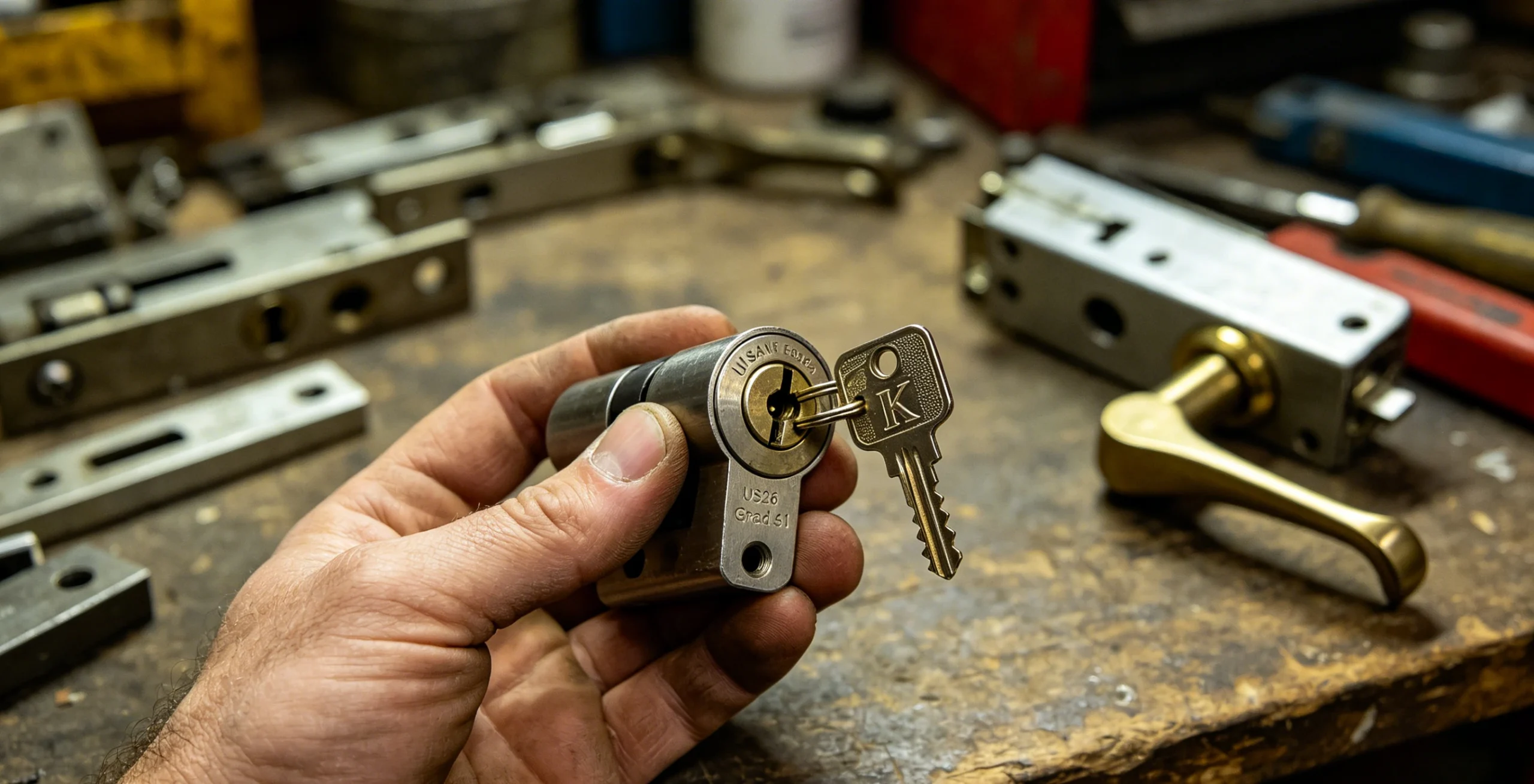
Walk into a supplier and say “I need a lock.” You’ll get a question back. Walk in and say “I need fifteen 05F functions in US26 finish, keyed to system K.” The dynamic shifts. You’re speaking their code. This precision prevents the “or equal” bait-and-switch and eliminates costly misinterpretations. It signals competence, and suppliers price for competence differently than they price for ignorance.
3. The Grade Gambit: A Calculated Risk
Hardware is graded for durability (ANSI/BHMA Grade 1, 2, 3). Grade 1 is the heavyweight champ. It’s also the most expensive.
Here’s the grumpy truth: not every opening needs a champ. An interior office door in a low-traffic admin corridor? A Grade 2 lock will likely survive its entire useful life for 20-30% less. The cost cut is in matching the product’s duty cycle to its actual use. But—and this is a fire-rated, steel-reinforced but—on main entrances, stairwell doors, or any high-abuse location, spec’ing down is a false economy. The failure will be spectacular and expensive.
Know the difference.
4. The Labor Black Hole (And How to Avoid It)
The largest variable cost isn’t the hardware. It’s the person installing it. A $200 lockset that takes 90 minutes to install because the instructions are hieroglyphics or the prep is wrong is more expensive than a $300 lockset that drops in 20 minutes. This is where supplier selection is critical. A good supplier provides prepped hardware—assembled, keyed, ready to mount. This transfers cost from the variable, high-dollar site labor to the efficient factory floor.
Ask the question: “What’s your lead time on pre-assembled, pre-keyed opening suites?”
Supplier Selection: It’s Not a Bid, It’s an Alliance
Choosing a vendor on price alone is like choosing a surgeon because he has a Groupon.
The right partner functions as an extension of your team. They provide value engineering, not just value pricing.
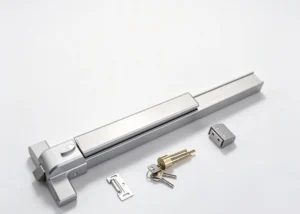
- They are your code firewall. A cheap online discounter will happily sell you a non-compliant panic device. A true partner will stop you. They know that saving $500 on a device that triggers a $5,000 rework order is a catastrophe.
- They hold inventory as a strategic buffer. When a door closer fails, a 12-week lead time from an overseas factory is a business interruption event. A local supplier with a warehouse is a risk mitigation strategy.
- They speak architect and contractor. They translate between the design intent and the field reality, finding solutions that satisfy both without costly change orders.
The procurement litmus test? Call them with a half-baked idea. Do they ask smart, probing questions to clarify the *need* behind your request? Or do they just quote the part number you provided? The former saves you money for a decade. The latter costs you.
The Inconvenient Realities (Nobody Talks About These)
Let’s get gritty.
The Keying System is a Money Pit. Grandmaster systems with layers of sub-masters and change keys are complex, expensive to generate, and a security liability if not managed perfectly. Question every level of access. Does the night cleaner really need a master key, or just a defined sub-master for their zone? Simplification is security. And savings.
“Reclaimed” or “Existing” Hardware is a Lottery Ticket. Sometimes you win. A solid, heavily-built hinge from 1970 can often be re-used. A mortise lock body of unknown lineage is a ticking time bomb. The cost to disassemble, evaluate, re-key, and re-install often outweighs the cost of new, warrantied hardware. Sentimentality has no place in a cost spreadsheet.
The “Or Equal” Clause is Your Greatest Vulnerability. In your spec, it provides flexibility. In the hands of a low-bid contractor, it’s an invitation to substitute a marginally compliant, inferior product. The defense? Specify by performance requirements and named testing standards, not just brand names. Force the “equal” to prove it’s actually equal.
Final Thought: The One Call You Must Make
All this strategy, all this careful procurement, can be vaporized by one individual: the Authority Having Jurisdiction. The AHJ. The fire marshal, the building inspector. Their interpretation of the code is the final law.
An upfront, pre-submittal consultation with them is not a cost. It’s the cheapest insurance policy you will ever buy. It derails assumptions, clarifies grey areas, and prevents the soul-crushing, budget-obliterating sentence: “That’s not how we read that section here. You’ll have to redo it.”
Your move isn’t to find the cheapest hinge. Your move is to build a system—of products, partners, and knowledge—that delivers reliability and compliance at the lowest total cost of ownership. That’s where the real money is saved.
It is recommended to consult the local Authority Having Jurisdiction (AHJ), such as the fire marshal or fire code official. Do not delegate this. Own it.