Coffee’s cold. The phone’s been ringing non-stop with the “five-minute” emergency calls. And you’re staring at a van full of panic bar parts that, once again, fit absolutely nothing on today’s site survey. Welcome to my world—and probably yours.
Ordering exit devices is a uniquely torturous form of inventory management. A labyrinth of fifty brands, a hundred models, and a thousand variations for trim, finish, and handing. It’s engineered chaos, designed to make you scream into the void. The catalogs are a monument to confusion. My solution? Intentional, controlled, snark-laced simplification.
Here’s the grumpy, unvarnished truth from a guy who’s wasted more daylight on a ladder with the wrong part than he cares to admit: you can address a shockingly high percentage of panic bar emergencies—replacements, retrofits, repairs—with just five core SKUs. Not fifty. Five.
This isn’t about building an archive. It’s about strategic dominance. It’s about having the right leverage points on your truck so that 80% of the time, you walk away with a closed ticket and a paid invoice, not a vague promise to “see what we can source.” Let’s cut through the manufacturer-sponsored noise.
The “Why Bother” Philosophy: Firefighter, Not Archivist
Before we get to the what, you must understand the why. Your mission parameters are clear: panic bars fail. They are abused, neglected, and purchased by the lowest bidder. Fire marshals wield red tags like confetti. Your primary function in these moments is not to be a museum curator for every exit device conceived since the Industrial Revolution.
Your function is to restore security, ensure compliance, and regain functionality—today. Often, this demands a functional equivalent retrofit. We are not matching a 1970s Von Duprin for a historical landmark. We are securing the back door of a logistics warehouse that was compromised last night. Think like a pragmatic firefighter, not a sentimental archivist. Efficiency trumps purity every single time.
The Dirty Five: Your Bread-and-Butter Panic Bar Arsenal
Forget “comprehensive.” Think “strategic coverage.” These are the workhorses. I won’t name brands—their marketing departments have caused enough trouble—but I’ll give you the functional specifications to hunt down. The descriptions are messy because the reality on the ground is a beautiful disaster.
1. The 3-Foot, Rim Mounted, Standard Duty, Universal Prep Workhorse.
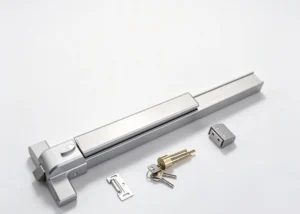
What it is: The quintessential surface-mounted bar. 36 inches. Fits the most common commercial door width. “Universal prep” is the key—it accommodates the most frequent hole patterns already vandalizing your doors (think 4.75″ backset, 5.5″ backset). It includes a template for new holes; a small act of creation in a world of destruction.
Why it’s here: This is your volume leader. It replaces a staggering percentage of the cheap, failed bars on storefronts, office stairwells, and secondary school exits. It’s the “get it done” part. Stock it in Aluminum (AL) and, if your clients have notions above their station, Dark Bronze (DB). Do not get emotionally attached to stocking every finish under the sun. Order the obscure ones on demand and charge accordingly for the privilege.
Strategic Coverage: A vast ecosystem of failed no-name bars, aging Simplex units, and the ubiquitous “I don’t know what it was, just make it stop beeping” special.
2. The 6-inch Crossbar for Narrow Stile Aluminum Doors.
What it is: The short, stubborn cousin. Designed for those slim aluminum-framed glass doors lurking beside main entrances. Typically a 6″ to 8″ crossbar. Surface mounted, universal prep.
Why it’s here: Because these doors are pervasive, and the bars are subjected to incessant, misguided force by the general public. They fail with predictable regularity. Having two of these on the van means you can resolve the pharmacy’s ADA door crisis while you’re already on-site for the main entrance. Two devices, one trip, one invoice. They call it “efficiency.” I call it not being inefficient.
3. The “Dummy” Trim-Only Kit (Rim Mount, Mortise Lock Cylinder).
What it is: A tactical illusion. It’s not a full panic device. It is the interior trim—the part with the cylinder for keying—that pairs with a separate exterior push pad or pull handle. Common on paired doors or main entrances on exit-only mode after hours.
Why it’s here: The failure point is almost never the exterior hardware. It’s the interior mechanism—the latch wears out, the screws surrender, the cylinder is assaulted. A complete “dummy trim” kit allows you to replace the entire interior assembly without engaging with the exterior facade. This solves a disproportionate number of “won’t latch” or “key is fighting me” service calls. Ensure it’s the common mortise lock prep version. This is a high-margin, low-effort fix.
4. The Universal Dogging Device. (The “Fire Marshal’s Shadow” Special)
What it is: A small, crank or tool-operated mechanism that, when legally installed, locks the panic bar latch in the retracted position. This permits use as a pass-through without constant alarm triggering. Let me be perfectly clear: This is a compliance product, not a convenience widget.
Why it’s here: Because facility managers engage in illegal dogging with zip ties, duct tape, and blind optimism. The fire marshal arrives, sees the contraband, and issues violations. You arrive, remove the hazardous improvisation, and install a proper, listed dogging device. You are the hero who understands code, you command a premium, and you sleep at night knowing you didn’t contribute to a potential catastrophe. Stock the universal kits compatible with your #1 and #2 bars.
5. The “Most Common” Replacement Latch Assembly.
What it is: For your primary #1 bar, identify and stock its specific, slide-out latch mechanism. Usually a 1″ throw, deadlocking latch.
Why it’s here: Often, the bar body and door are perfectly serviceable. Only the latch is defeated—worn, bent, refusing to deadlock. Instead of a full unit replacement, you extract two screws, eject the old latch, insert the new. A ten-minute operation billed as a “major hardware repair.” Customer satisfaction is high; your profit margin on this small piece of machined metal is borderline hilarious. Know the part number. Have it.
The “Fine, Here’s the Real Talk” Addendum
Handing: Your primary bars must be field-handable. They must be configurable for Left-Hand and Right-Hand doors from a single SKU. If the unit you’re considering isn’t, you are considering wrong. This is non-negotiable.
Finish: I stipulated AL and DB. If your operational zone demands it, add Satin Chrome (SC) or US26B. Full stop. All other finishes are special orders with lead times and financial commitments from the client.
What This System DOES NOT Cover: Heavy-duty institutional bars (stadia, arenas). Vertical rod devices (a specialized niche). Fire-rated wood doors with specific, proprietary preps. Anything marketed as “architectural” or “designer.” Those are “measure with a micrometer, order once, wait eight weeks” projects. A different business model entirely.
The Van Stock Logic: Maintain 2 of #1, 1 of #2, 1 of #3, 2 dogging kits, and 3 latch assemblies. This represents a minimal capital outlay that empowers you to resolve the majority of panic bar calls on the first visit. The remaining 20%? That is what your supply house relationships and expedited shipping are for. Maybe.
THE NON-NEGOTIABLE, ALL-CAPS, GRUMPY AHJ WARNING
LISTEN. YOUR ASSUMPTIONS ARE WORTHLESS HERE.
EXIT DEVICES ARE FIRE AND LIFE SAFETY HARDWARE. THEY ARE LISTED AND TESTED ASSEMBLIES FOR A CRITICAL REASON. THE AUTHORITY HAVING JURISDICTION (AHJ)—THE FIRE MARSHAL, THE BUILDING OFFICIAL, THE INSPECTOR WITH THE BADGE—HAS ABSOLUTE, FINAL AUTHORITY OVER ANYTHING YOU INSTALL.
THE TERM “FUNCTIONAL EQUIVALENT” DOES NOT MEAN IGNORING THE LISTING. YOU CANNOT FABRICATE A SOLUTION FOR A FIRE-RATED OPENING. YOU CANNOT IMPROVISE MOUNTING METHODS. YOU CANNOT INSTALL DOGGING WHERE IT IS EXPLICITLY PROHIBITED BY CODE.
IF YOU REPLACE A PANIC BAR, YOU OWN THAT INSTALLATION. IF A LIFE SAFETY EVENT OCCURS AND THAT DOOR FAILS DUE TO INCORRECT OR NON-COMPLIANT HARDWARE, THE LEGAL AND FINANCIAL CONSEQUENCES WILL BE CATACLYSMIC. YOUR INSURANCE WILL BE A SPECTATOR.
ALWAYS, AND WITHOUT EXCEPTION, VERIFY WITH THE LOCAL AHJ ON ANY REPLACEMENT WHERE THERE IS AMBIGUITY. DOCUMENT THE EXISTING CONDITIONS. OBTAIN SPECIFICATIONS. PHOTOGRAPH EVERYTHING. THIS ISN’T RED TAPE; THIS IS YOUR PROFESSIONAL AND FINANCIAL SHIELDLING. THIS IS THE BURDEN—AND THE JUSTIFICATION—FOR THE RATES WE COMMAND.
Now go restore order to the chaos. And for heaven’s sake, start with a fresh, hot cup of coffee.