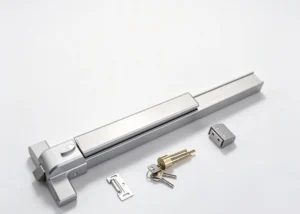
Right. Let’s have the uncomfortable chat. The one your facility manager is already having with a broken piece of hardware in a locked broom closet. You, or some spreadsheet jockey who thinks “ANSI/BHMA A156.3” is a prison inmate ID, found a “deal.” A panic bar for 40% less. It looked the part. It had a shiny finish and a PDF “Test Report” from a lab you can’t find on a map. You bought it. You installed it. And now, it’s a flaccid, wobbly monument to false economy. It doesn’t latch; it suggests latching. The finish is blistering. It feels…cheap.
Of course it does. You bought metallurgical theater. You prioritized a line item over physics. This isn’t a product failure; it’s a predictable outcome. Let’s strip away the polished lies and melt down the grimy truth about why cheap life safety hardware is a ticking, wall-mounted liability.
The Foundation of Failure: It’s in the Dirt
Every decent panic device begins with intention. The steel matters. For the bar, the latch bolt, the chassis? You need a consistent, low-carbon or mild steel with proper tensile strength. It’s boring. It’s foundational.
The bargain bin special begins with mystery. Sourced from the discount alloy bazaar, it’s often a soup of recycled scrap with the metallurgical consistency of a teenager’s promise. The sins are elemental:
- The Grain Structure Catastrophe: Quality steel has a fine, uniform grain. Cheap steel is coarse, erratic, and lazy. Under cyclic load—say, the thousandth shove against the bar—those coarse grains are nucleation sites for cracks. The metal doesn’t wear out; it micro-fractures from within.
- Inclusion Souvenir Shop: Non-metallic inclusions (sulfides, oxides) are the garbage trapped in the melt. Good production minimizes them. Cheap steel is a tourist trap for these flaws. They are microscopic stress concentrators. Internal fault lines. Your latch isn’t failing; it’s succumbing to its birth defects.
The Forming Farce: Engineering Weakness by Design
So they have their subpar slab. Now, they shape it. A proper manufacturer uses forging or high-tonnage precision stamping. Forging, in particular, aligns the grain to follow the part’s contours—it makes it stronger. It requires expensive tooling and presses that cost more than your annual maintenance budget.
The cost-cutter? They use underpowered, worn-out dies. The result is “springback”—the metal warping from intended tolerances. The real crime, however, is material thickness. The spec might imply 3mm. They’ll use 2.1mm and call it “weight optimization.” Pick up a cheap mounting bracket. Now pick up a quality one. The weight difference isn’t innovation; it’s absence. It’s planned vulnerability. That thin metal fatigues, warps, and allows mounting screws to pull through like butter. The weakness is designed in.
The Thermal Temper Trap: The Hardness Shell Game
Here’s where the wizardry (or fraud) happens: Heat Treatment. For a latch bolt, you need case hardening. The core stays tough to avoid a brittle snap; the surface becomes file-hard to resist wear. The proper method is carburizing: a long, controlled bake in a carbon-rich atmosphere, creating a deep, uniform hardened case (0.5-1mm).
The discount alternative? A cyanide dip or flash plating. They dunk the finished part for minutes. It yields a surface hardness that passes a quick Rockwell test for the catalog sheet but has the depth of a politician’s sincerity. In service, that brittle, paper-thin shell chips off. Underneath is soft, gummy metal that wears away like chalk. The gritty feeling in the operation? That’s your hardware turning into abrasive dust.
The Corrosion Comedy: Plating as Wishful Thinking
“Stainless steel finish!” It’s almost always a zinc plating with a chromate conversion coat or a whisper-thin layer of chrome over nickel. Quality plating is a science: meticulous cleaning, controlled baths, specific currents. The goal is adhesion and sacrificial protection.
The cheap version is a “wheelbarrow dip.” Parts are tumbled, plated for minimal time. The coating is thin, porous, and poorly bonded. The white rust (zinc oxide) blooming at the screw holes isn’t a cosmetic flaw; it’s galvanic cancer. Where dissimilar metals meet in a humid environment, they electrochemically feast on each other. The finish isn’t peeling; it’s being vomited off by the base metal.
And the springs? Don’t get me started. Made from poorly tempered or untempered wire, they take a “set” immediately. The bar develops rattle. The latch return fails. Your emergency device now relies on gravity and goodwill to secure a door. Brilliant.
The Assembly Abomination: The Symphony of Slop
Every part has a dimensional tolerance. In a real device, these are tightly managed with stack-up analysis—ensuring that even at extreme tolerances, the thing still works. It’s boring, essential engineering.
In the cheap bar, every part is at the far edge of its sloppy tolerance. The hole is +0.5mm. The pin is -0.5mm. The bracket is bent 1.5° off. Alone, manageable. Assembled, these errors compound. This is the “slop,” the wobble, the misalignment that causes asymmetric wear and premature failure. It’s not precision assembly; it’s parts corralled into proximity and hit with a hammer until they stop moving.
The Real Cost Calculator: Where Your “Savings” Go to Die
Your $95 “bargain” bar fails in Month 8. Direct cost: service call ($180), replacement hardware (a proper one, $340). You’re already at a 550% loss on the original “saving.”
But the indirect costs are the bankruptcy of common sense:
- Security Theater: A sloppy bar doesn’t latch reliably. You’ve installed a courtesy entrance for intruders.
- Life Safety Lottery: In a panic, a crowd hits that bar. If a cheap casting shatters, if the latch binds, if the mechanism fails under load… the legal term is “negligence.” This hardware has one job. One.
- Liability Landfill: Knowingly installing sub-par life safety equipment shreds your liability shield. In court, your purchase order is Exhibit A for the plaintiff.
- Reputational Cremation: “Emergency Exit Failed at Downtown Venue.” That headline has a half-life longer than your company will.
The AHJ Intervention: The Only Truth That Matters
Save your “value engineering” pitch for the breakroom furniture. The Authority Having Jurisdiction (AHJ)—your Fire Marshal, Building Official—operates on a simpler principle: The code and its referenced standards (like ANSI/BHMA A156.3) are the bare legal minimum for not endangering lives.
That cheap bar with its questionable “listing”? The AHJ sees it weekly. When they inspect, they will grab, shake, and cycle it. When it fails their basic operational check, the dominoes fall with bureaucratic finality:
- Failed Inspection. Red Tag.
- Mandated full replacement of all non-compliant hardware.
- Requirement for certified documentation (UL, Intertek, etc.) for the new, proper hardware.
- Re-inspection fees. Lost time. Delayed occupancy.
Your “savings” transform into a 1000% cost multiplier, plus operational paralysis, plus professional embarrassment.
Buy cheap toilet paper. Buy discount light bulbs. But do not, under any spreadsheet-induced hallucination, economize on the engineered interface between a panicked human and a means of escape. You’re not buying a product. You’re procuring reliable performance under duress. The former is a line item. The latter is a moral and legal obligation. Now, if you’ll excuse me, I have to go throw a poorly cast latch bolt at a wall. For science.
AHJ WARNING: The Authority Having Jurisdiction (AHJ) is the final arbiter of code compliance. This article discusses general principles of metallurgy and manufacturing. It is not a substitute for specifying and installing hardware that is listed, labeled, and approved by your local AHJ for your specific application. Always consult with the AHJ, a qualified architectural hardware consultant, and a professional door and hardware installer. Failure to install code-compliant, listed life safety hardware may result in failed inspections, legal liability, and most critically, a failure to protect life during an emergency.