
Listen. That infernal racket coming from your fire exit isn’t just an annoyance; it’s a procurement problem disguised as a mechanical one. Every groan, shriek, and rattle is a direct debit from your credibility and a potential line item on a future capital request. I’ve watched budgets evaporate over these clattering metal geese for longer than I care to remember. The solutions peddled are typically binary and brainless: the quick squirt or the full-system swap. Both are usually wrong. Let’s cut through the vendor-speak and get grumpy about the messy reality.
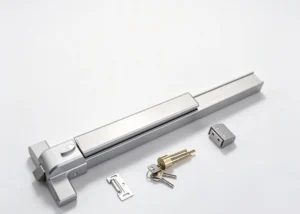
First, strip the mystique. A panic bar is not a black box. It’s a kinetic system: a lever, springs, rods, pivots, and a latch. The noise is a symptom report—metal parts communicating distress. Your job is to interpret the report and authorize the correct, cost-effective countermeasure without compromising the one non-negotiable function: life safety. Fail that, and the noise will be the least of your worries.
The Squirter-Juicer Fallacy: A Can of False Economy
This is the knee-jerk reaction from Facilities, often with your blessing because it shows “initiative” and has a near-zero parts cost. The janitorial-grade lubricant comes out, a film of hope is applied, and for a glorious 48 hours, peace reigns. Then it returns, a sticky, grit-attracting, gummy mess, now louder and angrier.
Lubrication is a tactical tool, not a strategic solution. If you sanction it, mandate the right kit. Ban all-purpose garage gunk. Demand a dry lubricant—graphite powder or PTFE spray—that won’t act as a dirt magnet. The application must be surgical:
- Pivot Points: Where the bar meets the end cap. A groan often lives here.
- Rod Connections (Clevis Pins): Inside the housing. Friction here equals internal rattle.
- Latchbolt: A dry bolt makes a loud, sticking CLACK. A micro-dose on its sides smooths the action.
- Spring Ends: Not on the spring, but where its ends bear against the housing.
Consider this approach approved only for early-stage wear. If the noise persists post-lube, you’ve just purchased valuable diagnostic data: this is a mechanical failure, not a maintenance omission. Stop throwing lubricant at a parts problem.
The Full-Replacement Mob: Capitalizing on Panic
Then you have the vendors—and sometimes your own ops team—who hear a noise and see a green light for a full replacement. “Just swap the whole unit!” they chirp, presenting a quote for $800-$1200 per door. Sometimes they’re right. Often, it’s gross overkill, like replacing an entire conveyor because one roller bearing is shot.
Mechanical intervention is required when lubrication is futile. You need to know what you’re buying. Common, noisy failures demanding parts include:
- Worn Rollers/Bearings: Grinding metal-on-metal sound. Can’t be lubed smooth. Requires end cap or roller replacement.
- Bent Linkage Rods: Often from impact (forklifts, pallet jacks). Causes a sharp, binding snap. Straightening is unreliable; replacement is the fix.
- Loose Hardware: The #1 cause of rattles. The device, door, or frame is loose. A simple tightening of every screw is the highest-ROI activity in facilities management. If screw holes are stripped, that’s a mechanical repair (helicoil, etc.).
- Failed Spring: Results in a slack, slappy sound ending in a crash. Springs are cheap; labor is fiddly but often justifies the part cost.
- Worn Latch Mechanism: Causes slop and a loose, clattery sound. Often means replacing the latch module, not the entire crossbar.
My grumpy mandate: Diagnose before you disburse. Require a 10-minute audit: operate slowly, listen, feel for grinding, check for play. 80% of the time, the fix is tightening hardware or a sub-component replacement, not a blank-check capital outlay.
The Unvarnished, Economically Brutal Truth
Here’s what the glossy brochures omit: most modern exit devices are designed with a cost-of-repair cliff. The labor hours to fully disassemble, diagnose, and repair microscopic components often surpasses the price of a new, warrantied unit. It’s a cold calculus. An iconic Von Duprin 99 might be worth rebuilding with OEM parts. A cheap imported clone? You’re pouring man-hours into a depreciating asset.
Furthermore, repair is messy. Replacing a roller isn’t a clean swap; it requires degreasing adjacent parts, applying new lubricant correctly, and ensuring alignment. It’s a holistic procedure. And manage expectations: a properly tightened, repaired device might trade a rattle for a solid, resonant CLUNK. You’re aiming for functional, reliable quiet—not library silence. It’s a heavy metal mechanism; it will announce its operation.
The Non-Negotiable, Liability-Laden Final Point (READ THIS)
I’ve been grumpy about spend and specs. Now I need to be deadly serious about liability. Everything above is academic if you ignore this.
Any action performed on a fire exit device—a squirt of graphite, tightening a screw, replacing a roller—is regulated. It falls under your Authority Having Jurisdiction (AHJ), typically the Fire Marshal. This is Life Safety equipment, full stop.
AHJ WARNING: Before authorizing any work, you must identify your AHJ and understand their requirements. In most jurisdictions, repairs or adjustments to panic hardware must be performed by a licensed, certified, or AHJ-approved professional. Your in-house maintenance tech, however skilled, may be legally unqualified. If an altered device fails during an emergency, you face catastrophic liability, code violations, fines, and occupancy restrictions.
Post-repair, the device must be tested to relevant standards (e.g., ANSI/BHMA A156.3) and often requires AHJ re-inspection. A quieter bar is not a compliant bar. The quietest bar is one that has been disabled and fails to open.
So, to synthesize: Yes, authorize the screw tightening. Approve the dry lube for early wear. Source the correct sub-components for observed failures. But your ultimate procurement duty is to mandate compliance. Engage your AHJ. Contract only qualified professionals. It’s the only way to silence the hardware without inviting a world of legal and ethical noise no budget can cover. Now, go check your boilerplate service contracts.