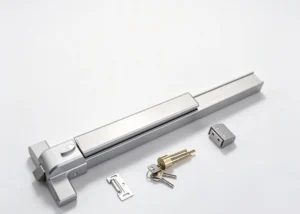
Let’s not mince words. You’re not here for architectural reverie. You’re here because you have a gate—a substantial, costly piece of perimeter hardware—and a code book, architect, or spreadsheet jockey has decreed it needs a panic device for egress. Now you’re contemplating an indoor-grade piece of sleek mechanics destined for a lifetime of rain, ice, and the unique violence of public use. You’re about to learn that specifying a panic bar for an outdoor gate isn’t procurement. It’s a declaration of war against entropy, corrosion, and the fundamental incompatibility of precision engineering with the great, wet, shifting outdoors.
Welcome to the front lines. The coffee is terrible, the budget is a punchline, and your primary enemy is wishful thinking.
Chapter 1: The Great Outdoor Lie – Where “Stainless” Meets Stupidity
The first and most seductive falsehood is “weatherproof.” It’s a term tossed around in catalogs with the casual grace of a sales rep who never leaves the showroom floor. Let’s eviscerate it.
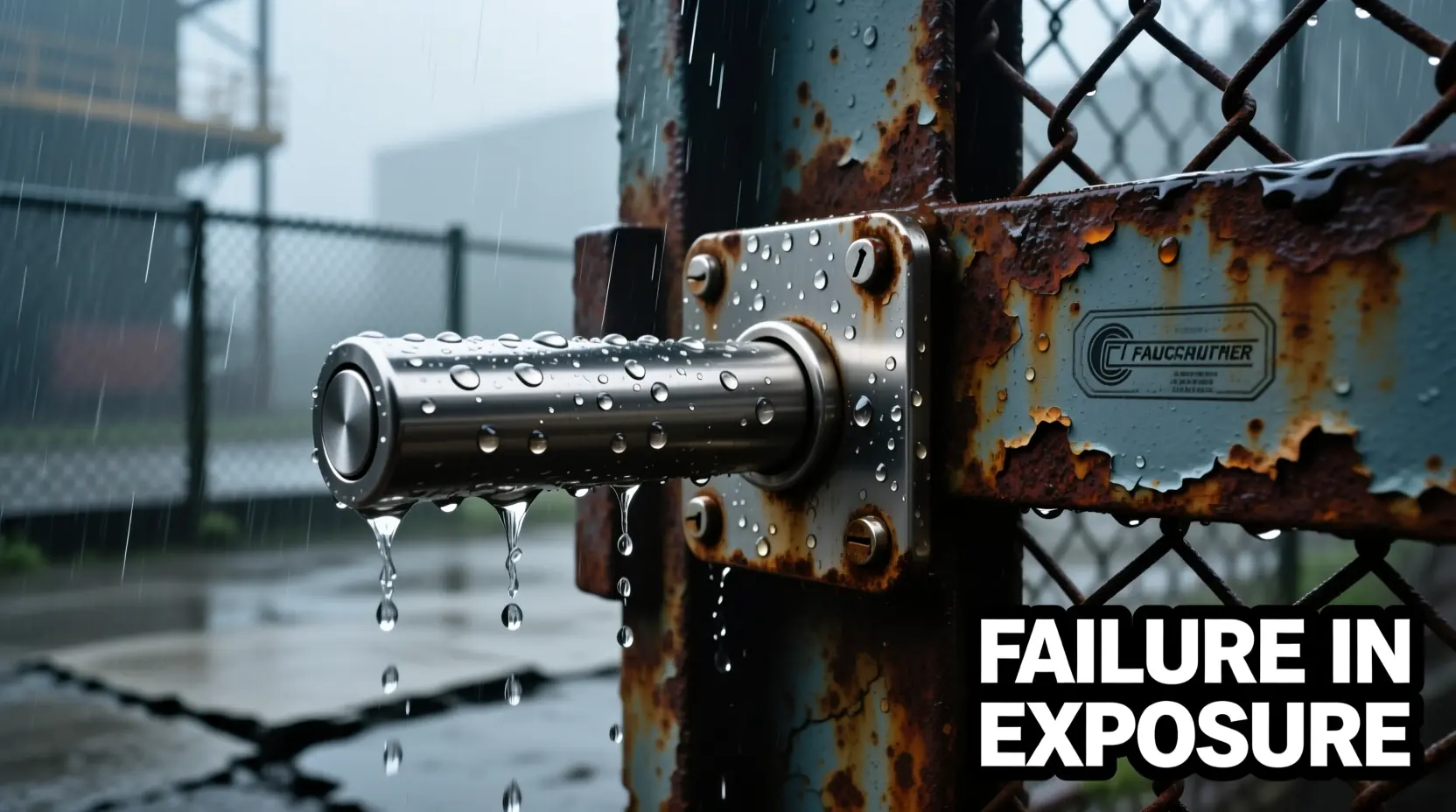
You’ve spec’d 304 or 316 stainless steel. A solid start. Pat yourself on the back, lightly. Now, remember: stainless is stain-less, not stain-proof. This is not semantic quibbling; it’s the foundation of your future problems. In a marine environment, it will host a crusty, white carnival of salt deposits. In an industrial zone, atmospheric pollutants will wage a slow, chemical siege. And everywhere, in every microscopic crevice—where the end cap meets the tube, where the pushbar attaches—water will ingress. It will sit. It will freeze. It will expand. One morning, the smooth, compliant action of your panic device will feel like you’re crushing gravel inside the housing. That’s not a defect; it’s physics, and it’s winning.
And the guts! Ah, the glorious, hidden internals. The springs, latch bolts, and rollers within that mortise lock. Do you genuinely believe they’re marine-grade bronze? Don’t be charmingly naive. Countless “outdoor-rated” devices are just indoor units wearing a slightly thicker stainless-steel raincoat. Inside, carbon steel components await their first damp breath to begin their inexorable transformation into brittle, oxidized rubble. You must demand a device that is through-and-through bastard-built for outside. The spec sheet must explicitly crow about “corrosion-resistant internals,” “sealed assemblies,” and the presence of weep holes—not just to let water in, but crucially, to let it out. If the literature doesn’t read like a survivalist manual, it belongs on an office door, not your perimeter gate.
Chapter 2: The Mounting Plate Morass – When Your Gate Is a Sail, Not a Wall
Consider the humble indoor door. It’s a static, rigid panel in a static, rigid frame. Now consider your outdoor gate. It’s a sail on hinges. It flexes in the wind. It sags over time. It gets assaulted by delivery drivers, leaned on by smokers, and shaken by slams. This movement isn’t an occasional nuisance; it’s the gate’s permanent state of being.
Now, imagine attaching a precise, mechanical panic device directly to this flexing, twisting canvas with a handful of #10 screws. It’s an act of profound mechanical ignorance. The flex translates directly to the mounting points, working the fasteners loose, destroying alignment, and guaranteeing premature failure. The solution is not found in a hardware catalog. It’s found in a fabrication shop.
You need a substantial, custom-fabricated backing plate. This plate spreads the device’s load and the gate’s stresses across a vast area of the stile. It provides the rigidity the gate itself lacks. It is non-negotiable, rarely standardized, and always an afterthought until the device is hanging by two threads and the service calls start. Budget for steel, welding, and design time. Or budget for replacement. Your choice.
Chapter 3: Latch Post Alignment – The Tenth Circle of Procurement Hell
If the gate is a sail, the latch post is a shifting monument in an unstable world. The ground heaves with frost, settles with thaw, and moves with time. Your gate’s latch bolt—a rim bolt, a mortise latch, a vertical rod—must find a hole in this wandering post with millimeter precision. Not just on Installation Day, a crisp Tuesday in spring. But in the swollen heat of August and the clenched contraction of a February deep freeze.
Get this wrong, and you curate a gallery of classic failures:
- The Grinder: The bolt scrapes pathetically against the strike plate face, never engaging, polishing itself into a shiny, useless stub.
- The Jam: The bolt engages just enough to stick but not enough to release. You have now ingeniously created an entrapment hazard with a device whose sole purpose is to prevent entrapment. Award yourself no points.
- The Ghost Latch: The gate appears closed, the device emits a satisfying ‘clunk,’ but the bolt is merely tapping the strike. The next gust of wind blows the gate open, and your security posture becomes a communal joke.
The strategy here is not victory, but damage mitigation. First, oversize the strike hole. Think landing pad, not sheath. A minimum of 1/8-inch clearance on all sides is a good start; more is pragmatic. Second, employ a deeply beveled, forgiving strike to guide the bolt home. Third, consider adjustable strikes to allow for seasonal tweaks without acetylene torches. Fourth, and this is critical: install a rugged, independent positive stop. The gate’s closed position must be defined by this stop, not by the latch bolt slamming into the back of the strike hole. The stop absorbs the impact and alignment stress; the latch bolt simply drops into place to secure. Different tools, different jobs.
Chapter 4: The Rods of Perdition – A Special Word on Vertical Rod Devices
To the individual contemplating a vertical rod panic device (the “dogbone”) on an exterior gate: I see you. You are a romantic, a dreamer, a glutton for exquisite punishment. You have now doubled your alignment problems—top and bottom. The lower rod is condemned to a life in a sump of leaves, mud, road salt, and frozen slush. It will bind. Its guide will clog. The floor strike will shift with the earth. These devices are sometimes necessary for very tall gates, but treat them as the high-maintenance thoroughbreds they are: magnificent when working, catastrophically expensive and temperamental always. Plan a rigorous, quarterly maintenance ritual or prepare for heartbreak.
Chapter 5: The Vanity of Finishes – Or, Why Raw Steel is an Honest Friend
“We want it in black to match the fencing.” Fine. That black is a powder coat or PVD finish applied over the stainless steel. Every chip from a stray tool, every scratch from a key fob, becomes a potential nucleation site for corrosion. The base metal will oxidize beneath the finish, blistering it from the inside in a betrayal you cannot see until it’s too late. Sometimes, the most durable and honest finish is the raw, mill-finish stainless. It will patina. It will show its service. It will not hide its sins. In the world of outdoor hardware, honesty is often the best policy.
The Grumpy Procurement Protocol
- Buy Ugly and Overbuilt: Seek out the industrial-grade, “we-don’t-care-if-it’s-pretty” hardware lines from manufacturers with proven outdoor, high-abuse credentials. The catalog should smell faintly of grease and pragmatism.
- Interrogate the Technical Rep: Skip the salesperson. Demand a conversation with a technical representative. Ask the mean questions: “What is the exact material of the internal spring?” “Show me the cross-section with the weep holes.” “What voids the warranty when installed outdoors?”
- Budget for the Unsexy: The backing plate, the custom strike, the positive stop, the adjustable mounts—these are the cost items that separate a working installation from a failed one. They are not optional.
- Plan for Maintenance, Not Miracles: Schedule bi-annual hands-on maintenance: clearing debris, checking alignment, and lubricating with a dry-film, outdoor-specific lubricant (WD-40 is for squeaky hinges on garden sheds, you animal).
Remember: the device is a component. The installation is the system. A perfect device installed by a cowhand is a liability. A robust device installed by a craftsperson who understands movement, weather, and force is your only hope for a dignified outcome.
AHJ WARNING: The Only Opinion That Actually Matters
Listen carefully. Your internal aesthetic preferences, your clever cost-saving measures, your contractor’s “we’ve always done it this way”—all of it is noise. For any commercial, institutional, or multi-family residential project, the final arbiter is the Authority Having Jurisdiction (AHJ)—your local building official, fire marshal, or code consultant. This gate is a means of egress. They will test the operating force (typically a max of 15 lbs to release the latch). They will verify clear width. They will check for obstructions. They will ensure it requires no special knowledge (no “lift and push” nonsense).
If your alignment causes binding, they will fail it. If your hardware seizes from corrosion, they will fail it. A failure means ripping it out and starting over, absorbing all costs. Do not end up in that meeting. Engage the AHJ during the design phase. Submit your hardware specs, your mounting details, your strike solutions. Secure their approval before metal is cut or concrete is poured. Their interpretation of the code is the only law that applies. Ignore this step, and your panic bar project will become a masterclass in fiscal panic. Consider yourself warned.