Let’s get one thing straight from the start: I don’t procure temporary exit hardware. I procure liability mitigation devices that happen to open doors. If you’re in my world—European and American construction, where regulations shift like the wind and budgets are perpetually optimistic—you already know the drill. This isn’t about shiny catalogues and vendor lunches. It’s about avoiding the soul-crushing spectacle of an Authority Having Jurisdiction (AHJ) shutting down your €20 million project because some genius thought a zip tie was an acceptable fire exit strategy.
My philosophy? Embrace the intentional chaos. Assume everyone on site—from the project manager to the apprentice—is actively trying to defeat your carefully sourced safety equipment. Plan for it. Procure for it. Because in the grimy, real-world gap between a door being hung and the final, beautiful panic bar being installed, people can die. And my job is to make sure the gear I buy doesn’t let that happen.
The Procurement Minefield: What You’re Really Buying
When the requisition for “temp exit hardware” lands on my desk, I don’t just see a line item. I see a cascade of hidden costs and responsibilities. I’m not just buying a metal bar. I’m buying:
- Compliance Insurance: Will this satisfy the Frankfurt building official AND the Chicago fire marshal? Their whims are my spreadsheet’s problem.
- Labor Overhead: The cheapest hardware often requires a PhD in mechanical engineering and three hours to install per door. I factor the carpenter’s hourly rate into my total cost calculation. A product that bolts on in 90 seconds is cheaper, even if the unit price is higher.
- Durability Capital: This gear will be painted over, used as a ladder rung, sprayed with concrete, and likely kicked by a frustrated subcontractor. I need the kind of over-engineered robustness you’d expect from mining equipment, not a bathroom door handle.
- Clarity as a Service: If a terrified, disoriented person can’t immediately understand how to operate it, my procurement failed. Signage isn’t an add-on; it’s part of the core product.
The Vendor Dance: Cutting Through the Marketing Nonsense
Sales reps love to dazzle with talk of “innovative egress solutions.” I love to bore them with specifics. Our conversations sound less like a sales pitch and more like an interrogation.
My Script: “Lovely brochure. Now, show me the independent test report proving it can be operated with under 15 lbs of force after being subjected to a simulated six months of construction site dust and moisture. What’s the documented MTBF (Mean Time Between Failures) under lateral impact? Can you provide a list of five comparable projects in the EU and US where your product passed AHJ inspection without a single deviation? Don’t email it later. Show me now.”
The fluff evaporates quickly. I’m looking for the vendor who has the grimy, unpolished case studies, not just the glossy ones.
The Snarky Specification: Writing a PO That Can’t Be Misunderstood
Vague specifications are how you end up with junk. My POs read like the ramblings of a paranoid survivalist, and I’m proud of it.
Bad Spec: “Temporary exit device, as required.”
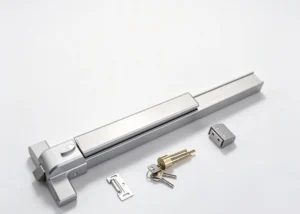
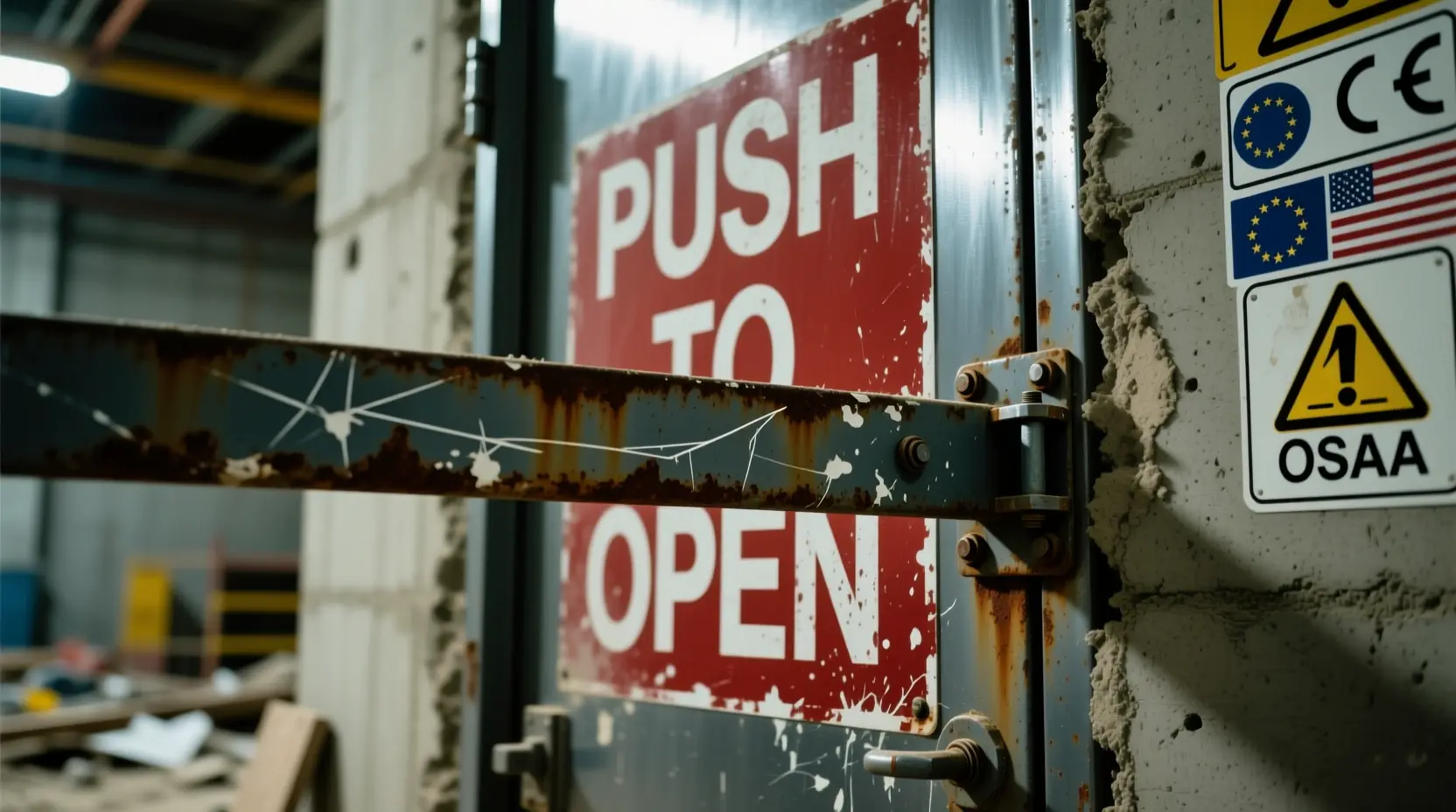
My Spec: “Temporary crossbar exit device, minimum 60% of door width. Must be single-motion operation (push). Factory-pre-applied, high-contrast ‘PUSH TO OPEN’ labeling on bar face. Mounting hardware: corrosion-resistant bolts, with oversized, non-removable security nuts to prevent ‘borrowing.’ No exposed sharp edges. Finish: phosphate-coated for paint adhesion and corrosion resistance. Packaging must include installation instruction sheet in English, German, French, and Polish.“
See the difference? I’m procuring the entire outcome, not just a piece of metal.
The Transatlantic Tango: EU vs. US Procurement Headaches
Ah, the joy of multi-jurisdictional projects. In the EU, I’m probably wrangling with CE marking, the Construction Products Regulation (CPR), and country-specific Annex Z devilry. In the US, it’s all about UL listings (UL 305 for panic hardware) and the ever-looming IBC/NFPA. Sometimes, the standards align. Often, they don’t.
My strategy? I source products that are dual-certified or have a clear, documented history of acceptance in both markets. I’m not funding an R&D project for a manufacturer. I need a turnkey solution that gets me through inspection in Munich and Milwaukee. This usually means a smaller pool of premium, globally-oriented suppliers. Their invoices make me wince, but their documentation saves my projects.
The Hidden Line Item: Training and Integration
The biggest procurement failure is thinking the job ends when the pallet arrives on site. If the crew doesn’t know how or where to install it, my perfect hardware ends up in a corner, and someone rigs the door with a piece of conduit.
Now, I bundle. My purchase order often includes:
– An on-site installation demo for the site supervisor (first 10 units).
– Laminated, multilingual quick-guide cards for the site noticeboard.
– A direct line to the vendor’s technical support, not sales.
I’m procuring compliance, not just components. The installation knowledge is a critical component.
The Grand Finale: The AHJ Warning
Now, for the most important part. Lean in close.
YOU CAN DO EVERYTHING I JUST SAID AND STILL GET SLAMMED BY THE AHJ.
The Authority Having Jurisdiction. The Building Official. The Fire Marshal. God, as far as you’re concerned on their inspection day.
They are the final arbiter. They do not care about your schedule, your budget, or your “industry standard practice.” What you think is “fine” might be a violation to them. I’ve seen AHJs reject perfectly good temporary crossbars because they wanted a specific brand listed in their local amendments. I’ve seen them demand that temporary hardware be listed to the same standards as permanent hardware (UL 305). I’ve seen them shut down entire sites over egress issues.
HERE IS YOUR SINGLE BEST PRACTICE: TALK TO THE AHJ BEFORE YOU ISSUE A SINGLE PURCHASE ORDER.
Bring them a sample or the product data sheet. Get their approval in writing or at least a documented email. “Hello Inspector, for the project at [Address], we intend to procure the ‘[Product Name]’ for all temporary fire exits. Attached are its test certifications against [Relevant Standard]. Please confirm this is acceptable to your office.” This email is more valuable than any discount from a supplier. It is your get-out-of-jail-free card.
Ignoring this step isn’t just risky; it’s a fundamental failure of the procurement function. You’ve bought the wrong thing before you even place the order. My career is a testament to one simple fact: the right conversation with the AHJ is the most cost-effective item you will ever procure.