Right. You’re not here for a hug and a participation trophy. You’re here because you’ve just had the chilling realization that your property insurance policy and your local fire code are locked in a petty, bureaucratic cage match, and you’re the one about to get beaten senseless in the crossfire. The catalyst? That metal bar on your emergency exit. Let’s dispense with the pleasantries. We’re talking about denied claims, six-figure liabilities, and the sheer, unadulterated chaos of trying to please two masters who fundamentally despise each other’s goals.
The Core Conflict: Security vs. Escape
Your insurance policy is a risk-aversion robot. It views your building as an asset portfolio to be hardened against external threats. Its sacred text—the “Protective Safeguards” endorsement—demands deadbolts. Not suggestions, not “security-ish things.” Deadbolts. Thick, single- or double-cylinder lumps of steel whose sole purpose is to be a physical “NO” to anyone outside trying to get in. It’s a pure, cold calculation: a kicked-in door equals a claim equals a payout equals unhappy shareholders. The deadbolt lowers the statistical probability. That’s all the insurance algorithm cares about.
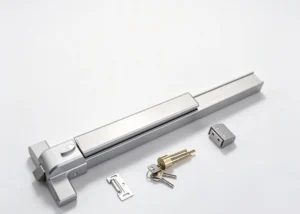
Your panic bar (or crash bar, or exit device, to use the technical terms we save for when we’re billing by the hour) is an instrument of panic. Its design philosophy is the absolute antithesis of security. It exists for one reason: to allow a crowd of panicking, blinded, disoriented humans to blast through an opening with a simple, instinctual shove. It is governed by fire codes written in the blood of past tragedies. Its deity is the Authority Having Jurisdiction (AHJ)—usually your local fire marshal, a person whose entire worldview is shaped by preventing people from burning to death in a locked room.
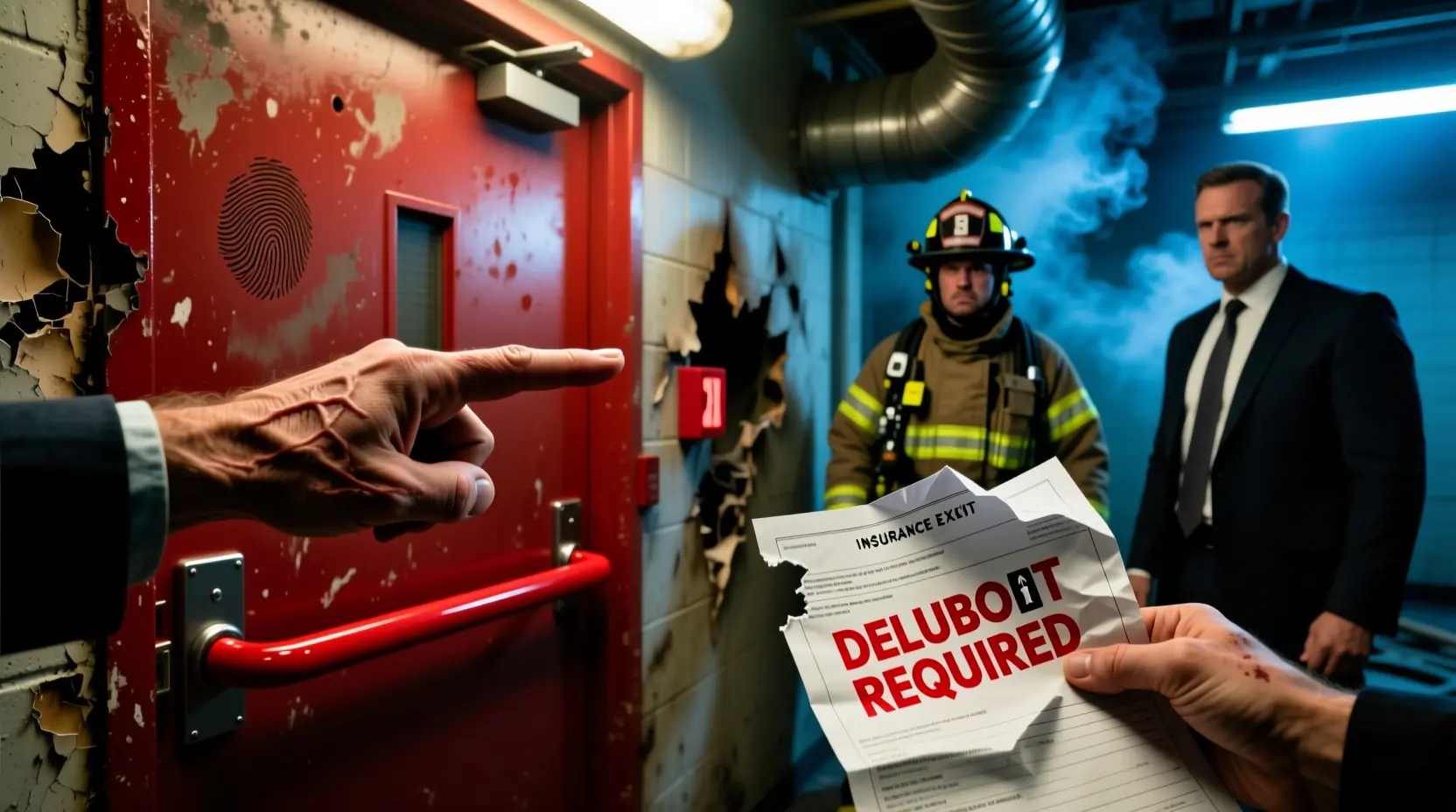
See the problem? One entity wants the door impossible to open from the outside. The other demands it be effortless to open from the inside. This isn’t a minor disagreement; it’s a philosophical war fought across the threshold of your rear delivery door.
The Catastrophic Misstep (A Tale as Old as Time)
Here’s the predictable, soul-crushing scenario I audit monthly. The business owner—let’s call him Kevin—reads his insurance policy. “Deadbolt required,” it states. Kevin glances at his fire exit. It has a shiny panic bar. “It’s metal,” he thinks. “It looks secure. It’s bolted to the door. Good enough.” Then, in a move of breathtaking negligence, Kevin decides to key the panic bar. He installs a lock cylinder that requires a key to operate the bar from the inside.
Kevin has just achieved the trifecta of failure:
- He violated the fire code. He turned an instantaneous-egress device into a potentially fatal obstacle. This is how wrongful death lawsuits are born.
- He violated his insurance policy. He didn’t install the specified deadbolt. He modified an approved life-safety device in a way that creates a gargantuan new liability.
- He created a perfect storm for claim denial. If a theft occurs, the insurer will say, “You modified the door hardware outside of code and our requirements. Denied.” If a fire occurs and someone is injured, the insurer will say, “Your negligent modification created the hazard. Denied. Also, we’re dropping you like a hot rock.”
All to save the cost of a proper, compliant hardware configuration. It’s a masterclass in false economy.
The “Yeah, But…” Objections (And Why They’re Wrong)
The grumbling starts. I’ve heard it all.
“My panic bar has a keyhole on the outside!” That’s a dogging device. It mechanically holds the bar retracted so you can use the door normally without setting off the alarm every time the dishwasher takes out the trash. It does not transform the panic bar into a security deadbolt. Not even a little.
“We have an exit alarm with a 15-second delay!” Wonderful. That’s an alarm system, not a physical, insurance-grade locking mechanism. The policy likely doesn’t care about your beeping noise. It wants the metal bolt.
The only hardware that even begins to whisper in both worlds is a mortise lock exit device—the industrial-grade units you see in hotel stairwells. These integrate a panic bar with an independent, keyed deadbolt in one chassis. They’re beautiful, they’re expensive, and I can guarantee with 99.7% certainty that your small-to-medium operation doesn’t have one. You’ve got a $250 rim-mount panic bar from a hardware store catalog. Let’s not pretend otherwise.
The Practical Guide to Navigating This Mess
So, how do you avoid becoming Kevin? You need a plan that doesn’t involve wishful thinking.
- Decode the Policy: Find the “Protective Safeguards” section. It will be hilariously specific and unforgiving. It says “deadbolt.” Assume it means it.
- Conduct a Door Autopsy: Classify each exterior door. Main public entrance? Install a deadbolt, full stop. The problem child is the designated fire exit. It must have the panic bar. To appease insurance, you often need to add a separate, auxiliary deadbolt installed high on the door (often at 60″ to prevent accidental engagement in a panic) or explore a removable core cylinder with a strict key-control log. In some cases, a hardwired, monitored alarm on the door with a significant exit delay might be accepted as a risk equivalent. You must ask.
- Initiate the Conference Call from Hell: This is the key step. Do not work in a vacuum.
- Email Your Insurance Agent (Get It In Writing): Don’t ask vague questions. State: “Per our policy section X, deadbolts are required on exterior doors. Our Fire Exit Door #2 is equipped with a [Brand/Model] panic bar, mandated by the local fire code for egress. Will you accept this as compliant, or what specific supplemental hardware do you require to satisfy the deadbolt clause?” The written response is your only shield.
- Call Your Local Fire Marshal (The AHJ): Present them with your insurance demand. Ask: “To meet my insurer’s requirements, what are my approved options for adding security to this panic bar exit without violating egress codes?” Their answer is law. Full stop.
The Inevitable, Grumpy Conclusion
A panic bar and a deadbolt solve two mutually exclusive problems. Forcing one to perform the other’s job is an exercise in catastrophic thinking. The panic bar is there to keep you from being led out of your business in handcuffs after a fire. The deadbolt is there to keep you from being led into bankruptcy after a robbery. Confusing them isn’t just wrong; it’s a direct flight path to liability hell, where insurance denials and wrongful death suits go to sunbathe.
AHJ WARNING: All of the above is the cynical, battle-weary advice of someone who cleans up these messes. Your local Authority Having Jurisdiction (AHJ)—fire marshal, building official, etc.—holds absolute, unappealable authority over life safety code. Their rulings supersede your insurance policy, this article, and any cost-saving “hack” you read online. Modifying fire exit hardware without their explicit blessing isn’t just risky; it’s professionally negligent. A denied insurance claim ruins your quarter. A blocked fire exit ruins lives. Choose wisely.