Let’s clear the air. The procurement manager who spends their days agonizing over the fire rating of every single interior door is wasting time and mental bandwidth. It’s a category error. Most doors in your facility—the ones to offices, closets, copy rooms—are simple, non-fire-rated assemblies. Their failure point isn’t a blaze; it’s Tuesday.
The real risk isn’t combustion. It’s function.
Or rather, the lack of it. A door that sticks. A latch that doesn’t catch. Glass that shatters into daggers. These aren’t theoretical fire code violations; they are daily operational failures waiting to cause injury, bottleneck an evacuation, or simply piss everyone off. Your job isn’t to turn a hollow-core door into a fortress. It’s to ensure it doesn’t become a liability.
Think of it as basic mechanical sympathy for your building. You wouldn’t ignore a pallet jack with a wobbly wheel. Don’t ignore the door that needs a shoulder-check to open.
The “Why” That Actually Matters
If a fire marshal walks your site, they’ll spot-check your rated assemblies, sure. But if a door is visibly broken, obstructed, or hazardous, they’ll write you up for that, too. It falls under general life safety, accessibility, and occupational health codes. The legal imperative is already there, hiding in plain sight.
More critically, it’s about flow. A door that doesn’t work properly disrupts the rhythm of a workplace. It’s a friction point. In procurement, we talk about total cost of ownership. A poorly performing door has a high TCO: maintenance calls, employee frustration, potential injury claims, and the reputational hit when a client sees shoddy facilities.
It looks cheap. And in our world, looking cheap is cheap.
The Walk-Through: A Consultant’s Disorganized Checklist
Forget the pristine 10-point list. Real assessments are messy. Here’s how it actually goes down, based on walking a few hundred thousand square feet of office and light industrial space.
You start with the swing. Not a gentle push. Open it like you’re late for a meeting. Does it clear 90 degrees without gouging the wall or slamming into a desk? Good. Now look down. Is the floor space on both sides clear? That 18-inch clearance on the latch side isn’t just ADA pedantry; it’s the space a person in a wheelchair or someone carrying a box actually needs. No room? That’s an egress issue, not an inconvenience.
Listen.
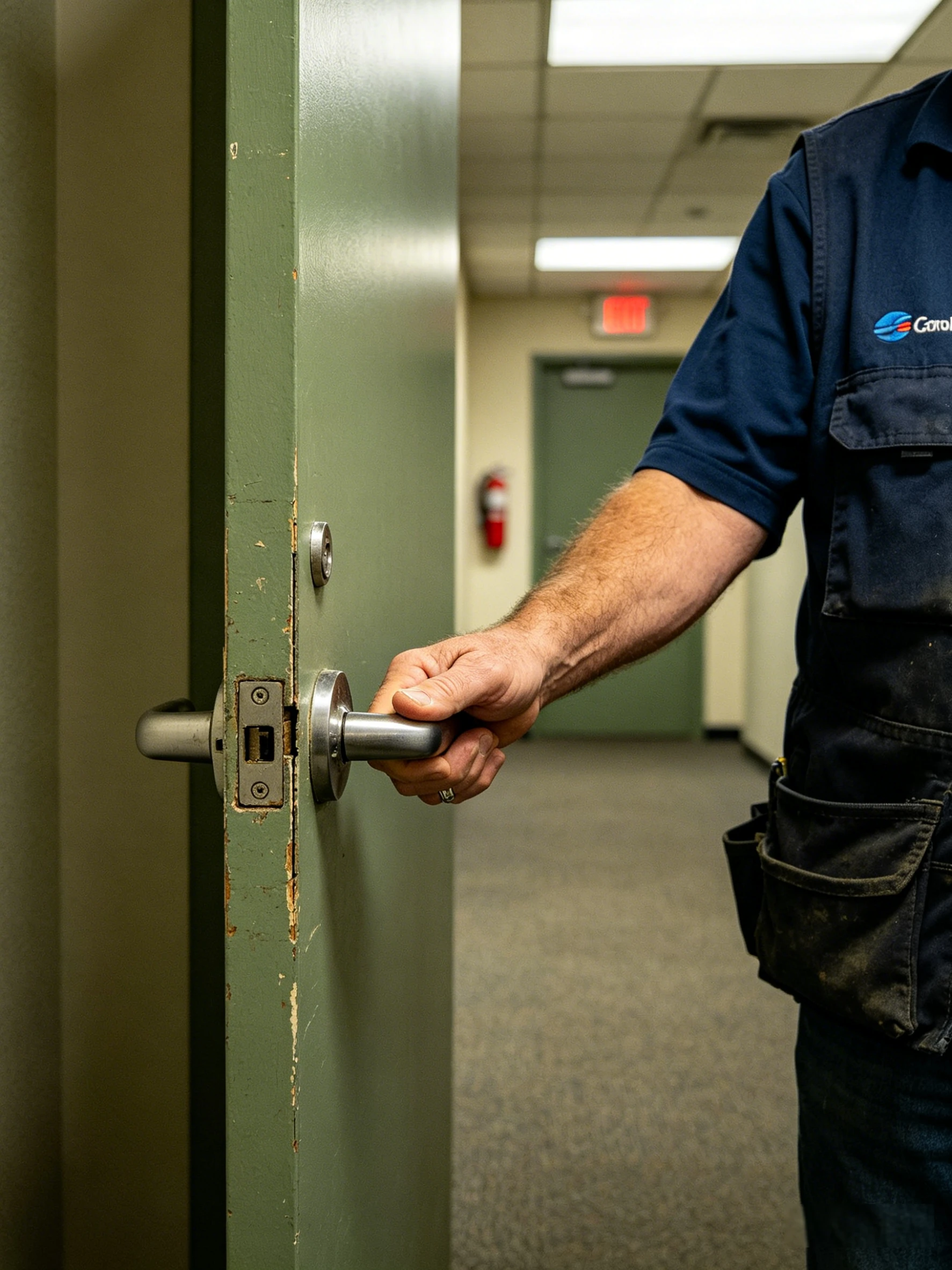
Close the door. Slowly. You’re listening for the latch. There should be a solid, metallic *click* as the bolt fully engages the strike plate. No click? Just a soft thud? That door isn’t closed. It’s just… occupying a space near the frame. Security is nil. Sound privacy is a joke.
Now jiggle the lever. Any play? Any rattle? The latch is misaligned. It’s the most common failure I see. People just get used to slamming it.
Feel the effort.
This is subjective, but your arm is a decent gauge. The opening force shouldn’t make you brace your shoulder. If there’s a closer, does it shut the door with controlled authority, or does it snap closed like a mousetrap? I saw a closer so strong once it cracked the door’s edge. That’s not safety; that’s a manufactured hazard.
The Glass Question
If there’s glass, find the mark. Get down at eye level and look in the corner. You’re searching for a small, etched logo—the manufacturer’s mark for tempered or laminated safety glass. No mark? Assume it’s annealed, or “plate” glass. That’s the stuff that breaks into long, vicious shards.
I once had a facilities guy tell me, “It’s fine, it’s thick.” Thickness isn’t the point. The tempering process is. No mark, no proof. Flag it. It’s a liability in a shirt-sleeves environment.
The Supplier Tangent (This Is Important)
We’re mid-checklist, and I’m jumping to suppliers. Because that’s where this problem often starts.
You’re buying a batch of interior doors. The spec says “paint grade, hollow core, 1-3/4″, hardware prep.” The quotes come in. The low bid is 30% under the rest. Tempting.
Dig deeper. What does “hardware prep” mean to them? Is it three crisp, CNC-routed hinge mortises? Or is it three rough chisel marks that’ll split when you drive a screw? Is the bore for the latch perfectly centered, or is it slightly off, guaranteeing a lifetime of latch misalignment?
A good supplier understands that a door is a system. The stiles and rails need to be square. The core material needs stability. The prep must be precise. Their catalog will have clear, unambiguous specs. They’ll ask you about the operating environment—humidity, traffic, abuse factor.
The cheap supplier is selling you a rectangle of molded fiber and timber. It’ll warp. The hardware will loosen. Within a year, you’ll be paying a technician $150 an hour to shim, plane, and tweak a door that was a false economy.
Procurement isn’t just buying a thing. It’s buying a future state of operation. A reliable door supplier sells you fewer callbacks.
That’s the calculus.
Back to the Walk-Through: The Snag List
Look at the bottom edge. Is it dragging a trench in the carpet? That’s a tripping hazard and it destroys the floor covering. Check the hinges. Are all the screws present and tight? A door hanging on two out of three screws will sag, guaranteed. It’s physics, not magic.
Scan for sharp edges. Old strike plates with burrs. Splintered wood on the latch side. A missing door stop that lets the knob punch into the drywall.
And signage. A full-glass door needs decals. Not a dinky little sticker at the top. Proper, eye-level markings. I’ve witnessed a senior VP walk straight into a clean glass door. The sound was unforgettable. The embarrassment was worse. It’s not a joke; it’s a concussion risk.
The Unasked Question: Whose Job Is This?
It’s yours. And mine. Procurement specifies it. Facilities maintains it. But oversight? That’s a shared responsibility. You can’t outsource vigilance.
Formal inspections? Not like the annual fire door drop-test. But any competent life safety auditor will note dysfunctional doors. A stubborn door isn’t just stiff; it’s a potential barrier during an evacuation drill that turns real. In a post-incident review, “The door always stuck” is a damning sentence.
Can your team fix it? Minor stuff, yes. Tightening screws, adjusting a closer arm. But for latch alignment, hinge sinking, or glass replacement, call a technician. A professional with the right tools and gauges will solve in ten minutes what your maintenance guy will fight for two hours.
Don’t let pride turn a $200 service call into a $500 repair-plus-downtime event.
The Grumpy Truth
Here’s the unfiltered opinion: we ignore this because it’s boring. Fire doors are dramatic. They have labels, inspections, and a clear narrative of heroism. A sticking door is just annoying. But risk management isn’t about the dramatic. It’s about systematically eliminating the mundane, predictable points of failure.
A building that handles the mundane well is a building that’s fundamentally sound. It signals control. It signals care. That perception matters, whether you’re trying to impress a client, retain tenants, or simply sleep well at night knowing you’ve mitigated the stupid, obvious risks.
So start simple. This week, pick one corridor. Walk it. Open every non-fire-rated door. Close it. Listen. Feel. Look.
Make a snag list. Not a spreadsheet for the sake of it. A simple, brutal list: “Door 104A – latch doesn’t catch. Door 105 – glass unmarked. Door 107 – drags on carpet.” Prioritize. Then fix it.
Turn the mundane into a metric. Reduce friction. Literally.
It is recommended to consult the local Authority Having Jurisdiction (AHJ), such as the fire marshal or fire code official.