
The Unvarnished Truth About Warehouse Doors and Panic Bars
It’s 4:17 PM on a Friday. The email from the fire marshal’s office lands like a lead weight. “Routine inspection scheduled for Monday.” Your eyes drift to the man-door on Bay 3. The one with the janky latch and the questionable history. A cold, familiar dread settles in. Is that thing even up to code?
Let’s bypass the fluffy intros. You’re not here for platitudes. You need a straight answer, filtered through the grimy reality of steel-toe boots, shipping deadlines, and bureaucratic paperwork. The question isn’t just academic—it’s about liability, operational continuity, and, let’s be blunt, staying out of legal purgatory.
So, does a warehouse door require a UL-listed panic bar?
The template answer is a milquetoast “It depends.”
My answer, forged from a decade of navigating this exact minefield, is more direct: If that door is on an egress path, the answer is almost invariably yes. And if you’re even asking the question, you should act as if it is. The cost of being wrong isn’t a polite suggestion. It’s a red tag. A shutdown. A headline nobody wants.
Decoding the Jargon: Egress, Occupancy, and the Guy With the Clipboard
Forget the vendor speak. Let’s distill this.
It all hinges on one concept: Means of Egress. This is a fancy term for “your legally mandated way to get the hell out.”
Is your warehouse door part of that official escape route? Not the 24-foot-high rolling door for the forklifts. I’m talking about the standard personnel door—the one your team uses for smoke breaks, the one embedded in the larger door, the one leading from the high-bay area to the yard.
If it’s stamped as an exit on your floor plans, or if it’s one of a calculated number of required exits for the space, the game changes.
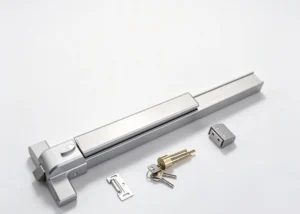
The code—typically the IBC—gets particular. It’s not just about having a door. It’s about how it opens. In a panic, people push. They don’t fumble for knobs. The hardware must release with a single, simple motion. One push. That’s the genesis of the panic device (or “exit device,” if you want the technical term).
Now, about that “UL-listed” part.
This isn’t a marketing sticker. It’s a forensic audit of failure points. Underwriters Laboratories (UL) doesn’t just check if the bar depresses. They bake it, freeze it, slam it, cycle it thousands of times. They test it on a fire-rated door assembly to see if it compromises the seal. The listing (UL 305 for panic hardware, UL 10C for fire door assemblies) is a warrant that the device won’t betray you when the heat is literally on.
Using an unlisted piece of hardware on an egress door is like installing decorative string where your building’s suspension cables should be. It might look fine until the moment it absolutely, catastrophically isn’t.
The Supplier Dilemma: Partners vs. Parts-Pushers
Here’s a grumpy truth: the cheapest bid is usually the most expensive choice.
Procuring life-safety hardware isn’t like ordering office supplies. The wrong choice doesn’t mean a subpar paperclip. It means a systemic failure with profound consequences.
A real supplier—a partner—doesn’t just ship you a box. They ask inconvenient questions.
What’s the door’s fire rating? Is it hollow metal or solid core? What’s the swing? Are we talking a rim device, or do you need a through-the-door vertical rod setup for a double egress? They speak the language of the code because they’ve sat across the table from the AHJ a hundred times.
The discount online retailer? They sell a “panic bar.” Full stop. No context. No liability. When the inspector asks for the product data sheet showing the UL listing for the specific model and configuration you installed, you’ll be left holding a PDF in a language you don’t understand—or worse, an empty hand.
I learned this the hard way early on. We “saved” 40% on hardware for a retrofit. The devices failed within 18 months under normal use. The service calls and replacement labor cost triple the initial “savings.” The fire marshal’s comment during the next audit? “I’m surprised these lasted this long.” Never again.
A Tangential War Story: The 95-Person “Conference”
A client once called me, frustrated. Their 50,000 sq. ft. warehouse had a “training room” – really a cleared corner with some folding chairs. They’d host quarterly all-hands meetings there for 95 employees. The primary exit was a pair of doors with standard levers.
“The fire marshal is saying we need panic hardware. For a warehouse. It’s ridiculous!”
I had to deliver the bad news. It wasn’t about the warehouse classification. It was about the occupant load of that specific room during those events. The IBC is brutally logical: 95 people in one room? That’s an Assembly occupancy scenario for that period. The egress doors serving that space must be equipped for a crowd’s panic response. Those lever handles were a code violation waiting to happen.
The fix was a hardware swap on those two doors. The lesson was permanent: codes don’t care about your primary business. They care about the use case. Always think in scenarios.
The Pragmatist’s Playbook: Navigating This Mess
You’re a manager, not a code scholar. Here’s your action plan, stripped of theoretical fluff.
First, diagnose the door. Pull the archived architectural drawings. Find the life-safety plan. Is the door in question marked with an “EXIT” symbol? If the plans are lost to time (a common scenario), a rule of thumb: if it’s a door to the outside from a space where people work, and it’s not clearly a secondary, non-required access point, treat it as an egress door.
Second, embrace the consultation. This is not a DIY moment. Hire a Door and Hardware Consultant (DHC) or a certified locksmith with commercial expertise. For a few hundred dollars, they’ll perform a life-safety survey. This document becomes your shield. It’s a professional assessment of what’s required. It translates code into a spec sheet.
Third, procure with specificity. Go to your supplier with the DHC’s report. You’re not asking for “a panic bar.” You’re requesting: “One, Von Duprin 33 rim exit device, UL Listed per UL 305 and UL 10C for 3-hour rated doors, finish 626 US32, with dogging.” The difference is everything.
Fourth, installation is not an afterthought. The best hardware, poorly installed, fails. Use the supplier’s recommended installer or a licensed contractor. They’ll ensure the door, frame, and hardware work as a cohesive system. They’ll adjust the spring pressure so the door closes reliably but doesn’t slam shut. These details matter.
This process isn’t linear. It’s iterative. It’s messy. It involves phone calls, waiting for quotes, clarifying details. But it’s the only process that ends with a signed inspection card, not a violation order.
Straight Answers to the Questions You’re Actually Asking
We only have 15 people in the whole building. Surely we’re exempt?
Maybe. But the code calculates “occupant load” by square footage and use, not just headcount. A wide-open warehouse space can have a surprisingly high calculated load. Don’t assume. Calculate. Or better yet, let the AHJ calculate it. Their number is the only one that counts.
Can’t we just put up an “Exit” sign and call it a day?
The sign tells you where to go. The hardware gets you through. They’re a team. One without the other is useless—and non-compliant.
What about magnetic locks tied to the fire alarm?
Access control integration is a whole other beast. Yes, you can use mag-locks on egress doors, but the release requirements are fiendishly complex (instantaneous upon fire alarm, plus a manual bypass like a push-to-exit button). This is deep consultancy territory. Tread carefully.
The price tag on this hardware is a shock. Why?
You’re not paying for metal. You’re paying for the ten thousand cycles of testing. For the forensic engineering that ensures the latch retracts every single time, even if the door frame warps in a fire. You’re paying for the liability insurance the manufacturer carries. It’s not a commodity. It’s a certified life-saving device.
Let’s be brutally honest for a second. The entire system—the codes, the listings, the inspections—exists because, historically, people cut corners. They used substandard locks on fire exits to save a few bucks. The results were tragic. The regulations are written in the legacy of those failures. Ignoring them isn’t savvy cost-cutting; it’s ignoring the very reason the rules exist.
The Final, Non-Negotiable Step
All this chatter, all this planning, hinges on one final authority.
Your local fire marshal. The Authority Having Jurisdiction (AHJ). The person with the clipboard and the power to red-tag your operation.
Their interpretation is the law in your building.
So here’s the move: don’t hide from them. Engage them. Before you finalize a purchase order for $20,000 worth of hardware, send the specs to the fire marshal’s office. Ask for a preliminary review. Frame it as, “We want to ensure we’re meeting your expectations for safety.”
This does two things. First, it gets you a definitive answer, eliminating guesswork. Second, it builds a relationship. It shows you’re proactive, not reactive. When the official inspection happens, they’re verifying a plan they’ve already tacitly approved, not discovering a potential violation.
Look, this isn’t a glamorous part of the job. It’s infrastructure. It’s compliance. But in the procurement world, the true cost of an item is never just its invoice price. It’s the total cost of ownership—including the cost of failure.
The failure mode for the wrong door hardware isn’t a missed shipment. It’s exponentially worse.
Your action isn’t to just buy a panic bar. It’s to initiate a due diligence process. Audit your egress doors. Get a professional survey. Source hardware from a specialist who treats compliance as a baseline, not a feature. And for heaven’s sake, loop in your local AHJ early. Their guidance is the final, and only, spec that matters.
Start this week. Pick one door—the one that gives you that nagging feeling. Make the call to a DHC. That’s how you move from worrying about compliance on a Friday afternoon to sleeping soundly on Sunday night.
It is recommended to consult the local Authority Having Jurisdiction (AHJ), such as the fire marshal or fire code official.