You’re wondering if you can cheat.
This isn’t about cheating. It’s about precision. And liability. Mostly liability.
The Supplier Isn’t a Vendor; They’re Your Translator (And Maybe Your Lifeline)
We’re tackling this first because getting this wrong sinks the ship before it leaves port. Do not—I repeat—do not source your hardware from a digital warehouse that also sells yoga mats and Bluetooth speakers.
A proper supplier is a conduit between your reality and the labyrinth of IBC, NFPA 101, and UL 305. They ask the questions you haven’t thought of: “What’s the occupant load for this egress path?” “Is this wall part of a smoke barrier?” “Is that corridor rated?” A box-mover just asks for your credit card number.
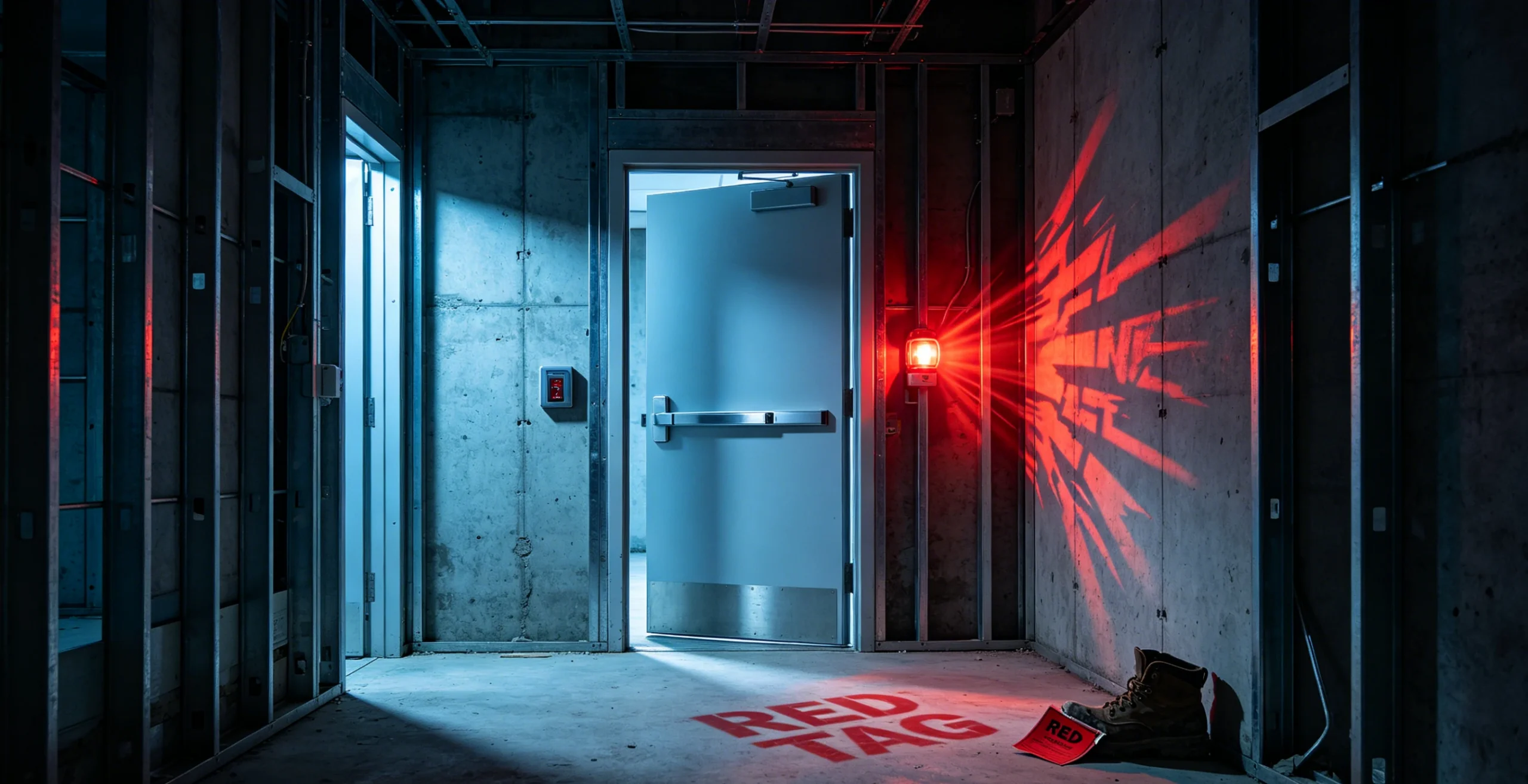
The good ones will sometimes tell you no. They’ll say, “For this application, you need a rated assembly. Here’s why.” That refusal is worth its weight in gold. It’s the difference between a clean inspection and a costly, embarrassing retrofit when the AHJ (Authority Having Jurisdiction) does their walk-through with a disapproving glare and a red tag.
You need the paperwork. The UL listing. The installation templates. The warranty that doesn’t vanish post-sale. This is not a corner to cut.
The “Where”: It’s Not About the Door. It’s About the Wall.
This is the core misunderstanding. The device doesn’t exist in a vacuum. Its eligibility is dictated by the wall it’s mounted in.
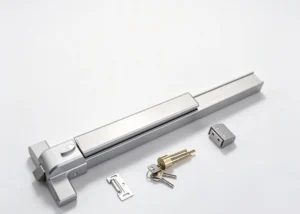
A non-rated exit device is simply a mechanical egress tool. Its job is to unlock a latch when a body presses against it. That’s it. It has not been tested and certified as part of an assembly designed to compartmentalize flame and smoke for 20, 60, or 90 minutes.
Therefore, its use is a process of elimination. You start with the building’s fire separation plan and work backwards.
Permissible Zones (Proceed with Caution)
- The Truly Non-Rated Partition: This is the sweet spot. A wall between two offices, a closet door, a partition separating a conference room from a hallway that is not itself a rated corridor. The wall is just a spatial divider, not a fire barrier. The door is merely a privacy panel. Here, a non-rated device is perfectly legal and often economically sensible.
- Interior Non-Rated Cross-Corridor Doors: Sometimes, within a tenant space, you’ll find doors across a corridor that aren’t for fire separation but for acoustics, HVAC zoning, or security. If the wall isn’t rated, the door in it isn’t a fire door.
- Certain Secondary Exterior Doors: A door from a non-habitable storage room directly to the outside, located in a non-rated exterior wall. It’s an egress point, but not part of the primary rated building envelope. The key, again, is the wall assembly.
- Non-Separated Use Areas: Think open-plan retail, warehouse sections, or large workshop areas. Interior divisions might be simple stud-and-drywall for zone definition only.
See the pattern? It’s forensic.
The Absolute “No-Fly” Zones (This is Where Dreams Go to Die)
Get this wrong, and you’ve created a lethal deficiency.
- Any Fire-Rated Door Assembly: This is non-negotiable. If the door is listed as a 20-minute, 45-minute, 60-minute, or 90-minute fire door, every component on it—hinges, latch, exit device—must be part of that tested assembly. Swapping in a non-rated panic bar voids the entire listing. It’s a cardinal sin.
- Stairwell Enclosure Doors: The end. Full stop. These are sacred fire and smoke barriers. The hardware is life-critical.
- Corridor Doors in Rated Corridors: Apartments, hotels, hospitals, offices—if the corridor itself is a rated fire separation (and most are, for occupant escape), every door off that corridor is part of that barrier.
- Doors in Exit Access Pathways: The path you take to get to an exit. It’s usually protected.
- Doors to Hazardous Areas: Boiler rooms, generator rooms, bulk storage. These require separation.
- Main Exit Doors: Unless specifically evaluated otherwise by the design professional and AHJ, assume they are part of a rated assembly.
If you’re squinting at plans and feel a hint of uncertainty, you’re already in the danger zone.
The Grumpy FAQ (Because Real Questions Aren’t Clean)
Q: They look identical. How can I tell?
A: Look for the label. A fire-rated device will have a tiny, permanently attached UL or WH label listing its fire door compatibility (e.g., “3 Hour,” “90 Min.”). The non-rated one won’t. Check the spec sheet. No label, no rating. It’s that simple.
Q: My contractor/G.C./uncle says it’s fine for this interior door.
A. Are they sealing their opinion with their professional license and liability insurance? Get it in writing, with a reference to the specific code section (IBC Chapter 7, likely) that permits it. If they balk, you have your answer.
Q: Can’t I just upgrade it later if I’m wrong?
A. No. You replace it. The entire door assembly—door, frame, hardware, seals—is tested and certified as a unit. You can’t “upgrade” a component post-installation and claim the rating. You start over.
Q: What about cost? The savings are real, right?
A. Sure, on the unit cost. Now calculate the cost of: 1) Failing final inspection. 2) Demolishing and reinstalling the wrong hardware. 3) The project delay. 4) The potential liability if that deficiency contributes to fire spread. The hardware cost becomes a rounding error.
The Pragmatist’s Bottom Line
Using a non-rated exit device isn’t a hack. It’s a specific, code-compliant application for specific, non-rated locations. The temptation is to see a lower price and justify the fit. The professional approach is to start with the building’s fire protection schematic and justify the exception.
This isn’t about finding loopholes. It’s about understanding the map well enough to see where the bridges are already built. When in doubt—and doubt is your friend here—the path is clear.
It is recommended to consult the local Authority Having Jurisdiction (AHJ), such as the fire marshal or fire code official. Not as a last resort. As your first call. Their interpretation is the only one that matters. Bring your drawings, your product data, and your logic. A five-minute conversation can save fifty thousand dollars in rework. And maybe more.