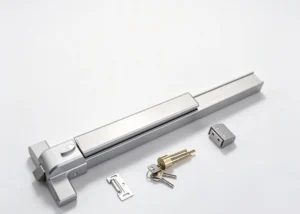
Antimicrobial Exit Hardware: Audit Bait or Infection Control Asset?
Let’s be brutally honest. You’re staring at a spec sheet demanding “antimicrobial-coated exit devices,” your budget is screaming, and The Joint Commission’s shadow looms over next quarter. You’re being sold a silver-bullet solution. Here’s the unvarnished truth.
Part 1: The Science vs. The Sales Pitch
First, terminology. We’re not talking magic. Most coatings use silver ions or copper alloys, leveraging the “oligodynamic effect”—a fancy term meaning heavy metals disrupt bacterial cells. It’s suppressive, not disinfectant. It aims to inhibit microbial growth between cleanings, not vaporize pathogens on contact. The promise: if a contaminated hand touches the bar at 2 PM, the bacterial party is suppressed by 4 PM. That’s the theory. The reality is messier.
Part 2: The Audit Circus – What Are They Really Measuring?
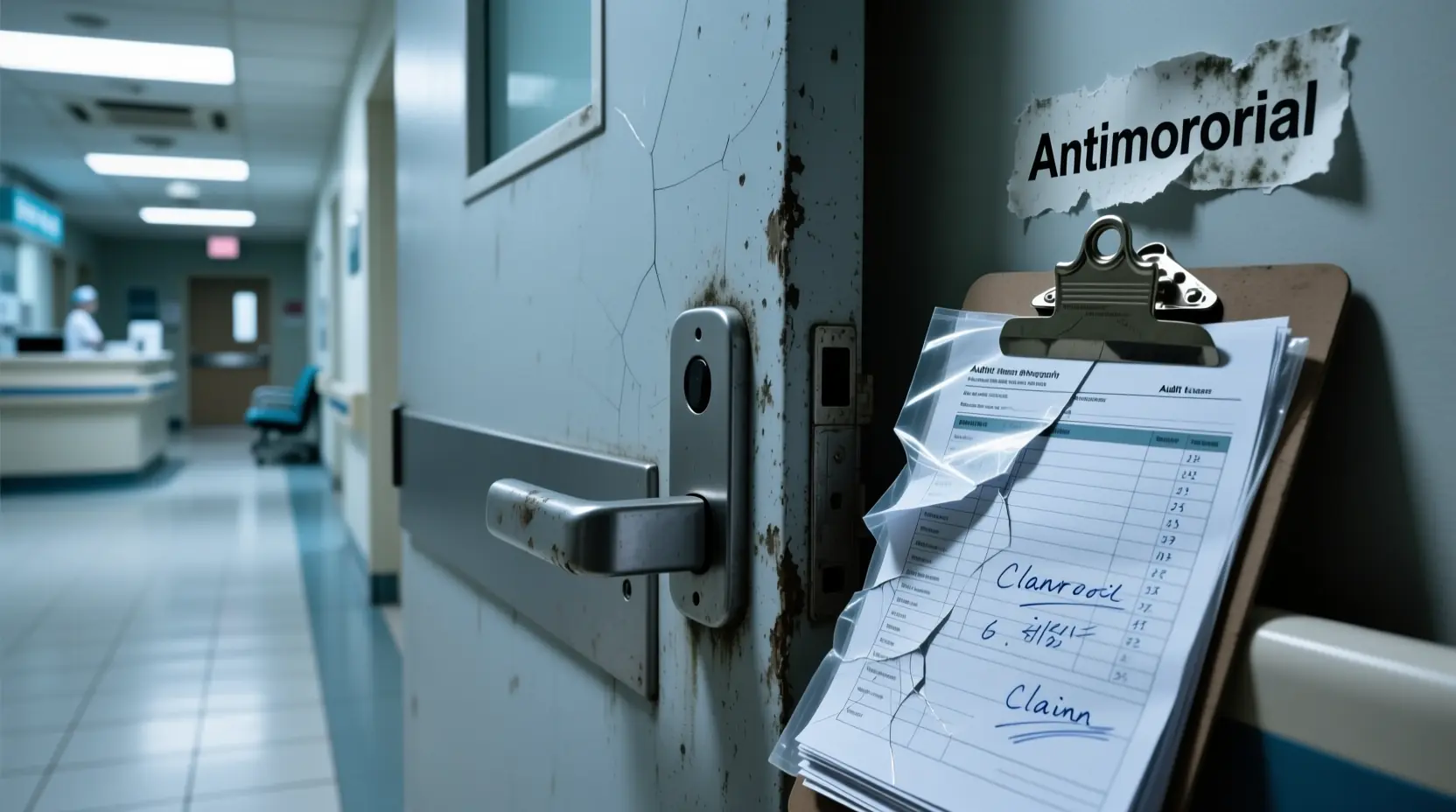
When an auditor walks in, they operate on checklists and snapshots. Their focus? Environmental hygiene and your cleaning protocol. They want to see the log: How often is that bar wiped down? With what? By whom? They might swab for ATP (adenosine triphosphate) to measure organic residue. A high reading is a fail, coating or not. Does the coating help? It can serve as a documented complementary measure in your Infection Control Risk Assessment (ICRA). It looks proactive on paper. A less-informed auditor might see the spec and tick a box. But if your ATP swab lights up due to poor cleaning, that coating is a costly facade. You will get a citation.
Part 3: The Grumpy Caveats & Why I’m Skeptical
Here’s where my patience for marketing dissolves.
- The “Touch Time” Fallacy: The coating is on the bar. Is it on the adjacent wall, door frame, or other hardware people grab? No. You’ve created a tiny, expensive fortress in a sea of uncoated surfaces.
- Biofilm: The Party Crasher: Coatings are tested against lab bacteria. Reality grows biofilm—a microbial fortress of dirt, skin cells, and grime. Against biofilm, your suppression effect is laughable. Only mechanical cleaning breaks it.
- Wear and Tear – The Great Unveiling: It’s a finish on a device designed to be slammed and cleaned aggressively. It wears off, starting at the highest-touch point. You may be paying a premium for a feature with a limited lifespan.
- The “Set It and Forget It” Poison: The most dangerous assumption. This coating is NOT A SUBSTITUTE FOR CLEANING. Treating it as one is a catastrophic, citation-worthy error.
Part 4: When It *Might* Make Sense (The Narrow Niche)
I’m not a complete nihilist. Consider it only in these contexts:
- As part of a documented, holistic strategy in a critical area (e.g., ICU entrance), alongside stellar, audited cleaning protocols.
- For specific, high-touch, intricate hardware that’s notoriously difficult to clean effectively.
- When using specific copper alloys with compelling, peer-reviewed data against pathogens like MRSA in clinical settings. This is a serious materials science discussion, not a marketing bullet point.
Part 5: The Procurement Verdict
Will it help you pass an audit?
Paper/Visual Audit: Maybe. It shows “consideration.”
Operational/Process Audit: No. They care about logs and results.
Outcome Audit (HAIs): Almost certainly no. Its impact is lost in the noise of hand hygiene, terminal cleaning, and sterilization protocols.
Your capital is almost always better spent on:
• Reinforcing and auditing Environmental Services protocols.
• Better training for cleaning staff.
• More accessible disinfectant stations.
• Simpler, smoother hardware designs that are easier to clean properly.
Part 6: The Final, Grumpy Summary
Antimicrobial coatings are a marketing-first, science-adjacent feature. They are not magic. They do not absolve you of fundamental hygiene responsibilities. They can, in very specific, well-managed scenarios, provide a minor supplementary benefit. But if a sales rep tells you it’s a game-changer for passing audits, show them the door. Preferably one with a standard, easy-to-clean bar that your staff knows how to maintain.
⚠️ AHJ WARNING (PAY ATTENTION): Everything here is general guidance. Your local Authority Having Jurisdiction (AHJ)—The Joint Commission, DNV, health department—has the final, absolute say. Their inspector’s interpretation on audit day is your law. Some may credit the coating as innovative; others may see it as a distraction. Consult your facility’s code experts and get precedent from your specific AHJ before any purchase. And never install anything not listed and tested for its primary purpose (e.g., fire life safety). Do your own homework.