Look. I can smell the confusion from here. It reeks of stale coffee and sales brochures. You’ve been pitched “Tactical Exit Signs” by someone whose last brush with a fire code was a marshmallow roast. Meanwhile, your facilities manager is confidently tapping a dimly lit panic bar, declaring the problem solved. Let’s inject some harsh, caffeinated clarity into this fog of misinformation before you waste a fortune and fail an inspection. This isn’t about aesthetics; it’s about not having your building featured in a “what went wrong” case study.
The Code’s Cold, Hard Logic (Spoiler: It’s Not About Looking Cool)
First, shelve the glossy catalogues. The real story is in the dry, unforgiving text of the IBC and NFPA 101. The translation from bureaucrat-ese to English is simple: smoke rises. Your beautiful, ceiling-mounted EXIT sign becomes a ghost in the machine when the air turns thick. People crawl. The old logic failed. So, the codes now demand a clear, unambiguous path out at floor level for certain large, non-residential buildings. It’s a rare moment of sense from the rule-making labyrinth.
“Tactical Exit Signs”: The Overhyped, Overpriced Wall-Huggers
This is where marketing departments have done their finest work of obfuscation. A “Tactical Exit Sign” is not a mood light. It is a wayfinding system. Its sole purpose is to act as a runway guide for a disoriented person crawling through pea-soup darkness. Installed no more than 18 inches above the deck, they must form a continuous, directional breadcrumb trail—along corridors, around corners, to the door. They have arrows. They have specific luminance rules. They can be photoluminescent (glow-in-the-dark) or powered.
The Grumpy Procurement Reality: These are a capital project, not a consumable. You need them on both sides of a corridor. They must survive janitorial mops and forklift drivers with a grudge. Choose photoluminescent? Hope your maintenance team never “upgrades” to lower-lumen LEDs that fail to charge the strips, rendering them as effective as a screen door on a submarine when the lights go out. This is a system, not a sticker.
Panic Bar Lighting: The Final Destination, Not the Journey
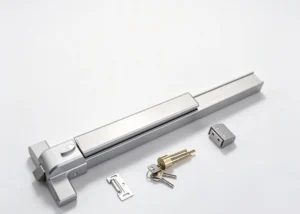
Now, shift focus to the door itself. The lit panic bar (or touchpad) has a different, singular job: to scream the location of the door release hardware. You follow the wall-mounted trail, you find a door. Where in this smoky haze is the bar? The illuminated “PUSH TO OPEN” is your target. Code demands it on the egress side, with a minimum brightness (aim for “obvious,” not “minimum”).
The Classic, Idiotic Conflation: This is the heart of the failure. So many procurement souls see the glowing panic bar and think, “Ah, our low-level egress is handled.” It is not. It is the finish line. If you have a lit bar at a door but no compliant path marking leading to it through a 150-foot labyrinthine corridor, you have built a cliffhanger with no third act. You have failed.
The Venn Diagram of Procurement Disasters
Let’s catalogue the common, expensive blunders. See yourself here?
- Disaster 1: The “Tape is Tactical” Fallacy. “We stuck photoluminescent tape on the baseboards.” Lovely. Unless it’s part of a listed, code-compliant system with certified spacing and luminance, it’s decoration. The AHJ will treat your submission with the derision it deserves.
- Disaster 2: The “Projection Illusion.” “Our ceiling signs have battery backups that project onto the floor.” Neat party trick. Does it provide a continuous, directional path? No. Is it blocked by a trash can or a prone body? Yes. It’s a supplement, not a solution.
- Disaster 3: The “Futuristic” Misstep. “We installed sexy LED strips along the floor.” Are they listed for this specific application? Correct color? Or do they create glare for someone at floor level? Is the wiring to code? This is where “visionary” meets “violation” and gets a stop-work order.
- Disaster 4: The “Door-Only” Delusion. I know I said it, but it bears screaming: A LIT PANIC BAR IS NOT A LOW-LEVEL EGRESS PATH. It is the door’s name tag. The path is the hallway’s guiding hand.
A Grumpy, Non-Nonsense Procurement Checklist
- RTFC. (Read The Flipping Code). Is this even required for your building type and occupancy? Often, it’s triggered by new construction or major renovation. Don’t buy a solution for a problem you might not legally have.
- Path. Then Door. Design the continuous low-level path from all remote areas to the exit doorway. Then specify the illuminated door hardware. In that order. Always.
- Listed. Not “Looks Good.” Your vendor’s word is worthless. Demand products listed to UL 1994 or equivalent for “low-level exit path marking.” This is your armor against liability and AHJ rejection.
- Choose Your Poison: Photoluminescent vs. Powered. Photoluminescent? Your maintenance plan is now married to ensuring adequate ambient light charges it. Powered? It must be on an emergency circuit. Factor the lifetime cost of ownership, not just the unit price.
- Coordinate, You Muppets. This isn’t an electrical silo. It impacts architecture (wall space), interiors (finishes), and flooring. If the millwork guy installs a full-height cabinet where the wall sign needs to go, you have a very expensive problem. Early trade coordination is non-optional.
THE AHJ WARNING: THE ONLY OPINION THAT ACTUALLY MATTERS
Listen closely. All my grumpy wisdom is just advice. The deity you must appease is the Authority Having Jurisdiction (AHJ). Your local fire marshal. The building official. Their word is gospel. They can stroll in, glance at your six-figure, technically-code-compliant-on-paper installation, and utter the most expensive phrase in construction: “Nope. Doesn’t meet the intent. Fail.”
They are the final, grumpier, less-negotiable version of me. Their interpretation is the code. What flies in one county may be rejected in the next.
THE SINGLE MOST IMPORTANT PROCUREMENT STEP: Engage the AHJ before you finalize specs. Before you issue POs. Show them your product submittals. Get their informal nod. This is not red tape; this is risk mitigation. Ignoring this is professional malpractice. You will be left holding a very large bag of very expensive, non-compliant components.
So, to distill this chaotic rant: The path and the door are different beasts. Your panic bar light is a destination billboard, not a road. Your ceiling sign’s cute projector is a flashlight, not a guidance system. Specify correctly, demand listed products, and for the love of all that is sane, talk to the AHJ first. Now go away. My coffee is cold.