Alright. Stop the procurement software demo. Mute the vendor on speakerphone. We’re talking about something that actually matters: your vertical rods are stuck. They’re jammed, they’re dangling, they’re sitting there like expensive, useless sticks. And now it’s holding up a project, a shipment, or an inspection, and the phone is ringing. My phone. Because you need someone to state the grumpy, obvious truth.
You’ve pulled the disconnect chain. You’ve heard the clunk. Yet, the rods defy gravity and logic, refusing to retract. Before you authorize a PO for a whole new door assembly—calm down, we’re not there yet—let’s diagnose why your mechanical linkage has decided to go on strike. This isn’t rocket science. It’s usually a cascade of neglect, poor maintenance, and someone’s previous “good enough” fix coming home to roost.
The Idiot Checks (We All Miss Them When We’re in a Panic)
Before we dissect the linkage, let’s run the basic diagnostics. The ones you skip because a foreman is yelling. Is the door actually fully disconnected? That ‘clunk’ you heard might be the release mechanism hitting its travel stop, not the clutch dogs disengaging. Manually try to lift the door leaf an inch. If it’s still latched at the top or sides, the rods won’t move. That’s not a failure; that’s user error. Next, inspect the rods themselves. Are they bent? Not a gentle curve, but a proper kink from a forklift’s affectionate nudge? A bent rod binds in guides and floor sockets. Speaking of which, are the floor sockets packed with the concrete slurry, dirt, and fossilized chewing gum of the last decade? The rod descends into that muck and seizes. It’s a simple, stupid problem.
Ground Zero: The Linkage Arm & Its Catalogue of Failures
The linkage arm is the metal bar connecting the cross rod to the vertical rod lift lever. It’s a simple component, which means it fails in beautifully simple, predictable ways. Your maintenance team’s ‘fixes’ often make it worse.
1. The Wallowed-Out Pivot Hole (A Study in Incremental Failure)
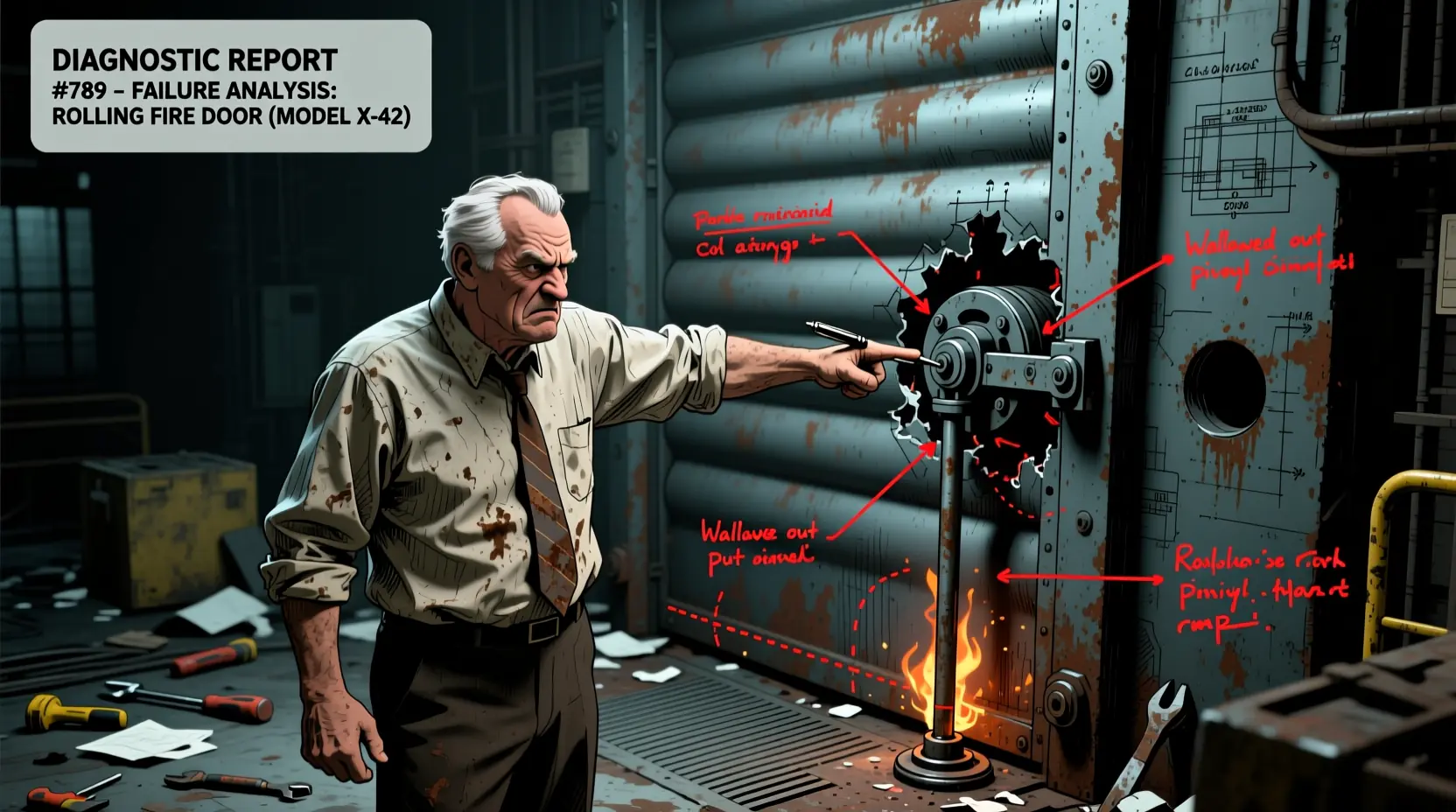
The linkage arm connects via a clevis pin or bolt. That hole wears. It becomes oval. Egg-shaped. Every door cycle adds microscopic slop. For years, it ‘works’. Then, one day, the slop is so profound the arm can’t pull the lever through its full arc. It just flops around in the enlarged hole. You get partial retraction, or none. Look for shiny wear marks. If you can see an elongated shadow around the pin, it’s toast. This is a procurement problem: was the specified pin material hard enough? Was maintenance even on the radar?
2. The Seized Pivot (The Paint-Over-It-All Strategy)
That same clevis pin is supposed to pivot. In reality, it gets rust-welded, painted over during every annual inspection, or some genius cranked the nut down with an impact wrench until it might as well be a weld. A joint that doesn’t pivot is a solid beam. Force is applied, something binds, motion stops. You’ll feel the resistance. A functional linkage should move with modest finger pressure. If you need a cheater bar, you’ve found your culprit. This is a failure of process and specs.
3. The Bent Linkage Arm (The Brute Force ‘Repair’)
A classic. A stuck door meets a determined individual with a pipe wrench. They pry. They heave. The mild steel arm yields and bends. Now the geometry is all wrong. A bent member tries to do a straight-line pull, binding against the door panel or hood. It might work intermittently, then jam solid. This is why we can’t have nice things. Or functional fire doors.
The Lift Lever: Where Motion Goes to Die
This L-shaped or triangular piece is directly attached to the vertical rod. It’s a superstar of failure.
- The Sheared Pivot Pin: The lever pivots on a pin mounted to a bracket. That pin takes pure shear force. Increase the force (bent rod, dirty socket) and it shears. Clean. Clinical. Now your linkage arm moves beautifully, but it’s waving at a disconnected lever. The rod wins.
- The Migrating Bracket: The bracket holding the lever works loose. Screws unwind. Welds fatigue. The entire assembly shifts. The linkage pulls, but the lever binds in an unnatural arc. This is often accompanied by a sound like a dying animal.
- The Cracked Lever: Common in older, cast components. A hairline crack forms at the stress point. It propagates with each cycle. Then, it separates. You’re left with two pieces of lever and a profound sense of disappointment.
Upstream Catastrophes: Don’t Forget the Cross Rod
The problem might start before the linkage. The cross rod is the horizontal rod connected to the clutch. If it doesn’t turn, nothing downstream happens.
- The Seized Carrier Bearing/Bushing: The cross rod is supported by bearings or bushings. They dry out, fill with paint, seize. The chain pull feels impossibly heavy because all the force is spent fighting friction just to turn the cross rod. Nothing is left for the linkages. You hear a groan, but no rod movement.
- The Slipping Disconnect Sleeve: Inside the clutch mechanism, worn dogs or springs mean the chain pull only partially engages the cross rod. You get a few degrees of rotation—enough to tease you—but not full retraction. It feels mushy and is often misdiagnosed.
The Domino Effect & The Procurement Nightmare
This is where my job gets annoying. Failures are never isolated. They cascade. A slightly bent rod increases force on the lift lever pin. The pin wears, creating slop. The slop lets the rod twist, binding it further. The binding force bends the linkage arm. Someone ‘fixes’ it by tightening every nut to oblivion, freezing the pivots.
Now you have a perfect storm. You, the procurement manager, get a frantic request for “one linkage arm, ASAP.” You secure it. Maintenance installs it. The new, stiff arm transmits full force to the already-weakened lift lever pin… which shears immediately. You’re back to square one, minus budget and time, and now you need a lift lever kit and a pivot pin. This is the cost of reactive, siloed maintenance. You’re buying parts, not solving systemic problems.
The Grumpy Path Forward: A Systemic Diagnosis
Stop looking for the single broken part. Diagnose the entire system of motion, from the chain to the floor socket.
- Start at the End: Physically inspect the vertical rods and floor sockets. Clear obstructions. Rule out the simple stupidity.
- Work Backwards: Can you move the lift lever by hand? No? Rod/socket issue. Yes? Does the linkage arm move it smoothly? No? Pivot or arm issue.
- Go Upstream: Does the linkage arm move freely when you manually turn the cross rod at the clutch? No? Linkage pivot issue. Does the cross rod turn freely at all? No? Bearing/bushing issue.
- Forensic Inspection: Look for the story: shiny wear marks (friction), paint over moving parts (idiocy), cracks (fatigue), and hammer marks (desperation).
AHJ WARNING: This is the only non-snarky part. Pay attention. Any modification, repair, or replacement of fire door components—including linkage, rods, latches—impacts the door’s listed rating and NFPA 80 compliance. This guide is for diagnostic purposes only. Actual repairs MUST be done by qualified personnel using listed, compatible parts. Final operation MUST be verified and certified per manufacturer instructions and local Authority Having Jurisdiction (AHJ) requirements. Using non-listed parts or improvisation isn’t clever; it’s a liability. When the AHJ writes the violation, your budget and my grumpy advice won’t save you.