Fire Door Latch Failure: The Grumpy Procurement Manager’s Guide
Let’s get one thing straight. You’re not reading this for a soothing chat about ‘best practices.’ You’re here because a fire door on your watch won’t stay latched. It’s a scandal. It’s a failure of procurement, of installation, of maintenance—and now it’s your problem. That click-*bang* of a door pretending to close is the sound of your liability meter ticking up. This isn’t a minor annoyance; it’s the complete and utter negation of the door’s sole, sacred purpose. And in 90% of cases, the villain is the same: pathetic, insufficient, non-existent latch engagement.
I don’t do corporate fluff. I manage the messy reality where capital expenditures meet the boot of a frustrated maintenance tech. The polished sales rep promised a ‘complete, code-compliant assembly,’ but here you are, reading about latch bolts because the real world doesn’t give a damn about brochures. This is the grimy, unvarnished truth about the most critical piece of hardware you never wanted to think about.
The Core Truth: A Click is Not a Latch
Forget everything you think you know. The ‘if it clicks, it’s fine’ mantra is for bedroom doors and cheap cabinets. For a fire door assembly, a click is just acoustics. Engagement is physics. That latchbolt must travel its full throw and seat deeply, securely, and without assistance into the strike plate hole. Anything less is a compromise. And in fire and life safety, compromise is just a prettier word for failure. This component’s job is to compartmentalize, to resist, to maintain integrity for 20, 60, 90 minutes under hellish conditions. An unlatched door is an open door. It might as well not be there.
The Gallery of Rogues: Who Broke Your Door?
Before we fix it, let’s assign blame. It’s therapeutic.
- The Carpet Contractor: The undisputed champion of destruction. New carpet = door drags. Their solution? A quick trim of the bottom of a fire-rated door. They’ve just voided the label, wrecked the bottom seal, and altered the door’s geometry so the latch can’t possibly align. Bravo.
- The HVAC ‘Optimizer’: Needed more airflow, created a wind tunnel. Now 300 Pascals of pressure are bullying a latch spring designed for 50. The door just blows open. This is a system balancing issue disguised as a hardware failure.
- The Building Itself (The Silent Saboteur): Settling, shifting, leaning. That perfectly plumb 1992 frame is now a trapezoid. The door is bound, hinges are stressed, and the strike plate is in a different time zone relative to the latch.
- The Original Installer (The ‘It’s Just a Door’ Guy): Used drywall screws for the strike plate instead of the provided 3-inch frame screws. Didn’t mortise hinges correctly. This is a foundational sin you’ve inherited.
- Time and Neglect (The Inevitable Duo): Decades of slamming. The latchbolt is polished to a slick nub. The strike hole is eroded. The spring has the vigor of a dead slug. Wear is a fact, but ignoring it is a choice.
The Diagnostic: Looking at the Thing (Novel Concept)
Skip the expensive ‘diagnostics toolkit.’ Use your eyes and a brain that’s actually connected.
- Flush Fit? Does the door sit evenly in the frame when nearly closed? A big gap at the top and tight at the bottom screams hinge misalignment.
- The Slow Close: Watch the latchbolt approach the strike. Does it hit the top of the plate and deflect down (high latch)? The bottom (low latch)? Or slide right past the hole (lateral misalignment)?
- The Thumbprint Test (Low-Tech Genius): Smear a bit of grease or dirt on the latchbolt face. Close the door. Open it. The mark on the strike plate is a map of the problem.
- Bind Check: Does the door swing freely through its entire arc, or does it get tight near the latch side? Binding equals friction, and friction defeats latching.
The Fixes: Where Theory Meets a Hammer
CRITICAL PRE-AMBLE: Fire door hardware is often listed as part of a specific assembly. Arbitrarily swapping a Schlage strike for a generic Home Depot special likely voids the listing and your liability coverage. Your goal is to adjust the original, listed hardware first. Document every step. Now, to the chaos.
1. Strike Plate Adjustment (The Primary Lever)
This is your first and best hope. The strike plate is the steering wheel for the latchbolt.
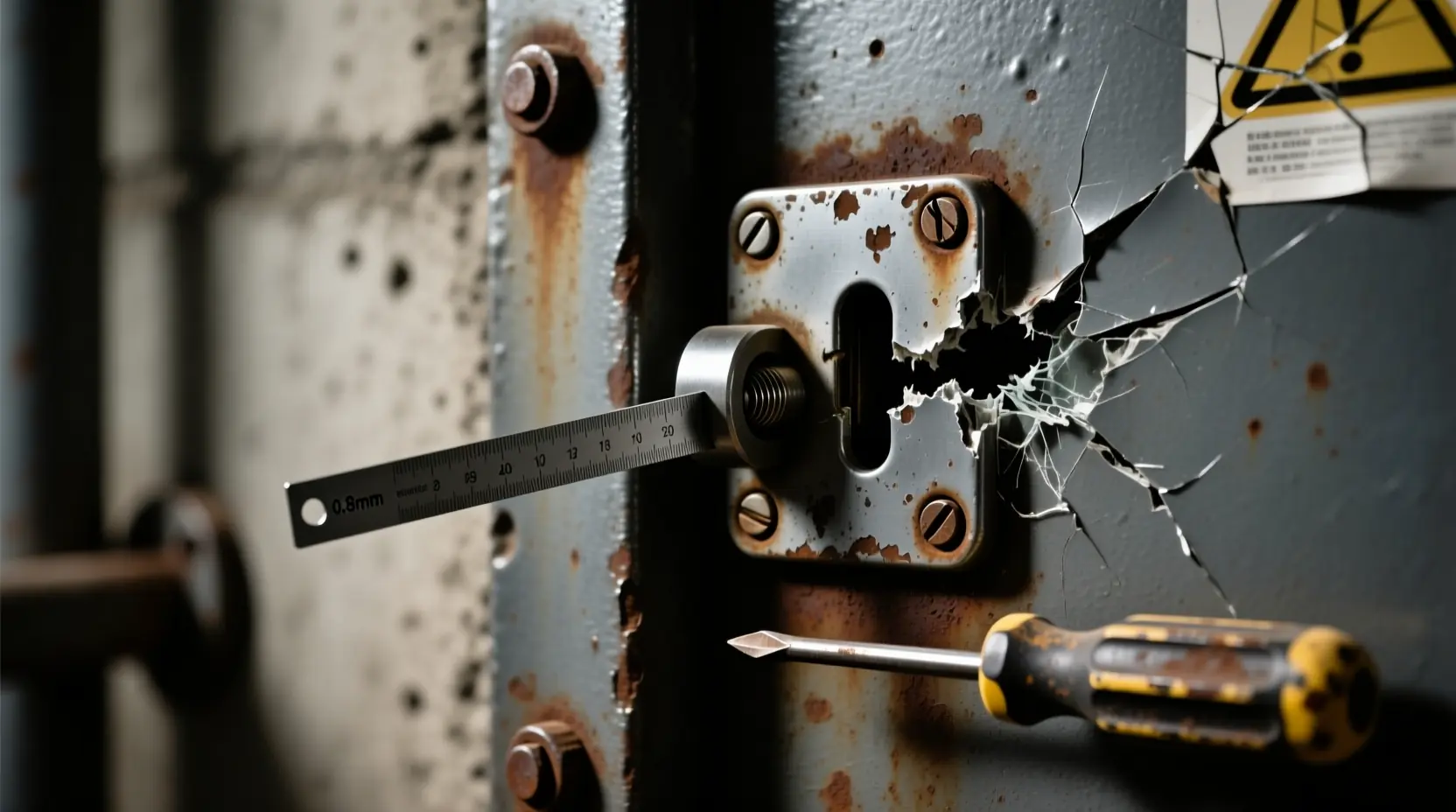
- High/Low Latch: Loosen the screws. You’ll likely need to elongate the screw holes in the frame with a round file to shift the plate up or down. Sometimes a washer shim behind the plate works. The Golden Rule: After moving, you must achieve minimum engagement. This is typically 3/16 of an inch as a bare-bones code minimum, but manufacturer listings often demand 1/4 inch or more. Get a ruler. Measure. Guessing is for amateurs.
- Lateral Misalignment: The bolt hits the side of the plate. Sometimes you can gently persuade the plate with a hammer and punch. More often, you need to carefully deepen or widen the mortise in the frame with a sharp chisel to let the plate move in or out.
- The Hogged-Out Hole: The strike hole is a crater. Source an identical, deeper replacement strike from the original hardware manufacturer. If you’re filling old holes and re-drilling, you’d better be a cabinetmaker.
2. Hinge Adjustment (The Foundation Work)
If the strike plate has no more room to move, the door itself is misaligned. This is back-end work.
- Loose Screws: Obvious, yet endemic. Tighten them. Ensure the top hinge at least uses the long screws that bite into the door frame structure, not just the jamb.
- Shimming: Door surgery. To raise the latch side, you lower the door by shimming behind the bottom hinge on the frame side. To move the latch in or out, you shim behind the hinges on the door leaf. This is iterative, millimeter-precision work. A 1mm shim can change everything.
3. The Latchbolt Itself
Is it worn to a smooth ramp? Does it spring out feebly? Replacement might be necessary, but it MUST be a listed, compatible component. Swapping a latch often means precision drilling into the door edge—a high-stakes operation.
4. The Nuclear Option
Sometimes, the building shift or initial install is so catastrophic that the frame itself is torqued. Now you’re talking about reframing—a core-drilling, dust-creating, budget-obliterating project. This is where my department gets angry emails.
The Non-Negotiable Final Test: The Credit Card of Truth
After any adjustment—any adjustment—you must perform the latching and relatching test. Close the door. Does it latch smoothly without force? Good. Now, take a credit card or a thin feeler gauge. Try to bypass the latch. Slide it between the strike plate and the beveled face of the latchbolt. If you can depress the latch and swing the door open, your engagement is trash. That door is not positively latched. Under fire conditions, pressure or a hose stream could do the same. It is defective. Full stop.
AHJ WARNING: Where Snark Meets the Law
Enough with the grumpy trades talk. Time for the serious bit. In the eyes of the Authority Having Jurisdiction (AHJ)—your Fire Marshal, Building Official, or Insurance Inspector—a fire door that does not latch positively is DEFECTIVE. It is a violation of NFPA 80, NFPA 101, the IBC, and every model code worth the paper it’s printed on.
If I, or anyone under my purview, adjust a fire door latch, we are performing a life safety alteration. We must ensure it meets code, uses listed components, and is documented. When the AHJ does their inspection and that door fails the credit card test, they write it up. They can compel immediate repair. They can restrict occupancy. And in the tragic event of a fire where that door failed, lawyers will dissect every decision, every purchase order, every maintenance ticket to establish liability.
So this isn’t about finding a quick fix. It’s about owning the integrity of the assembly from procurement through its entire service life. Do it right. Measure it. Test it. Document it. The chaos of the fix must end in perfect, verifiable order. Now, if you’ll excuse me, I have a pile of ‘value-engineered’ door submittals to reject.