The Procurement Manager’s Scream: Your ‘Emergency’ Kit is Already Late
Let’s not pretend. You’re here because a pipe is leaking, a pump is screeching its last rites, or a tenant’s email thread is developing its own gravitational pull. You’re in reaction mode, Googling for a miracle. Congratulations, you’ve found a list. But let’s reframe this: you haven’t found a solution. You’ve discovered a symptom of your own poor planning. This isn’t an “emergency kit.” That sounds too prepared, too heroic. This is a “Postpone-Doom Kit.” Its sole purpose is to keep the building from actively rejecting its occupants until proper help arrives.
I’ve managed procurement for facilities that would give a sane person night terrors. The difference between a manager who looks tired and one who looks haunted isn’t genius. It’s a dented, unlabeled toolbox in a forgotten closet. It’s the acceptance that certain things will fail, always at the worst time, and their replacements must be within arm’s reach, not a 4-hour minimum call-out away.
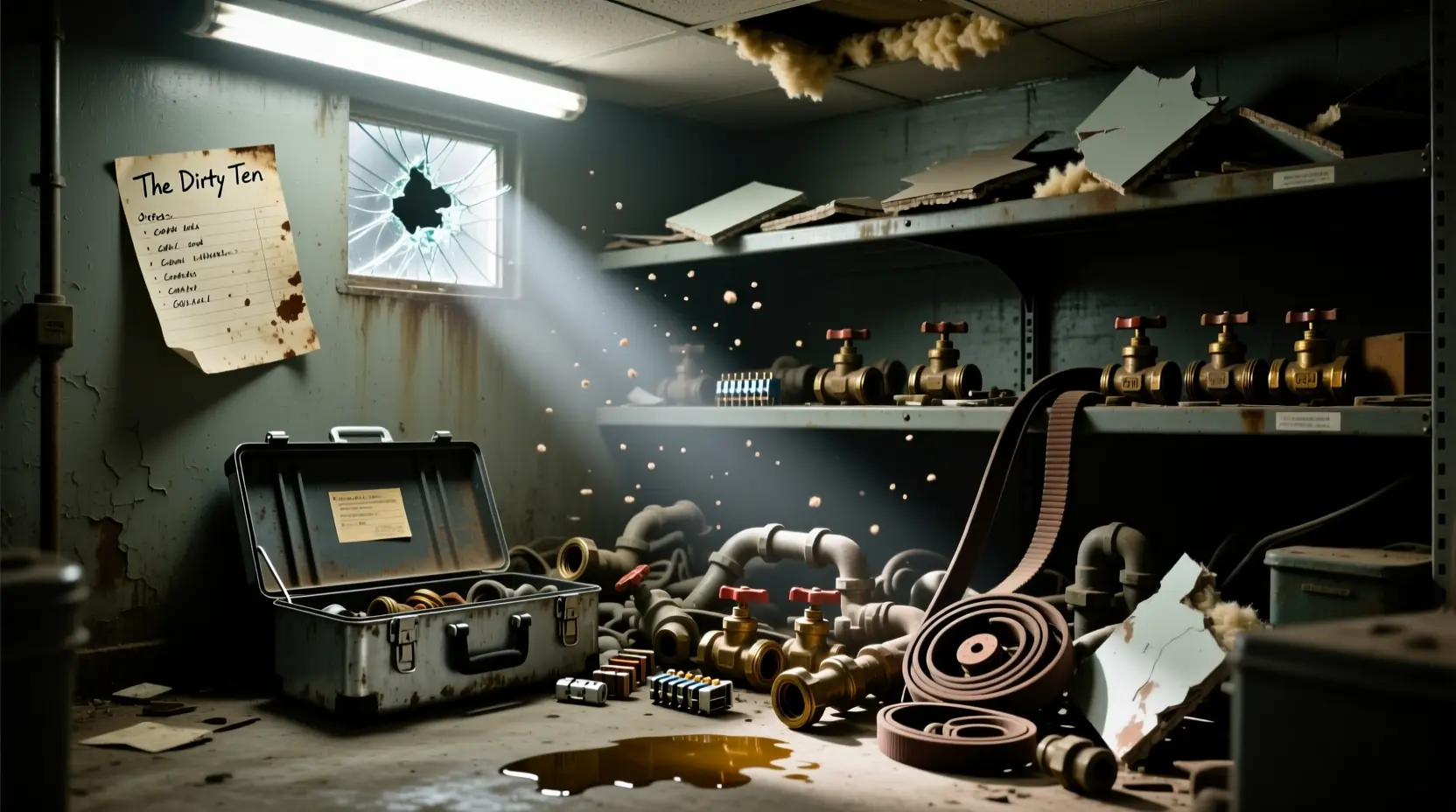
We’re not talking about OEM superhero parts. We’re talking about the humble, stupid, ubiquitous weak links. The ones whose failure halts revenue, creates liability, and makes your phone a torture device. Stock these ten items. Not “soon.” Now. Ideally, you should have done it last quarter.
The Non-Negotiable Dirty Ten
1. The Universal 3-Inch Toilet Flapper & Seat
The undisputed champion of silent water waste and urgent tenant complaints. A ghost-flushing toilet in a common-area bathroom isn’t a nuisance; it’s a meter spinning towards a budgetary crime scene. A $5 rubber flapper and its matching flush valve seat (because the seat gets gouged, don’t be cheap) can solve this in five minutes with a plunger and a curse. Buy half a dozen. They petrify on the shelf. Rotate them like the grim, uncelebrated inventory they are.
2. 1/2-Inch & 3/4-Inch Supply Line Stop Valves (Angle & Straight)
These little sentries under sinks and behind toilets are made of disappointment and zinc. They crack. They seize shut. They weep from the stem out of sheer spite. When one fails, you need to isolate that fixture immediately. Having the correct cheap, chrome-plated brass valve on hand means a 10-minute swap with two wrenches. Not having it means shutting down water to an entire wing, which is just a democratic way of spreading the anger.
3. Circulation Pump Couplings
Your pumps are fine. Mostly. The sacrificial coupling connecting the motor to the pump shaft? It’s designed to die so the expensive bits don’t. When it goes, the motor hums merrily while the system it supports cooks itself. Know the model numbers of your critical small pumps (boiler, HVAC secondary). Keep a spare coupling for each. It’s 20 minutes of swearing versus a weekend of waiting for a part while a system is down.
4. A Rogue’s Gallery of V-Belts
The shriek of a slipping V-belt is the sound of efficiency leaving the building. Fan belts, blower belts—they stretch, crack, and snap with poetic predictability. Stock a range: A25, A26, B45, B46. Know the belt numbers on your major air handlers. A $8 belt and 15 minutes of awkward tensioning can resurrect a $20,000 AHU. A missing belt turns you into a spectator.
5. Generic Pressure Switches (Know Your Settings)
Low-water cutoffs, high-pressure switches, air proving switches. These little fail-safes love to fail safe, shutting down your boiler or compressor. Often, it’s a gummed-up diaphragm or fouled contacts, not a real fault. If you know your common cut-in/cut-out settings (e.g., 30 PSI, 0.5" WC), a generic spare can get you limping until a proper diagnosis. (A necessary grumble: This is for informed emergency use only. Permanently bypassing a safety device is a fantastic way to feature in an incident report.)
6. Shunted & Non-Shunted Lamp Sockets (T8/T12)
The “tombstone.” It yellows, cracks, and loses its will to live. You’ll replace a $150 ballast only to find the culprit was a $1.50 socket. Have a bag of each type. The wiring is idiot-proof, assuming you are not, in fact, an idiot who forgets to kill the power first.
7. Cartridge Fuses for That One Ancient Panel
Every building has it: the legacy panel for critical equipment that still uses screw-in fuses. The breaker never trips, but the fuse blows. Know the amperages (15A, 20A, 30A). Have spares. A blown fuse might be masking a deeper problem, but replacing it can restore power until an electrician can trace the real fault. No fuse, no power. It’s simple math.
8. PVC/ABS P-Trap Kits (1-1/2")
The tubular garbage under a sink is the weakest link in any drainage system. It gets clogged, cracked, and mangled. A bagged plastic P-trap kit is a universal, if temporary, fix. It contains the mess and restores function until you can do a proper solvent-weld repair. It’s the duct tape of plumbing. Have two.
9. Ceiling Tile: The Forgotten Aesthetic Fix
You went into the ceiling for a leak and murdered a tile. Or a roof leak made a modern art stain. Nothing screams “we’ve given up” like a gaping hole with cables dangling through it for weeks. Stash a half-dozen 2’x2′ and 2’x4′ tiles flat where they won’t get crushed. Paint them if you’re feeling fancy. I am never feeling fancy.
10. The “Mystery Part” for Your Mission-Critical System
You know the one. The unique sensor on the chiller. The weird solenoid on the boiler. The proprietary gasket on the server-room AHU. It has failed before. It will fail again, predictably, at 4:45 PM on a Friday before a long weekend. When you order the next replacement, ORDER TWO. Stash one. When it fails, you will perform a 30-minute miracle and become a legend, while your peers listen to hold music from a supplier in a distant time zone.
The Cynical Reality Check
This kit is not about best practices. It’s about triage. It’s the grimy, practical buffer between a manageable service call and a four-alarm financial emergency. It keeps water contained, air moving, and lights on. Your stash will be an unsightly mix of new parts in torn boxes and salvaged components from decommissioned gear. It will contain odd screws, half-used tape rolls, and a caulk tube that’s solid as a rock. This is fine. This is the reality of the bunker. It’s not for show; it’s for survival.
The Grumpy Final Word & The Non-Negotiable AHJ Warning
Everything above comes from a place of worn-out, cynical experience. Now, let me put down this cold coffee and be blisteringly clear: Using these parts to effect a repair does not absolve you of your legal and professional duty to comply with all applicable codes and the Authority Having Jurisdiction (AHJ).
I’m talking about your local building inspector, fire marshal, and health department. That quick pressure switch swap? If it’s a listed, code-required safety device, your “temporary” fix must be followed by a permanent replacement with an identical, certified part, properly documented. That slap-dash P-trap? Maybe fine for a janitor’s sink, but illegal for a commercial kitchen grease line. That new V-belt? Did you check the motor amp draw afterward, or did you just mask a failing bearing?
The AHJ does not care about your emergency. They care about life safety and property protection codes. A “temporary” fix has a corrosive habit of becoming permanent, right up until it causes a catastrophic failure. My advice is for damage mitigation and basic function restoration, with the explicit, mandatory follow-up plan to have a licensed professional make a proper, code-compliant repair at the very first opportunity.
Ignore this warning, and you graduate from dealing with tenant complaints to dealing with red tags, fines, and personal liability. Now get off my lawn. Your stockroom is waiting, and you’re probably low on flappers.