Let’s get one thing straight, immediately. If you’re a procurement manager, project lead, or anyone with a budget and a building code to follow, you need to purge a specific thought from your brain. The thought that a sleek, cost-effective European panic device can be a drop-in replacement for its American counterpart. That thought is not clever. It’s catastrophically wrong. It’s a rookie fantasy that evaporates upon first contact with a grumpy local inspector, a set of calipers, or, God forbid, an actual emergency.
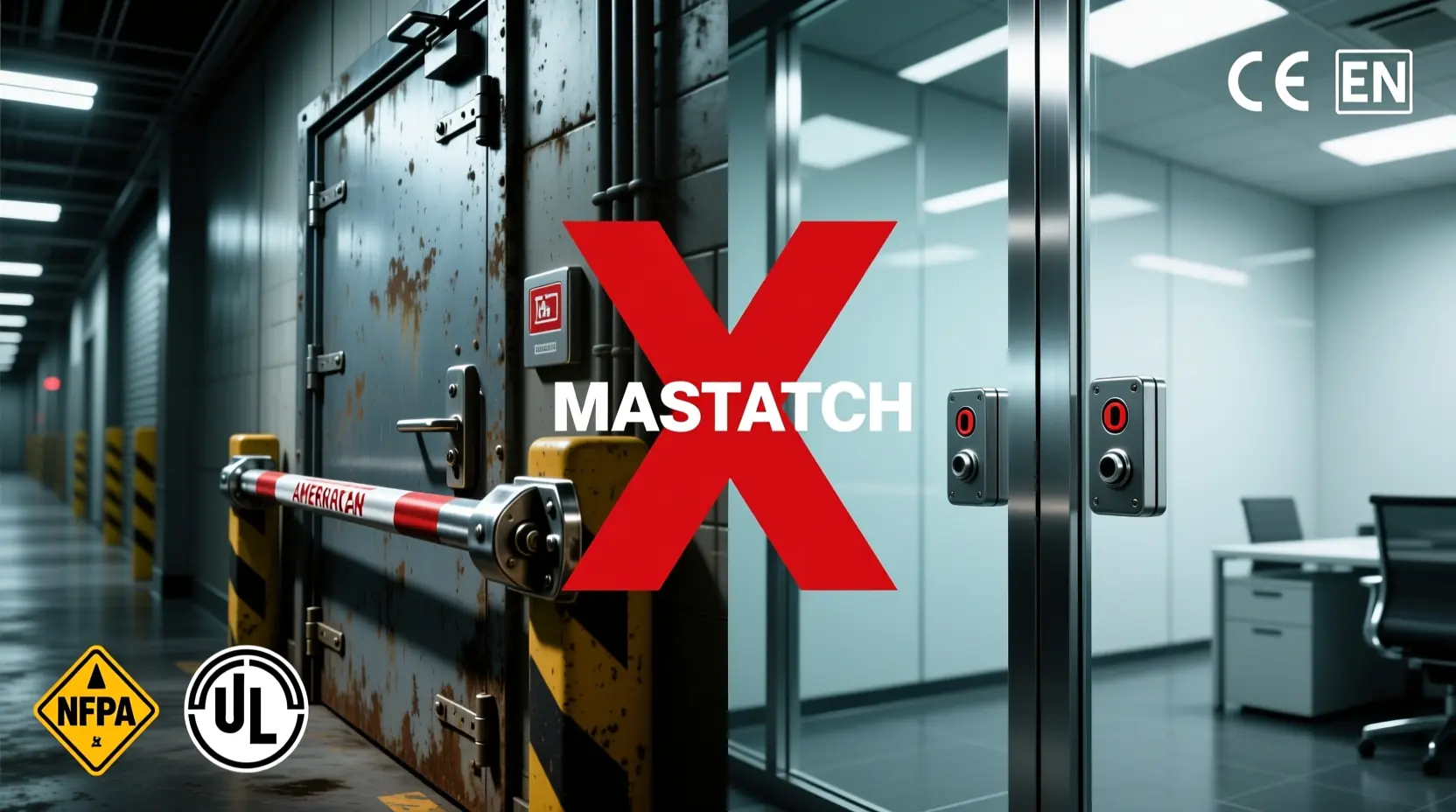
I’ve spent decades in this world, navigating the snarl of global supply chains and the blunt force trauma of building codes. I’ve seen the invoices from the “close enough” crowd. They’re not for savings; they’re for forensic rework, legal consultations, and door-shaped tombstones. The difference between EN 1125 and ANSI/BHMA A156.3 isn’t a paperwork quirk. It’s a philosophical war fought with different weapons, on different terrain, for a different idea of chaos.
The Grunt Work: Where Specs Collide Physically
Forget philosophy for a second. Let’s talk about why your brilliant plan fails in the metal. You can’t screw a European brain onto an American body.
- The Door Itself is a Different Beast: Your standard US hollow metal door is a steadfast 1-3/4 inches thick. A common European door thickness is 44mm (close, but not identical) and often jumps to 54mm for better performance. A mortise lock engineered for 54mm will laugh at your 1-3/4″ door. It simply won’t fit. Game over before it starts.
- Prep Work is a Permanent Tattoo: The cavities machined into a door edge—the mortise pocket, the cylinder bore, the faceplate recess—are dictated by rigid standards. An ANSI prep and a DIN/Euro prep are like two different jigsaw puzzles. You cannot force the pieces. Attempting to retrofit means one thing: a new door. Add that to your “savings” spreadsheet.
- Measurements That Matter (To Everyone But You): The backset (distance from door edge to cylinder center), the actuator height, the latch projection—these aren’t suggestions. They’re codified, drawn, and inspected. A mismatch here doesn’t just look off; it violates accessibility standards (ADA), building codes, and basic ergonomics. It screams “amateur hour” to every tradesperson who walks by.
- The Core of the Issue: Cylinders Are Not Universal: This is the trap door in your plan. A European DIN cylinder is an oval-shaped device that turns a cam. An American cylindrical lock (Schlage C, LFIC) is round and turns a tailpiece. They are mechanically incompatible species. The dubious “adapters” that promise unity are flimsy, unreliable, and the quickest way to get your key system flagged by every locksmith and inspector in the zip code.
The American Mind: Engineering for the Stampede
American and Canadian codes (NFPA 101 Life Safety Code, the IBC) operate on a beautifully pessimistic principle: assume the worst day of someone’s life. The power is out, alarms are deafening, smoke is thick, and a crowd of 300 panicked strangers—who have never used this door—is surging towards it. The hardware must work. First time. Every time. With one intuitive motion: PUSH. RUN.
This breeds uncompromising, non-negotiable mandates:
- The Sacred 30lb/5lb Rule: From the inside, the force to retract the latch cannot exceed 30 pounds. The force to depress the crossbar/actuator cannot exceed 5 pounds. This isn’t for firefighters. It’s for a child, an elderly person, someone injured. It’s rigorously tested and fiercely defended.
- Positive Latching is Non-Debatable: The door must audibly, physically *click* into the strike. A door that sits “closed” but isn’t positively latched is a failed door. It can be blown open by HVAC pressure or a stumble, breaking the fire and smoke barrier. The latchbolt and strike are a married couple; you don’t get to swap one out.
- Fire Ratings are a Package Deal: A 90-minute fire-rated door is a tested *assembly*—door, frame, hinges, and hardware tortured in a furnace together. Substitute an unlisted component, and you don’t have a 90-minute door. You have a decorative thermal mass with a fancy handle. The rating is null, void, gone.
- The UL Listing: The Third-Party Enforcer: In the US/Canada, a UL or Intertek (Warnock Hersey) Listing isn’t a self-declaration. It’s a brutal, ongoing audit of the product *and the factory making it*. It’s an external guardian. The European CE mark is the manufacturer’s declaration of conformity. This fundamental difference in verification alone shatters the interchangeable-core fantasy.
The European Ethos: Controlled Release for Known Users
European standards (EN 1125 for panic, EN 179 for escape) often stem from a different base assumption. There’s a greater expectation of user familiarity (it’s your workplace, your apartment) and a slightly more… orderly model of egress. It’s about managed escape.
Key features that would give a US fire marshal hives:
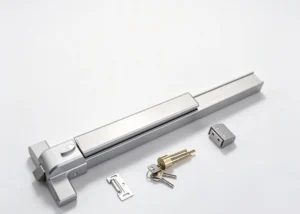
- Rim Devices are First-Class Citizens: The classic surface-mounted “rim” panic device is widely accepted. The mental image isn’t a crushing mob but individuals or small groups approaching the door.
- The Two-Pad Puzzle: Alongside crash bars, you’ll frequently encounter devices with two separate push pads, one on each door leaf. The theory? Both must be pressed simultaneously to open, preventing accidental release. The reality for someone crawling through smoke with impaired motor function? A potential death trap. See the rift?
- Different Gauges for Different Storms: European testing is rigorous, but its force metrics and methodologies are calibrated to their philosophy. A device proudly bearing the CE mark and EN 1125 compliance might fail the American 30lb/5lb test spectacularly. It’s not better or worse. It’s different. And in life safety, “different” means “not approved here.”
The True Cost of Your “Savings”
Okay, tough guy. You’re a developer or a value-engineer under pressure. The European hardware is 30% cheaper upfront. Let’s audit the *real* project costs you’re about to incur:
- The Instant Red Tag: Your local AHJ (Authority Having Jurisdiction—the building official or fire marshal) will spot it during inspection. No debate. Failed.
- Rip-and-Replace at Crisis Rates: You now pay to have the illegal hardware removed *and* the correct hardware installed. Not at planned project rates, but at emergency, gotta-fix-it-now overtime.
- The Door and Frame Domino Effect: If the prep is wrong or the door is butchered during removal, add brand-new doors and frames to the list. If it was a fire door, you’re now buying a whole new *listed assembly*.
- Paperwork Avalanche: Your door schedules, hardware specs, and submittals are now garbage. Cue architectural redraws, re-stamping, re-submittals, and more permit fees.
- The Liability Sword of Damocles: If that non-compliant hardware fails during an emergency, leading to injury or death, your “cost-saving” decision is the star exhibit for the plaintiff. Your professional liability insurance will evaporate. Enjoy personal bankruptcy.
The Only Path Forward (It’s Boring and It Works)
Yes, global manufacturers like Assa Abloy, Allegion, and dormakaba exist. They operate on both continents. Here is the critical nuance you must understand: they maintain **separate, distinct product lines for separate markets**. A Series 98 panic device for Europe and a 9500 Series for the Americas are corporate cousins, not identical twins. One is engineered, tested, and listed to EN standards. The other to ANSI/BHMA and UL. They offer a global supply chain, not a global product. Your job is to specify the correct line for your project’s location. Full stop.
AHJ WARNING: THE ONLY PARAGRAPH THAT MATTERS
This is not a suggestion. It is a survival guide. The **Authority Having Jurisdiction (AHJ)**—your local building department, fire marshal, or certified plan reviewer—is the final arbiter of reality on your project. They do not care about your procurement headaches, your lead times, or your appreciation for Scandinavian design minimalism.
They care about the **International Building Code (IBC)**, **NFPA 101**, and the **UL Listing** printed in the product catalog and stamped on the hardware itself. Submitting a product with CE marking for a US project is professional suicide. They will reject your submittals. If you somehow sneak it past them and it’s discovered during inspection, they will shut your site down. If it’s found after occupancy, they can levy massive daily fines or condemn the building until it’s fixed.
Your mandate is simple, unambiguous, and non-negotiable: **Specify, procure, and install exit hardware that is UL Listed (or WHI Listed) for the United States or Canada, with a clear, verifiable record of compliance with ANSI/BHMA A156.3 and all referenced life safety and fire codes.**
Any supplier, contractor, or “global consultant” who whispers sweet nothings about universality is either perilously ignorant or lying to you for a sale. Fire them. Your career, your project’s budget, and the safety of the building’s occupants depend on this single, grumpy, unyielding truth.