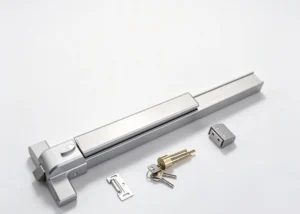
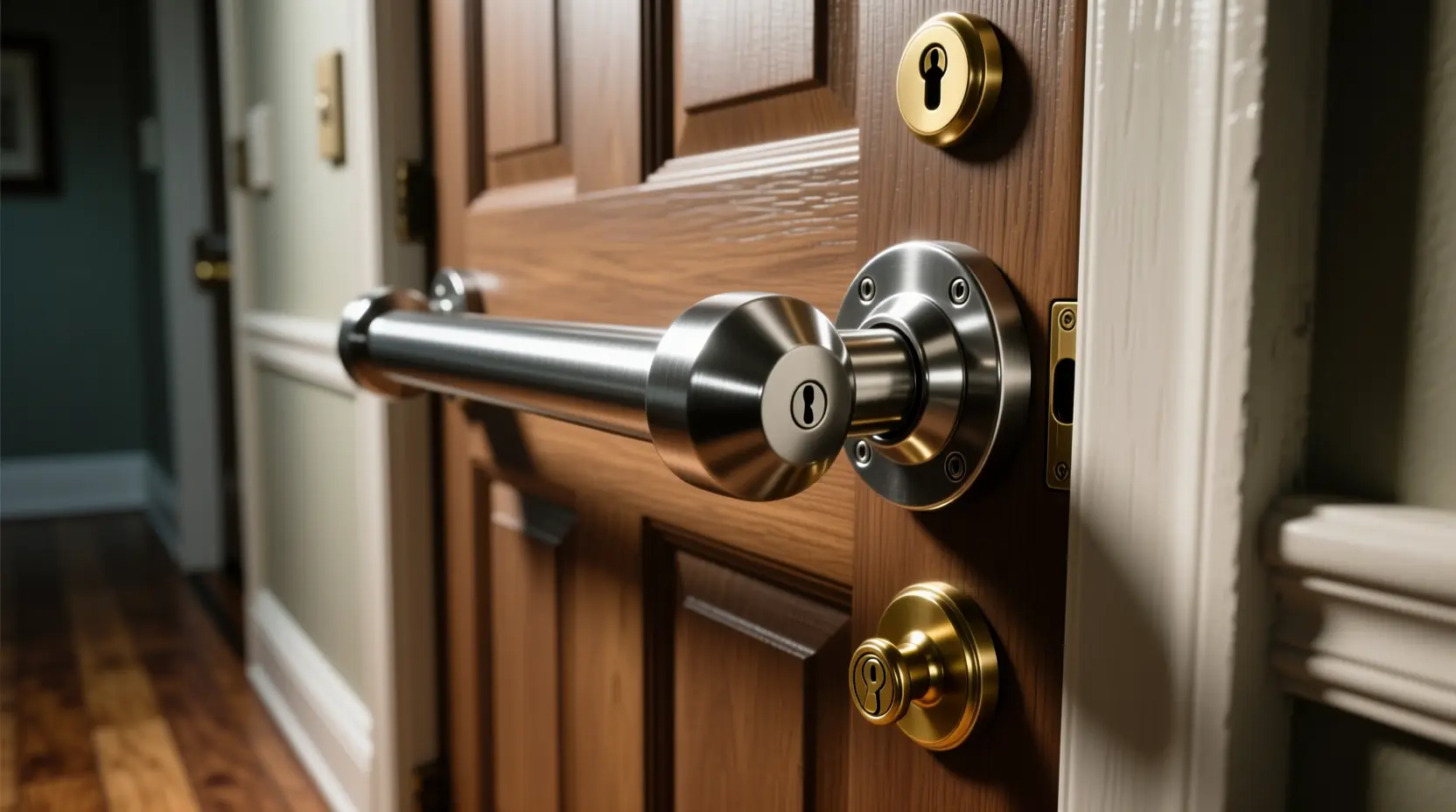
Forget “thinking outside the box.” Some ideas deserve to stay locked inside it, sealed with a proper deadbolt and three-inch screws. As someone who’s spent a career navigating the glorious, pedantic hellscape of door codes and hardware specs, I need to address the latest head-scratcher floating around DIY forums and home improvement rabbit holes: the notion of installing a commercial panic bar—a touchpad exit device in the trade—on your residential front door. Let’s be clear upfront: this isn’t an innovation. It’s a category error wrapped in a liability waiver, sprinkled with bad logic.
The Core Incompatibility: You Are Not a Crowd
A panic bar is engineered for one specific, stressful scenario: the mass, mindless egress of many people through an outward-swinging door. Its entire reason for being is to translate collective panic into a simple, linear shove. Your home’s front door? It (or at least, it should) swings inward. You are not a panicked throng; you’re a person, presumably with functioning hands and the cognitive ability to operate a lever. The fundamental physics and intended use cases are already screaming at each other from opposite sides of a very thick fire-rated wall.
Deconstructing the Terrible Justifications
Why would anyone entertain this? The reasons are as flimsy as a hollow-core slab.
- “Fire Safety!” A noble concern, tragically misdirected. Your code-compliant residential lever or knob already provides egress without a key. In a genuine, smoke-blind panic, you’re more likely to body-check the door than politely depress a bar. More critically, slapping on non-listed commercial hardware likely voids any fire-rating the door assembly had. You’re not enhancing safety; you’re potentially compromising it and giving your insurance adjuster a delightful ‘out.’
- “My Hands Are Full!” So your solution to carrying groceries is a three-foot-long industrial actuation bar? Brilliant. Get a keypad lock, a smart lock with geo-fencing, or a lever you can nudge with an elbow. You’re using a bunker-buster to crack a walnut.
- “The Aesthetic, Though…” This is the confession that kills the argument. You’re willing to flirt with code violations, security flaws, and weatherproofing disasters for a trendy, industrial look? Buy some exposed piping and an Edison bulb. Don’t re-engineer your primary security barrier into a themed prop.
- “Mobility Issues.” Finally, a thread of legitimate need. And yet, a panic bar remains a dreadful answer. The residential and accessibility worlds offer zero-force levers, push-paddle devices, and keyless systems designed specifically for dwellings. A commercial panic bar is a sledgehammer where a scalpel is needed—and prescribed by actual occupational therapists.
The Code: Your First and Highest Wall
This is where the dream meets the municipal inspector’s red pen. In the United States, dwellings live under the International Residential Code (IRC). Commercial buildings answer to the International Building Code (IBC) and NFPA 101. They are different legal universes.
The IRC dictates your door’s minimum width, maximum sill height, and that it must be openable from inside without a key. It says nothing about requiring panic hardware. That requirement kicks in the IBC for assembly occupancies with a certain occupant load (typically 50 or more). Your household of 2.5 humans and a goldfish doesn’t qualify.
Installing a device listed and labeled for IBC compliance on an IRC-governed door creates a regulatory Frankenstein. An inspector isn’t just being a bureaucrat if they flag it; they’re correctly identifying an improper, non-conforming application. You’ve mixed automotive and aviation parts, then wondered why the vehicle won’t pass inspection.
The Practical Execution: Where Hope Goes to Die
Let’s assume you ignore codes (a classic amateur move). The physical installation is a comedy of errors waiting for its third act.
- The Door Slab: Your residential door is likely 1-3/8″ thick. Commercial doors are a minimum of 1-3/4″. That panic bar is engineered for the thicker, heavier slab. Mounting it on a thinner door looks ridiculous, creates massive gaps, and often results in inadequate latch projection. The required reinforcement isn’t a DIY job.
- The Latching Paradox: The bar retracts the latch to exit. Wonderful. How do you secure it from the outside? Now you need a separate keyed cylinder, creating a clumsy, two-point locking system that defeats the ‘single-motion’ ethos of the panic bar itself.
- Weatherproofing Abandonment: That sleek bar runs the door’s length, creating a perfect, unsealed channel for air and water. Say goodbye to energy efficiency and hello to drafts and moisture intrusion. Your HVAC system will weep.
- The Security Sacrifice: This is the grand, unforgivable sin. A residential deadbolt throws a solid one-inch bolt into a reinforced frame. A panic bar’s latch is designed to retract under pressure. It is inherently less resistant to attack. You are trading a fortress component for a convenience component, making your home objectively less secure to solve a non-existent problem.
- Frame Failure: That bar transmits force across the door’s width. Your residential wood frame isn’t built for it. Repeated use—or one good kick—can splinter the jamb around the strike, rendering the whole expensive, ugly experiment useless.
The Correct Tools for the Actual Job
If egress or accessibility is a genuine concern:
- Install a high-quality, ADA-compliant lever handle requiring minimal grip force.
- Use a keypad or smart lock with automatic interior unlocking or touch-to-open features.
- Ensure a clear path, easy door swing, and a low or zero-threshold.
- Consult a locksmith or door hardware professional specializing in residential accessibility, not commercial egress.
If security is the priority:
- Reinforce your existing deadbolt with a strike plate secured by 3-inch screws into the framing.
- Upgrade to a door with a properly engineered multi-point locking system.
- Consider a supplemental security bar or brace for when you’re inside.
If you just love the industrial look, manufacturers make residential-grade levers with that aesthetic. Buy those. Don’t play engineer.
The Grumpy, Non-Negotiable Bottom Line
Installing a commercial panic bar on your house door is a masterclass in misapplied technology. It solves no problem you actually have while creating a host of new ones: code violations, security vulnerabilities, weatherproofing failures, and insurance complexities. It signals a fundamental misunderstanding of how buildings—and the codes that keep them safe—are meant to work.
And since we must end on the most critical note: MY FINAL, OFFICIAL AHJ WARNING. The Authority Having Jurisdiction—your local building inspector, fire marshal, code official—possesses the final, unappealable authority. Presenting them with this hybrid abomination is an invitation for correction notices, fines, and profound professional annoyance. Do not assume your internet research trumps their codebook. It does not. Their interpretation is law. And in my extensive, grumpy experience, they have a particular disdain for this flavor of well-intentioned chaos.