Look. You found me. Probably typed some panicked search into Google at 2 AM after a fire marshal glared at your back door. Or maybe you’re just trying to save three bucks on a crucial piece of life safety hardware. Congratulations. You’ve now entered the grumpy, grease-stained world of someone who has seen what happens when “value engineering” meets human stampede.
The question: “Will a budget exit device jam during an emergency?”
My short answer: It has a significantly higher probability of doing so than a quality one, and the reasons are both stupid and depressingly predictable.
This isn’t about snobbery. It’s about physics, metallurgy, and the cold, hard reality of panic. Let’s stop calling them “budget” devices. Let’s call them what they often are: Cost-Cut Catastrophes Waiting for Their Moment.
The Anatomy of a Jam (Or, Why Your Corners Were Cut)
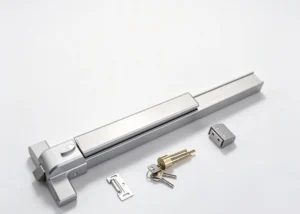
A panic exit device, a crash bar, a rim device—whatever you call it—has one job. ONE. To translate a body’s momentum or a hand’s push into a retracting latch, every single time, without electricity, for decades. It’s a beautiful, simple piece of mechanical genius. Until you gut its soul to save on material cost.
Here’s where the jamming starts, usually in the following order of cheapness:
1. The Latch Mechanism: Where the Ghost of Bad Metallurgy Lives.
The heart of the device. Quality ones use hardened steel, precision-milled, with proper springs that are rated for hundreds of thousands of cycles. The budget version? Softer alloys. Sometimes mystery metal that feels… chalky. Under repeated use (and yes, people lean on these things daily), these softer metals deform. Just micro-imperfections. A burr here, a slight warp there. Then, one day, under the frantic, uneven pressure of a real emergency push, those deformities align perfectly—like a malignant constellation—and bind. The latch stops retracting fully. The door is now locked with people behind it. Game over.
2. The Spring(s): The Tired, Under-Gauged Soul.
Springs are boring. They’re also the muscle. A quality device has robust, properly gauged springs that snap the latch back and return the bar crisply. Budget springs are like a worn-out rubber band. They fatigue faster. In a fire, with heat cycling, this accelerates. A tired spring doesn’t retract the latch with authority; it kind of brings it back. Enough for the latch to catch on the strike plate lip on rebound. That’s a jam. It doesn’t take much.
3. The Bar Itself: The Hollow Feeling of Doom.
Press on a high-end bar. Solid. Now press on a bargain-bin special. Feel that hollow flex? That’s thin-gauge steel. Under normal use, it bows. Under the force of multiple people piling into it, it can deflect so much that the linkage inside—the rods or cables connecting the bar ends to the latch—binds or pops loose. The bar goes down, but the force isn’t transmitted. You’re just pressing on a decorative piece of tin. Again, people are now pounding on a door that won’t open.
4. The Mounting & Adjustment: The Installer’s Nightmare.
Good hardware is forgiving to install. It has adjustment room. Cheap hardware has slop, poor tolerances. If the strike plate is off by 1/16”, a quality latch might still engage smoothly. A cheap latch will grind against it every time, wearing itself down, waiting to hang up. Plus, the screws supplied are often joke-metal. They strip. The device gets loose. A loose device is a misaligned device. A misaligned device is a jammed device.
The “Testing” Farce and the Reality of Panic
“But it’s UL listed!” I hear some procurement wizard cry. Sure. It passed a laboratory test. A defined number of cycles with a machine pushing the bar perfectly centered. It wasn’t tested after Derek from shipping body-slams it every day for two years because his hands are full. It wasn’t tested with a side-load, which is what happens when people are pushing from an angle in a crowded, smoky corridor. It wasn’t tested after being sprayed with cheap floor cleaner that turns into a gummy residue inside the mechanism.
Panic is not a lab test. Panic is 250 pounds hitting the bar at a 45-degree angle with a twisting motion. Panic is the cumulative neglect of daily abuse finally meeting its moment of truth. The budget device, whispering, “I was never built for this.”
The Cost You Didn’t Calculate (The Grumpy Math Lesson)
Let’s say you saved $300 per door on 10 doors. $3,000! Bravo. Put it on your bottom line.
Now subtract:
- The service call for the device that “feels sticky” ($150).
- The second service call when it happens again ($150).
- The overnight shipping for the “special order” replacement part when the generic one fails ($89).
- The potential fines from the AHJ for non-compliance during an inspection (varies, but it hurts).
- The lawsuit from one person, let alone multiple families, if that jam happens during a real event and people are injured or killed. Subtract your entire business. Subtract your soul, trying to sleep at night knowing you chose the cheaper option on the thing meant to save lives.
Suddenly that $3,000 “savings” looks like the most expensive decimal point error you ever made.
The Maintenance Lie: “We’ll Just Maintain It!”
Oh, you’ll maintain it? Will you? Let’s be real. The company that buys the budget hardware is the same company that skips scheduled maintenance because “it’s still working.” The budget device requires more frequent, more meticulous maintenance precisely because it’s inferior. Its springs need checking sooner. Its pivot points need lubrication more often. Its mounting needs constant re-tightening. You won’t do it. No one does. The quality device is built to survive in spite of neglect. The budget device is built to fail because of it.
The Final, Unforgiving Arbiter: Your AHJ
You know who has zero sense of humor about any of this? The Authority Having Jurisdiction. The fire marshal. The building official. That person.
They’ve seen the aftermath. They’ve cut bodies out of buildings. When they inspect your shiny new budget install, and they see the slop, hear the grind, feel the flex… they will fail you. Not because they’re pedantic. Because they can see the future jam. Their job is to stop it before it happens. And they have the absolute, unappealable power to red-tag your building and shut you down until you rip every last one of those cost-cut catastrophes off the doors and replace them with something legitimate.
AHJ WARNING:
Listen up. I don’t care what some online spec sheet says. If your local Authority Having Jurisdiction—the Fire Marshal or Building Code Official—deems your exit hardware insufficient or non-compliant, their word is final. You can whine about cost. You can show them your cheap certification. They will point to the code section that essentially says “must function reliably under emergency conditions.” They will ask you to demonstrate it under load. They will envision a crowd of desperate people. And if they have a doubt, you lose. Save yourself the monumental headache and the liability: Talk to your AHJ before you buy or install anything on a fire or egress door. Their approval isn’t a hurdle; it’s your only get-out-of-jail-free card.
The Bottom Line, From a Cynic Who’s Seen It All
Will a budget exit device always jam? No. Not always.
Will a quality, major-manufacturer device never jam? Nothing is perfect.
But we’re playing probability with lives. You’re stacking the deck against the people inside your building. You’re betting that the one-in-a-thousand chance of simultaneous failure happens on a Tuesday at 3 PM when no one is there, instead of during an emergency.
Exit hardware isn’t a place to save money. It’s a place to invest in certainty. It’s the insurance policy you hope to never use, but must absolutely trust when the alarm sounds.
Buy the cheap door handles. Buy the cheap carpet. Buy the cheap light fixtures.
But for the love of all that is holy, don’t buy the cheap thing that stands between a breath of fresh air and a tomb.
Now if you’ll excuse me, I have to go un-jam a “value” device some genius installed on a school kitchen. The grease from the fries has turned it into a sticky paperweight. A tragedy waiting to happen, one French fry at a time. Don’t be that guy.