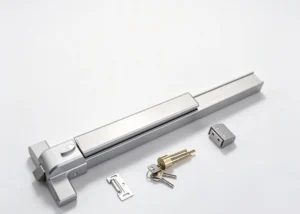

Let’s be clear from the start. That shiny online listing promising “Easy Self-Install Exit Device!” is whispering sweet, dangerous nothings. It wants you to believe you’re saving a few hundred bucks on a locksmith. What it’s not telling you is the potential cost: a failed fire inspection that shuts your business down, or worse, a bar that jams when someone’s life depends on it. This isn’t a scare tactic. It’s the daily reality of managing building egress. My job, for over a decade, has been to cut through this exact brand of marketing fluff and find what actually works without getting people sued.
The allure is real. I get it. Procurement is a pressure cooker of budgets and timelines. But some corners are cataclysmically stupid to cut. Exit hardware lives in that category.
Think about it. This piece of metal sits unused 99.99% of its life. It’s invisible. Until the single moment it’s not. That moment involves smoke, chaos, and human instinct overriding all rational thought. The hardware must perform perfectly under pure, unthinking panic. That’s the bar. Literally.
So let’s reframe the entire conversation. Instead of “no-professional-needed,” let’s talk about “where the professional’s role absolutely shifts, and where it remains non-negotiable.”
Forget the supplier’s glossy catalog for a second. Your first call isn’t to them. It’s to the local fire marshal’s office. The Authority Having Jurisdiction. The AHJ. This isn’t a suggestion; it’s the rule. Their word is gospel. I’ve seen projects stalled for months because someone assumed a national code was the final word, only to find the local amendment required a specific latch throw or finish. Start with them. Understand the *local* spec. It transforms you from a passive buyer into an informed client. It lets you push back on a supplier trying to pawn off a close-but-not-quite substitute.
Now, about those suppliers.
The market is a bizarre spectrum. On one end, you have boutique architectural hardware firms with white-glove service. On the other, faceless e-commerce platforms selling mystery metal with a UL label you can’t verify. Your goal is to navigate to the messy, robust middle.
A reliable supplier in this space isn’t defined by fast shipping. It’s defined by transparency *before* the sale. Can you get a full cut sheet with all BHMA grades and fire listing details from their website? If you have to email for it, that’s a yellow flag. Do they have technical support that answers the phone and doesn’t just read from a script? I once had a rep talk me through the load-bearing specs of a vertical rod device for a 600-lb historic door. That’s value.
They should also be brutally honest about install complexity.
Take the classic rim device. The one everyone pictures. Sure, the mounting looks straightforward: drill some holes, bolt it on. The online tutorial is 4 minutes long. Here’s what they don’t show. The prep work. Is the door already prepped for the correct backset? Is the existing door edge perfectly square? If not, that latch won’t engage the strike plate with the consistent, solid *thunk* the fire code requires. You’ll get a mushy, unreliable connection. A pro spots this in seconds and has the tools to correct it. You’ll spend a Saturday swearing at a door frame with a wood file.
Then there’s the mortise lock device.
The “no-professional-needed” tag on some of these is borderline fraudulent. Routing a mortise pocket requires a steady hand, precise measurement, and specialized tools. One slip with the router, and you’ve compromised the door’s integrity. For a fire-rated door, that’s a catastrophic failure. You’ve not only ruined the door, you’ve voided its fire listing. Instantly. The cost to replace a fire door makes the original locksmith quote look like pocket change. This is the discount parachute scenario. It looks fine in the bag.
Electronic options are their own special world.
A “push to exit” trim seems simple. But now you’re dealing with low-voltage wiring, potential integration with an access control system, and NFPA 101 requirements for delayed egress. If you’re not an electrician familiar with fire alarm interconnect rules, stop right here. The liability isn’t worth it. A botched wiring job can fail silently for months, only revealing itself when the system is needed. Or it can cause false alarms that piss off the fire department and rack up fines.
Let me share a war story.
We were retrofitting a small chain of cafes. The franchisee, trying to control costs, sourced his own “code-compliant” exit devices for the restroom hallway doors from a discount online vendor. They looked identical to the spec. We installed them. The local fire inspector did his routine walk-through. He pushed the bar. It operated. Then he asked for the manufacturer’s certification paperwork. The labeling was fuzzy, photocopied, not embossed. The inspector, a thorough guy, looked up the listing. It was for a different model series that had been discontinued. The hardware on the doors was a knock-off using an old, invalid label.
Failed inspection. All ten locations. The fix wasn’t just swapping hardware. It required re-submitting permit applications, paying re-inspection fees, and scheduling the work around business hours. The “savings” evaporated in a week, multiplied by ten, plus reputational damage with the AHJ. Trust, once fractured, is a nightmare to rebuild.
That’s the grumpy truth. The hardware is just a component. The system is the door, the frame, the hinges, the latch, the strike plate, the closing pressure, and the local code that governs it all. A failure in any link breaks the chain.
So, what *can* a determined, handy person do?
The single most viable candidate for a DIY approach is a like-for-like replacement of a *non-fire-rated* rim device on a standard interior door. Think a stockroom door in an office. Not a main egress. Not a fire door. You remove the old one, use it as a template to match screw holes and latch location, and bolt the new one on. Even then, test it fifty times. Have a heavy coworker body-check it. Make sure it latches every single time.
For everything else? Build a relationship with a good, local locksmith or door hardware distributor. Not as a vendor, but as a partner. Their knowledge is your leverage. They’ve seen every bizarre door condition imaginable. They know the inspectors by name. That relationship is an asset, not a cost.
Stop looking for a shortcut. Start looking for the right spec. Get the AHJ’s requirements in writing. Source from a supplier who provides verifiable documentation. And for the love of all that is holy, know when to pick up the phone and call the pro. Your liability insurance carrier will thank you. More importantly, the people who rely on those doors will never have to know you did the right, boring, professional thing.
It is recommended to consult the local Authority Having Jurisdiction (AHJ), such as the fire marshal or fire code official.