Alright, settle in. Or don’t. I don’t care. You’re here because some smooth-talking sales rep, an architect who thinks codes are ‘suggestions,’ or a fellow procurement bean-counter just asked the golden question: “Can’t we just buy one panic bar that’s rated for both hurricane and fire? Save some money?”
Sigh. I’m already mentally pouring a drink.
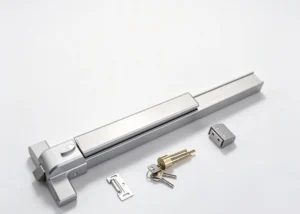
Let’s get this out of the way: Yes, technically, such a thing exists. No, it is not simple. No, it is not cheap. And no, you cannot just slap it on any door and call it a day. Thinking you can is how buildings fail, people get sued, and I get yet another migraine from a frantic facility manager who bought the wrong thing because it was $200 cheaper on some online marketplace.
I’ve navigated this grimy, glorious world of doors and hardware specifications for longer than I care to admit. I’ve seen ‘universal’ solutions cause universal problems and ‘value engineering’ turn into ‘catastrophic liability.’ So let’s break this down with the grace of a sledgehammer and the precision of a well-negotiated contract.
The Core Conflict: Two Disasters, Two Philosophies
First, you must understand that hurricane-rating and fire-rating are two completely different beasts, solving two diametrically opposed problems. Their testing standards loathe each other. Their design goals are in a perpetual bar fight.
The Fire-Rated Beast: Containment
This is about integrity under thermal attack. Its job is to keep a door closed, latched, and sealed against flames and smoke for a specified period—20, 45, 60, 90 minutes. When the building is burning and people are panicking (hence the name, genius), it must allow immediate, no-knowledge-required egress with a single pushing motion. The focus is on heat resistance. The hardware can’t warp, fail, or allow the latch to retract prematurely. Its gospel is found in NFPA 80 and UL listings (10C, 305).
The Hurricane-Rated Beast: Impact & Pressure Resistance
This is about brute force survival. Its job is to keep the entire door assembly intact when a 2×4 becomes a missile shot from a pneumatic cannon, followed by cycles of massive positive and negative pressure trying to turn your door into a sail. The focus is on structural fortitude, cyclic loading, and water infiltration resistance. The latch mechanism must be a vault, holding firm against forces trying to pry or blow it open. Its bible is Miami-Dade TAS 201-203 or ASTM E1886/E1996.
See the glorious conflict? One system is designed to stay resolutely closed under extreme conditions. The other must be easily opened by fleeing people but doggedly resist being forced open by a hurricane. It’s an engineering paradox wrapped in a compliance nightmare.
The Unicorn Hardware: How It’s Forged (At Great Cost)
So how do manufacturers create this mythical two-headed creature? With heavy-gauge steel, immense R&D costs, and a label that requires a magnifying glass and a law degree to decipher.
- The Latch is Everything: They start with an overbuilt, fortress-like hurricane latch—often a vertical rod (top and bottom bolts) or a monstrous mortise lock. Then, they subject that entire assembly to the furnace of fire endurance testing. The result is a latch that can theoretically withstand a beating from a wind-blown pallet and not melt into a puddle.
- Materials & Mass: Forget lightweight aluminum. Think stainless steel, reinforced alloys, and components that add significant weight and cost.
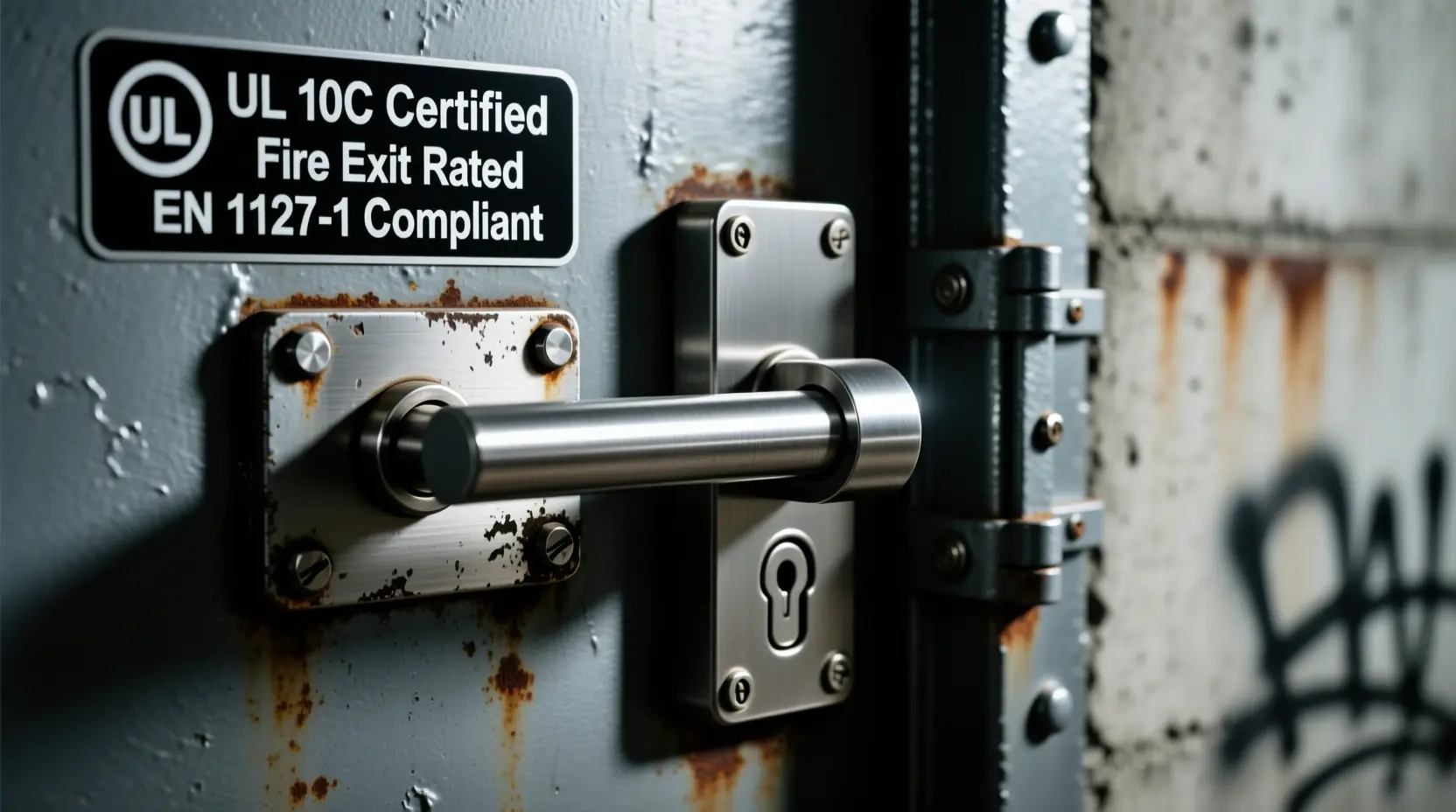
- The Label is Your ONLY Proof: A true dual-rated device will have two separate, distinct, and current listings. Not a marketing slogan. You must physically see:
- A UL Listing Mark for Fire Door Hardware.
- A Product Control Approval from a hurricane authority (e.g., Miami-Dade NOA, Florida Product Approval, TX TDI).
The Procurement Reality Check: Where the Dream Dies
Here’s where my professional grumpiness is fully justified. Sourcing the hardware unit is the easy 10%. The other 90% is a vortex of complexity.
- The Assembly is King (And You’re Not the King): You are not buying a panic bar. You are procuring a pre-tested, listed assembly. The specific door leaf, frame profile, anchor schedule, glazing type, and hardware must be purchased as a system. The hurricane listing is for a 4′ x 10′, 16-gauge steel door in a reinforced frame anchored at 12″ centers with 1″ laminated glass. Deviate to save a few bucks on the glass? You have just voided both listings and assumed catastrophic liability. The fire listing adds its own layer of requirements for seals and materials. This is a recipe, not a buffet.
- Configurator Hell: You will spend hours on the manufacturer’s technical site, cross-referencing submittal sheets, ensuring the model number matches the door preparation, the hinge type, and the handing. One wrong digit in the part number and you’ve ordered a very expensive, non-compliant paperweight.
- Cost: Prepare for Sticker Shock: Let’s be blunt. A standard fire-rated panic device has a price. A hurricane-rated one is a multiplier. A dual-listed unicorn is an exponent. We’re talking 3x to 5x the hardware cost, minimum. Then add the custom door, the fortified frame, and the certified installer whose hourly rate reflects their niche expertise. Your value-engineered savings from consolidating to one device just evaporated, likely surpassed by the premium for the total assembly.
- Operational & Maintenance Burden: That heavy-duty, dual-purpose mechanism is not buttery smooth. It may require more frequent adjustment. Replacing a worn part with a generic equivalent from a local supplier? Congratulations, you’ve just invalidated the listing. You are now married to the manufacturer’s OEM parts catalog for the life of the door.
The Grumpy Triage: When Does This Actually Make Sense?
In about 5% of the cases where it’s requested. Be brutally honest in your project assessment.
The Justifiable Niche: It is for a door that is legally mandated to be both a Fire Exit Door and is located in a Wind-Borne Debris Region. The classic example: a stairwell discharge door in a Florida hospital or high-rise. It’s part of a fire-rated corridor separation (fire assembly) and it’s an exterior door in a Coastal High-Velocity Hurricane Zone (HVHZ). That door has no choice; it must provide both protections. That’s your candidate.
The Far More Common (and Sane) Reality:
- Interior Fire Door? Procure fire-rated panic hardware. Full stop.
- Exterior Door in a Hurricane Zone, but NOT in a fire-rated wall? Procure hurricane-rated panic hardware (and its full assembly). Full stop.
The Bottom Line for the Jaded Professional
Can one panic bar do both? Yes, but it is a specific, exorbitantly priced, compliance-driven component for a specific, exorbitantly priced, pre-engineered hole in a wall.
It is not a generic solution. It is not a cost-saver. It is a necessary evil for a very narrow set of circumstances defined by overlapping, stringent codes. The moment you or a project team treat it as a convenient catch-all, you’ve failed in your duty.
Your job is to cut through the chaos and intentional oversimplification. It is to:
- Demand Clarity on Code Requirements for the exact door location (Fire, Building, Local Amendments).
- Specify and Procure the Complete, Listed Assembly by its official listing numbers, not marketing names.
- Enforce Installation per the Manufacturer’s Instructions and the listing details.
- Plan for Lifecycle Costs with OEM maintenance parts.
AHJ WARNING (NON-NEGOTIABLE):
Everything written above is merely academic until the Authority Having Jurisdiction (AHJ) weighs in. The Fire Marshal, the Building Inspector, the local plans examiner—these overworked, under-caffeinated arbiters have the final, absolute say. Your perfectly procured, dual-listed hardware on its flawless assembly is just a very expensive liability if the AHJ rejects the submittal, the installation, or your interpretation of the code. They can, and will, make you rip it out. Engage them early. Submit the technical data. Get their approval in writing. Their word is the only law that matters on-site. Ignore this warning, and all you’ve successfully procured is a failed inspection, a furious project manager, and a change order that will blow your budget apart with hurricane-force finality. Consider yourself warned.