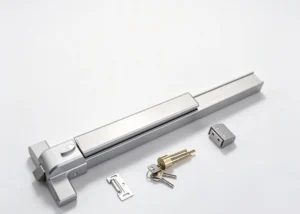
Let’s cut the optimistic nonsense. You’ve got a sleek, European-style aluminum door. It looks like it was forged in a minimalist Scandinavian design studio. Then reality, in the form of a fire code, intrudes. You need an exit device. So you, or your cost-obsessed contractor, procure a ‘standard’ panic bar. You mount it. It passes a cursory inspection. You feel a fleeting sense of accomplishment.
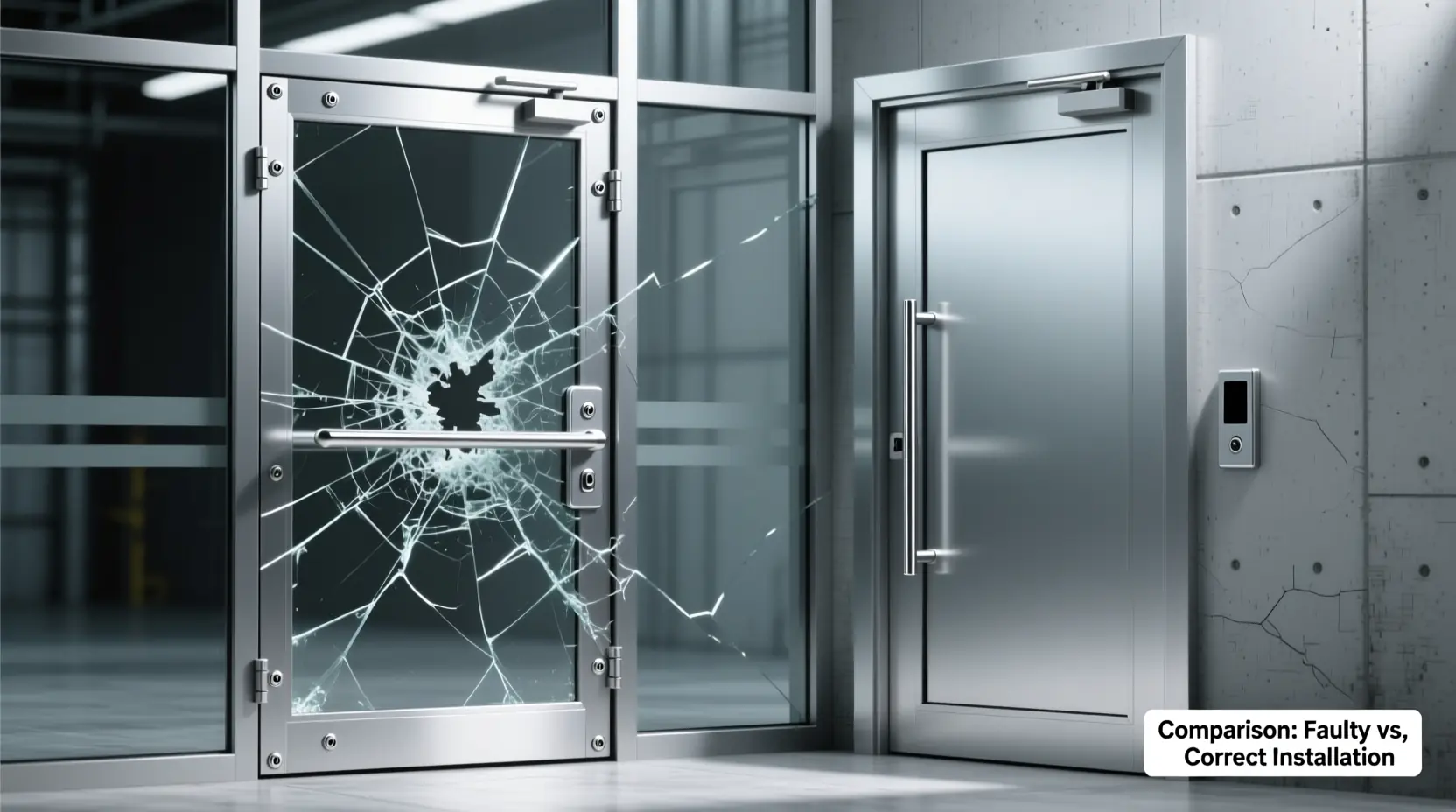
Fast forward. The door now resembles a vandalized artwork. The hardware is loose. The aluminum stile is cracked and deformed. Every use elicits a metallic shriek of protest. This isn’t bad luck. It’s the inevitable, predictable outcome of a fundamental category error. You installed hardware designed for a battleship onto a canoe. And now, someone like me gets the furious call to perform expensive corrective surgery on your self-inflicted wound.
The Core Misunderstanding: Aluminum is Not Steel (And Your Screws Are Whistleblowers)
This is where your project failed, in the procurement phase, before a single tool was lifted. Standard rim exit devices are engineered for solid core wood or hollow metal (steel) doors. These substrates have integrity. Mass. They can absorb the brutal leverage of a panic bar through repeated cycles.
Your elegant aluminum door? It’s a facade system. The stiles are thin-walled, often hollow extrusions engineered for holding glass and looking pretty, not for acting as a structural anchor for a three-foot lever. When you affix a heavy-duty panic bar, the mounting screws aren’t biting into substance; they’re clinging to a veneer of metal. Each activation torques them, slowly, inexorably, elongating the holes, stripping the threads, until the aluminum surrenders. You are witnessing metal fatigue in real-time. It’s not a hardware failure; it’s a procurement failure.
The Tyranny of the ‘Standard’ Fit
The ‘one-size-fits-all’ panic bar is a myth sold to the gullible. It arrives with a generic template, assuming a flat, dense, homogeneous door substrate. An aluminum stile is none of those things. It has thermal breaks, seams, and cavities. The rigid, ‘brute force’ hardware tries to impose its will on a material that cannot comply. The result is a permanent state of mechanical disagreement—the hardware is under stress, the aluminum is warping, and the door alignment fails. Now people shoulder-charge it to get it to latch, accelerating the entire pathetic cycle. You bought a solution that creates its own problems.
The Physics of Your Impending Disaster
Consider the mechanics you ignored. A push on the panic bar transfers force to its ends, where tiny clusters of screws act as fulcrums. On steel, this is manageable. On thin aluminum, it’s applied physics demonstrating why your door is failing. The concentrated stress at these points is catastrophic. The hardware isn’t just retracting a latch; it’s using your door stile as a pry point. You didn’t just buy hardware; you bought a very expensive crowbar pre-installed to destroy its own foundation.
The Corrective Procurement List (Stop Being Penny-Wise)
Forget ‘fixing’ this with longer screws or epoxy. That’s tantamount to using a bandage on a compound fracture. You need the right hardware, which costs more upfront. This is not an expense; it’s the cost of not having to pay me triple for an emergency retrofit later.
- Surface Mounted Vertical Rod Devices: The intelligent choice for narrow stile aluminum doors. The panic device mounts to the face of the door via a large backplate, spreading the load. Through-bolts secure it, often with an interior reinforcement plate. The latching force is transferred via vertical rods to the top and bottom of the frame—structures actually designed to handle load. It’s more visible, but it functions without being an act of slow-motion destruction.
- Manufacturer-Specific Integrated Systems: The door fabricators (Kawneer, Schüco, et al.) know their stiles aren’t suited for generic hardware. They offer proprietary exit devices or, more crucially, glazed-in reinforcement sleeves. These are metal channels installed inside the stile during fabrication, becoming part of its structure. The hardware then attaches to this armored sleeve. This is the correct, elegant solution, but it requires foresight and coordination with the door supplier—a step most procurement plans blissfully omit.
- Full-Length Through-Bolted Reinforcement Plates: The retrofitting brute. When forethought was absent, this is the answer. It involves a continuous steel plate fitted to the interior stile, running the full height of the hardware. The panic bar is through-bolted, creating a steel-aluminum composite that can actually bear the load. It’s industrial. It’s inelegant. It works. Use proper bolts, nuts, and washers. Self-tapping screws are for amateurs and future customers of mine.
Sometimes, the most rational procurement decision is to re-evaluate the door itself. Perhaps that all-glass aluminum wonder should be an entrance-only door, with a designated panic exit elsewhere via a suitably robust steel door. This requires planning and approval, but it’s smarter than perpetually fighting physics and material science.
The Non-Negotiable Finale
AHJ WARNING: All my grumpy expertise is theoretical without this. The Authority Having Jurisdiction (AHJ)—your local fire marshal or building official—holds absolute veto power. You cannot whimsically cobble together a door, a panic bar, and a reinforcement plate. The entire assembly must be listed and labeled for use together as a tested unit (e.g., UL10C). The inspector will demand to see the certification labels. Your brilliant, cost-saving improvisation will be met with a red tag, a fine, and an order to cease occupancy. Life safety hardware is not a playground for creative procurement. Get the specs, submit them, get approval. Then, and only then, proceed.
You now possess the grumpy, inconvenient truths. Procure correctly, or prepare to fund my next vacation when your beautiful door inevitably self-destructs.