Listen. I’ve sat on your side of the desk. I’ve seen the work order: ‘Panic bar sagging on warehouse exit. Probably just the hinge. Get a quote.’ You want it fast and cheap. Your facilities guy thinks he’s a detective. The janitor has a hunch. And I’m here to tell you the brutal, budget-blowing truth: you’re all wrong, and your procurement instinct to find the cheapest single part is about to cost you three times as much.
Let’s reframe this. You’re not buying a part. You’re managing a critical, liability-laden life-safety system. That wobbly bar isn’t an aesthetic issue; it’s a symptom of a failing mechanical system on a door that legally, morally, and financially must function perfectly when 200 panicked people slam into it. Think of it like a truck’s braking system. You wouldn’t just buy the cheapest pad and hope. You’d audit the rotors, calipers, and lines. This is no different. Your job isn’t to diagnose—it’s to procure a complete, compliant solution.
The Procurement Nightmare: Why Your “Simple Fix” Is a Fantasy
You want a hinge. Or a latch. A single SKU. A neat line item. I crave that simplicity too. But chaos is the default state of maintenance hardware. Here’ s why your neat purchase order is a pipe dream.
The Hinge Hypothesis: The Seductive, Simple Lie
The door swings, so the hinges wear. Logical. Tidy. Often wrong. On a fire-rated door with a panic device, you’re looking at heavy-duty ball-bearing hinges. If they’re truly gone, it’s a door-off, device-off, three-man-hour project, not a part swap. But before you approve that labor, you must ask: are the screws original? Or did some genius “temporary fix” it with drywall screws, stripping the substrate? Now your hinge replacement needs a helicoil kit or through-bolts. See? One line item just metastasized into four.
Procurement Red Flag: If the quote only lists hinges, your vendor is either lazy or setting you up for a change order. Demand they specify screw type/length, verify substrate, and include de-mounting/re-mounting the panic device in the labor estimate. This is now a kit, not a component.
The Latch & Strike Catastrophe: The Hidden Cost Multiplier
This is where amateurs waste your money. The latch bolt bears the leveraged weight of the entire panic bar when the door is closed. A worn latch and a wallowed-out strike plate in the frame are a pair. Replacing the latch is futile if the strike plate hole in the steel frame is an egg-shaped crater.
Now you’re not procuring a latch; you’re procuring metal fabrication. A new, heavier-gauge strike plate? Maybe. Welding and re-drilling the frame? Suddenly you need a certified welder and a magnetic drill press. The vendor quote now has three trades: door hardware, metalwork, and painting. Your “latch” P.O. is a fantasy.
Procurement Red Flag: Any quote for latch repair that doesn’t include a detailed inspection of the strike plate condition and frame integrity is worthless. Insist on photos. If the frame is damaged, you’re buying a repair, not a replacement.
The Device Itself: The Obsolete-Model Abyss
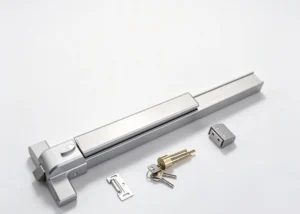
The worst-case scenario isn’t the most expensive part; it’s the unobtainable part. If the panic device’s internal mechanism is worn (the bar is mushy, the end caps rattle), you need a whole new unit. Hope that model is still in production. If it’s 20 years old, it likely isn’t.
Now you’re procuring a new device, which requires matching the exact door prep—the pattern of holes in the door. If the new model doesn’t match, you’re buying a door modification (more metalwork) or a new door leaf. A $1,500 device just triggered a $3,000 door and a $2,000 installation. This is where you learn the true meaning of capital expenditure.
Procurement Red Flag: The moment “device replacement” is mentioned, you must immediately requisition the model number and a current catalog cut sheet. Your first task is to confirm availability or begin sourcing a compatible alternative. Lead times can be 26 weeks.
The Grumpy Manager’s Truth: You’re Procuring a System, Not Parts
Here is the intentional chaos you must embrace: these failures are interdependent. A worn strike stresses the hinges. Worn hinges misalign the latch, destroying the strike. It’s a doom loop. Buying just one part is a temporary tax on future you.
The only fiscally sane approach is a systematic procurement package. You must commission a full assessment that evaluates, in order:
- Hinge Integrity: Play, screw condition, substrate.
- Latch & Strike Condition: Wear, frame damage.
- Device Health: Internal wear, model obsolescence.
- Door & Frame Alignment: The foundational geometry.
Then, you procure the suite of repairs needed. Yes, it’s a bigger upfront spend. But it’s one purchase order, one vendor mobilization, one AHJ inspection (more on that hellscape below), and one long-term fix. Buying piecemeal guarantees you’ll be back here in 12 months with a different symptom and a new budget request.
The “Value Engineering” Trap (A Rant)
Someone in a meeting will say, “Can’t we just shim it? Adjust the strike? Tighten something?” This is the siren song of the non-liable. These are temporary appeasements that alter critical geometries and accelerate the failure of the other components. You are literally purchasing future, more catastrophic failure at a discount today. As the procurer, you own this decision. When the “fix” fails and the fire marshal red-tags the door, your “cost savings” email will be Exhibit A.
Your Cheat Sheet for the Pre-Meeting (Because You’re Busy)
- Problem: Sag when door is open and closed. Procure: Hinge & Mounting Analysis Kit (hinges, appropriate screws/bolts, labor for full R&R).
- Problem: Sag appears or worsens ONLY when door latches. Procure: Latch & Strike Forensic Package (new latch, heavy-gauge strike plate, metalwork/frame repair).
- Problem: Bar feels loose, mushy, or bends. Procure: Full Device Replacement Project (new unit, door prep verification, possible new door leaf).
And always, always budget +30% for the “while we’re in there” discoveries. Because chaos reigns.
AHJ: The Final, Non-Negotiable Line Item You Forgot
This isn’t grumpiness. This is your get-out-of-jail-free card. The Authority Having Jurisdiction (AHJ)—fire marshal, building inspector—owns this door. You cannot procure, install, or modify a single component without their approval. Full stop.
Your procurement package must include:
- Pre-Repair Consultation: The AHJ must be notified of the intended work.
- Compliant Components: Every hinge, latch, strike, and device must be listed (UL, BHMA) for fire-rated assemblies. No off-the-shelf hardware store junk.
- Post-Repair Inspection & Certification: A signed, stamped approval from the AHJ is the only deliverable that matters. This is the most important thing you are buying.
Unauthorized work voids the assembly’s fire rating, creates catastrophic liability, and will get your building shut down. Procure the AHJ’s involvement upfront. Make their approval a condition for vendor payment. It transforms your purchase from a maintenance task into a liability shield.
So, stop looking for a part number. Start drafting an RFP for a compliant life-safety system remediation. Your future self—the one not dealing with lawsuits, violations, or tragedy—will thank you. Now get off my budget.