Locking a Panic Bar: The Grumpy Professional’s Messy Truth
Alright. You found me. You’ve been scouring the internet, watching videos made by people who think a flathead screwdriver is a multi-tool, and you’ve landed here. I’m the grumpy soul who’s been installing, servicing, and screaming at these infernal devices for decades. They’re called “panic bars,” or more properly, “exit devices.” And you want to know how to lock one. Not as simple as you thought, is it?
This isn’t a nice, neat, polished guide. The world isn’t polished. It’s messy, like my toolbox and my patience. So here’s the messy, inconvenient truth about locking a panic bar, served with a side of sarcasm and a warning you’d better not skip.
First, The Big Ugly Truth: Why This is a Stupid Question
Asking “how to lock a panic bar” is like asking “how to stop a heart.” It’s missing the entire point of the thing. The panic bar exists for one reason: TO GET OUT. Always. Unfailingly. In a panic. Its core function is egress. So when you ask about locking it, you’re immediately dancing with the devil of fire codes, building codes, and common sense. Most of the time, if it’s a main exit door, you simply cannot and must not lock it in a way that prevents immediate, free egress. Got it? Good. Now that my conscience is semi-clear, let’s talk about the times you might need to control it.
The Cast of Characters: What Kind of Darn Thing Do You Have?
You didn’t think there was just one type, did you? Oh, sweet summer child. You’ve got rim devices (mount on the inside of the door), mortise devices (fancy, sit inside the door), surface vertical rods (looks like a metal spider), and concealed vertical rods (the fancy, expensive spider). The locking method depends entirely on this. I can’t see your door from here, so you’ll have to use your eyeballs.
More importantly, what’s its mode?
- Fail Safe: Power unlocks it. Lose power, it’s locked. Think: stairwell doors that must be secure normally but unlock during a fire alarm. You don’t “lock” these manually; you control them with electricity and magic smoke (aka, electronics).
- Fail Secure: Power locks it. Lose power, it’s unlocked. Think: main exit door you want to keep locked during business hours but that MUST allow free escape. This is the usual suspect. Locking this often involves controlling the electric latch retraction (more magic smoke).
But you’re probably not dealing with the fancy electric ones. You’ve got a mechanical beast. Let’s talk about that.
The “Key Outside” Thing (The Dog Bolt)
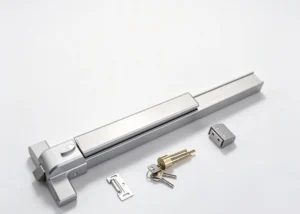
This is what most people mean. You want to lock the door from the outside so folks can’t just walk in, but people can still get out. The most common method is a dogging key. See that little hole, usually near the end of the bar or on the end cap? That’s for a dogging key—a flat, usually hex-shaped piece of metal that came with the device (and is now inevitably lost).
You stick the key in, turn it (often 90 degrees), and it mechanically “dogs down” or holds the latch retracted. The bar stays depressed, the latch stays in. Now you can pull the door open from the outside without activating the bar. To “lock” it, you simply remove the dogging key. The bar re-engages. Now, from the outside, the door is locked (needs a key in the cylinder). From the inside, one push on the bar and out you go.
Where people mess up: They dog the device down and LEAVE IT. Now your “secure” door is just a push-pull door for any jerk wandering by. Security fail. The dogging function is for momentarily holding the door open during moving or events, NOT for permanent “unlocked” status. Don’t be that guy.
The “Lock It From the Inside” Nightmare (Don’t Do This)
This is where people want to prevent someone from leaving. A retail store after hours, a school auditorium, etc. WARNING: THIS IS A MAJOR RED FLAG. You cannot simply prevent egress. But you can control it with authorized access.
For this, you need what’s called a controlled egress function. This usually involves:
- An electric latch retraction device (a solenoid that pulls the latch back).
- A push-to-exit button (a request-to-exit or REX device).
- A time delay (often 15 or 30 seconds).
- An audible alarm (a constant, annoying beep upon pressing).
Someone pushes the bar. A horrible, grating alarm sounds. A sign might say “PUSH FOR 15 SECONDS TO EXIT.” After the delay, the electric latch releases, and they can leave. An authorized person (staff) can use a key, code, or button to release it instantly.
This is not a DIY project. This is “call a professional who knows fire codes and has the proper hardware” territory. If you rig up some broomstick and duct tape solution to block the bar, I will find you. And I will be grumpier.
The Simple, Mechanical “After-Hours” Lock
Sometimes you just have a back door with a panic bar and you want it locked after everyone leaves. The simplest way? There’s usually a cylinder (keyhole) on the outside. That’s your primary lock. From the inside, the bar always works. From the outside, you need the key.
But what about the inside after hours? Ah. This is where exit device trim comes in. There might be a simple toggle, a hex-key turn, or a cylinder on the inside edge of the door. This is an “auxiliary lock” function. Turning this with the proper tool/key will mechanically throw a separate deadbolt or latch, securing the door from BOTH sides. To get in the next morning, you use the outside key cylinder. To get out in an emergency, the panic bar still works, but it might now also require you to turn a lever or knob to retract the auxiliary bolt as you push. This is usually code-compliant if it’s a single, obvious, unlatched motion.
The Messy Reality: It’s Probably Broken
Let’s be honest. You’re reading this because something’s not working. The key won’t turn. The bar is floppy. It’s making a sound like a bag of spanners. 80% of “how do I lock this” questions stem from a broken, neglected device.
- The dogging keyhole is stripped because someone used a bent paperclip.
- The cylinder is frozen because it’s never been maintained.
- The vertical rods are misaligned because the door sagged and nobody cared.
- The end cap is missing, and spiders have set up a condo inside the mechanism.
Your “locking” problem might be a maintenance problem. A shot of graphite powder (NOT WD-40, you monster) in the cylinder, tightening some screws, cleaning out the dead flies—might solve your issue. Might.
The Tool Graveyard
You’ll need tools. Not the junk in your kitchen drawer.
- A proper dogging key for your model (Von Duprin, Sargent, Corbin Russwin, etc.). They are NOT universal. Go buy one.
- Hex keys/Allen wrenches. Metric and SAE. Just have both.
- A flathead and Phillips screwdriver that actually fits the screws.
- Maybe a hammer for… persuasion. (Use sparingly and with regret).
- Patience. Which I have none of, so good luck to you.
The Final, Grumpy Summary
- Identify your device. Look for a brand name. Google it.
- Determine your goal. “Lock from outside only” is different from “control from inside.”
- Find the dogging keyhole or cylinder. It’s there. Probably dirty.
- Use the correct key/tool. Don’t force it.
- Test it. From both sides. Repeatedly. Does it always allow immediate, unobstructed egress from the inside with one simple motion? If yes, you might be okay. If no, you are not okay.
And for the love of all that is holy…
AHJ WARNING: PAY ATTENTION, THIS IS THE ONLY PART THAT MATTERS
Everything I just rambled about is technically meaningless without this. The Authority Having Jurisdiction (AHJ) is your local building inspector, fire marshal, or code official. They are the final boss. Their word is law. Your building’s specific certificate of occupancy, fire plan, and local amendments to the International Building Code (IBC) or NFPA 101 (Life Safety Code) dictate exactly what you can and cannot do with an exit door.
If you rig, modify, block, or otherwise mess with an exit device in a way that violates code—even if it seems logical to you—you are:
- Creating a life safety hazard.
- Risking massive fines.
- Invalidating your insurance.
- Potentially facing criminal negligence charges if something goes wrong.
When in doubt, which you always should be, consult a licensed door and hardware professional AND get approval from your AHJ. Don’t come crying to me when the fire marshal shuts your business down because you zip-tied the panic bar. I told you so. Now get off my lawn.