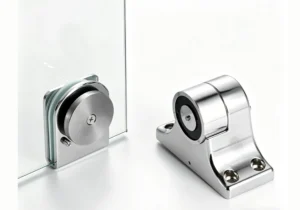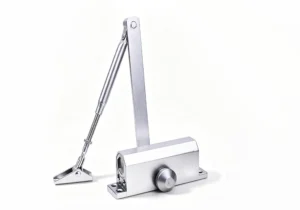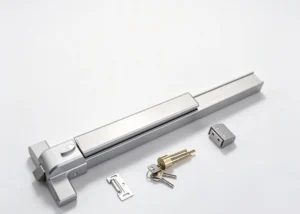

Let’s be honest. You’re not here for glossy marketing fluff. You’re here because you’ve got a budget to hit, a spec to ‘value engineer,’ and a deep-seated need for the unvarnished, slightly cynical truth about door hardware. Welcome. This isn’t a manufacturer’s catalog. This is the procurement trench.
The Brutal, Beautiful Simplicity of “Non-Rated”
Cut through the jargon. A “non-rated” exit device is, at its core, a cost-saving mechanism. It’s not tested to the extreme cycle counts or durability standards (like ANSI/BHMA A156.3) of its life-safety or fire-rated cousins. Its primary function? To open a door and save you money. Its secondary function? To give you a headache in 18 months if you use it wrong. Let’s map the minefield.
The Real-World Deployment Zones (A Pragmatic List)
1. The Non-Critical, Non-Egress Interior Door
This is the sweet spot. Think of the door between the accounting cave and the marketing circus. It’s not a fire barrier. It’s not on the path to the fire exit. It’s a glorified noise barrier for Karen’s Zoom calls. No fire label on the hinge? You’re in the conversation. Storerooms opening into non-public back alleys, internal equipment rooms, server closets (without special fire suppression requirements)—these are the domains of the non-rated bar. The rule is simple: If it’s not part of the required means of egress, you might have a case.
2. The Renovation & Retrofit Rabbit Hole
Here’s where your job gets ‘interesting.’ The original specs called for Grade 1. The budget screams Grade 3. Non-rated devices slink in here, on secondary doors in office fit-outs, interior classroom doors (check local codes aggressively!), and that third loading dock bay used for storage. They look the part from a distance—a perfect facade of compliance. Just don’t look too close or lean on it too hard.
3. Aesthetic Prison: The “Decorative” Application
Architects love these. Historic buildings, boutique hotels, high-end restaurants—places where visual charm trumps institutional brawn. Faux-antique push pads and lever sets often come non-rated. They’re for light traffic, gentle use, and Instagrammable moments. Specify them for a school corridor and you’re a fool.
4. Large-Scale Residential Grey Areas
Not your front door. Think big: apartment complexes, university dorms. The main entries and stairwells are sacred—rated hardware only. But the door from the underground parking to the storage lockers? The interior connection between two sections of a basement? The pool pump room? These are often non-rated territory, managing convenience, not lives.
5. The “Same Tenant” Suite Conundrum
A classic procurement headache. A law firm leases two floors, knocks a hole in the floor slab, and installs an interior stair door. Is this a fire separation? If not (and you must be certain), a non-rated device might fly. It’s an interior convenience within a single tenancy. The moment that space subdivides into two different companies, this decision explodes. Clarity is everything; assumptions are bankruptcy.
The Hall of Shame: Where Non-Rated Devices Go to Die (And Take Your Reputation With Them)
- Any Fire-Rated Door Assembly: The door’s label is law. Rated door demands rated hardware. Full stop.
- Any Door in a REQUIRED Means of Egress: Main exits, corridor doors, doors from high-occupancy rooms. The code demands proven performance here. Non-rated is a non-starter.
- High-Abuse Environments: Schools, hospitals, stadiums, bars. The cheap device will fail, the callback will be furious, and you’ll be replacing it with the correct, more expensive hardware on your dime. The math never works.
The Hidden Cost: Installation & Maintenance Nightmares
Listen closely, because the catalog won’t tell you this. That lower price tag? It’s an invoice for future pain. Non-rated devices often have sloppy tolerances. Thin-gauge metals. Subpar finishes. You’ll burn half a day shimming and adjusting to get a smooth latch, labor costs obliterating the hardware savings. And when the push pad gets sloppy or the latch fails in a year? The building manager doesn’t call the manufacturer. They call you. Your brand becomes synonymous with failure. Cheap hardware is the most expensive kind.
The Only Conclusion That Matters: The Tyranny of “It Depends”
Forget a neat answer. The final ruling on non-rated devices rests on a unholy trinity: the locally-adopted building code (IBC plus a thousand amendments), the door’s specific role in the building’s safety plan, and the mercurial judgment of your local Authority Having Jurisdiction (AHJ). Some inspectors are pragmatists; others are absolutists. There is no universal truth, only local law.
NON-NEGOTIABLE PROCUREMENT PROTOCOL: THE AHJ WARNING
Everything above is academic. Here is your actionable, career-preserving step:
Before you issue a single PO for a non-rated exit device, you must secure written confirmation from your local AHJ. Not the supplier. Not the contractor. Not some article on the internet. You, or your project’s licensed design professional, must submit the door location, its function, and the proposed hardware to the Fire Marshal or Building Department for formal review. Get the approval on paper. If you install a non-rated device where they require a rated one, you will fail inspection. You will rip it out. You will eat all costs—hardware, labor, and the replacement. You will delay the project. You will be the reason for the meeting nobody wants to have. This is not a best practice; it is the law. The AHJ’s interpretation is the only one that carries weight. Ignore this at profound professional and financial risk.
So proceed. But proceed with paranoia, precise documentation, and a deeply ingrained respect for the person with the badge. Now, if you’ll excuse me, I have a stack of submittals to reject with extreme prejudice.