Biometric Exit Bars: A Procurement Manager’s Grumpy Guide to a Terrible Idea
Let’s establish my credentials: I’ve bought more door hardware than you’ve had hot dinners. I’ve negotiated with vendors who think an exit device is a tech platform. I’ve sat through presentations where “innovation” meant gluing a problem to a solution and calling it synergy. The latest affront to common sense? Integrating biometric readers—fingerprint, palm vein, facial recognition—into exit bars. It’s marketed as the pinnacle of secure egress. In reality, it’s like using a satellite-guided smart lock on a saloon door. Over-engineered, unreliable, and completely missing the point.
The sales narrative is a masterpiece of misdirection. “Seamless integration!” “Positive egress control!” “Eliminate tailgating!” They flash dashboards showing security events dropping to zero. It’s compelling, if your entire world view is shaped by PowerPoint slides in a windowless conference room. What they tactfully omit, skating around it like it’s a freshly mopped floor, is the non-negotiable, sacred function of an exit device: It must provide immediate, unfettered, and unambiguous egress for every human being in that space, under any condition, especially panic. Full stop.
The Desk-Jockey Security Fantasy
I understand the sterile logic. From a theoretical, risk-matrix perspective, controlling who exits a sensitive area—a data vault, a research lab—seems prudent. An authorized person authenticates and leaves; an unauthorized person is contained. The asset is secure. In this fantasy, everyone’s hands are clean, dry, and perfectly positioned. The network is always up. People are calm, logical, and have memorized their biometric protocols.
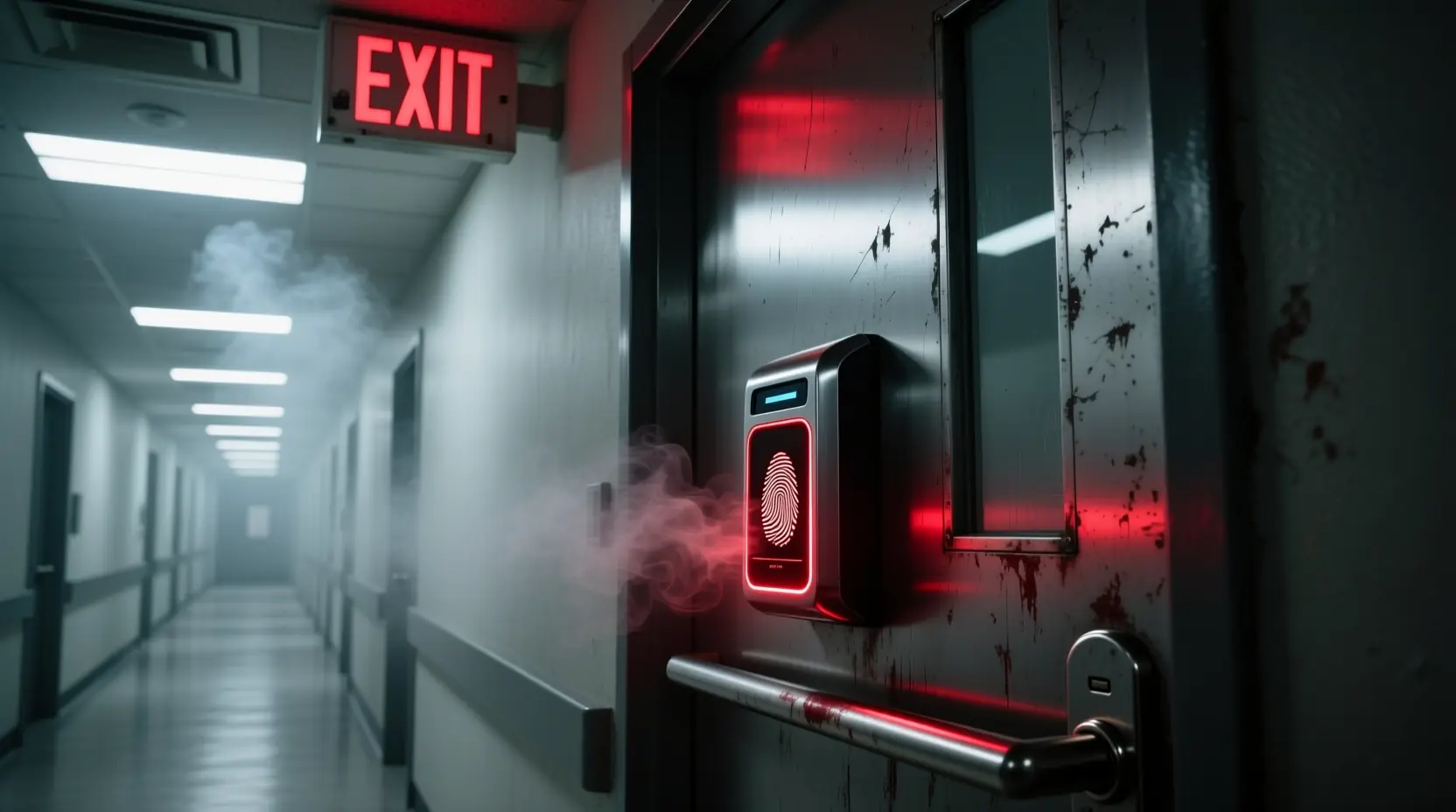
Now, welcome to the real world, where theory goes to die. First, consider failure modes. Not catastrophic system failure, but the daily grind of it. A plaster on a finger. Sweaty palms during a crisis. A smudge on the optical reader. A facial recognition system confused by smoke or poor lighting. You’ve now transformed a fundamental human right—egress—into a user authentication challenge. In a fire, that’s not an inconvenience; it’s a lethal flaw.
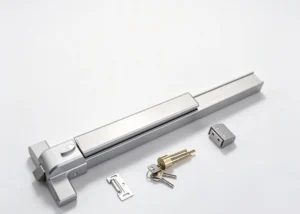
Then, ponder egress flow. A standard exit bar: approach, push, exit. One motion. One second. A biometric system requires: approach, pause, position body, present biometric (correctly), wait for processing/acknowledgment, then actuate the device. You’ve injected 3-5 seconds of delay per person. For a crowd of 50, you’ve just added over two minutes of bottleneck. In life safety, throughput isn’t a metric; it’s a moral imperative. You’ve traded a tangible safety feature for a speculative security one, and the building code is not on your side.
The Inconvenient Truths We Pretend Don’t Exist
Let’s dissect this “integrated solution” and see what’s really inside the box.
- Cost: The Real Price Tag: You’re not purchasing a lock. You’re funding an ecosystem: biometric readers, network controllers, middleware, software licenses, server infrastructure, dedicated IT support contracts, and a perpetual cycle of firmware updates. That $2,000 door device now carries a $15,000 tech appendage. The ROI calculation is a work of fiction.
- The Training Fantasy: “Comprehensive training will be provided!” To whom? The full-time employees? What about the temps, the contractors, the visiting auditor, the delivery person who took a wrong turn? Are they all in the biometric database? Of course not. So your “secure egress” plan now relies on the honor system or a colleague playing doorman. Security via happenstance.
- The Override Charade: To appease the fire inspector, you’ll be forced to install a big, red, mushroom-head override button. So, the actual security protocol becomes: “The door is secure, unless someone needs to leave, in which case they can just hit this obvious button.” You’ve spent a fortune on a system whose primary function is to be bypassed. It’s security theater, with a very expensive set.
- Maintenance: The Hidden Time Bomb: This isn’t a mechanical latch you hose down once a year. It needs software patches, database syncs, lens cleaning, calibration. It will fail, and it will fail at 3 AM on a holiday weekend, or worse, during an actual event. And the discovery of that failure will occur in front of a very unamused Authority Having Jurisdiction (AHJ).
The Fundamental Conflict: Controlled Access vs. Panic Egress
This is the heart of the matter, the philosophical rift no sales rep will articulate. An exit device exists for one reason: to facilitate rapid, unconditional escape. Its design is rooted in a century of fire tragedies and building codes. It is a tool of refuge. A biometric system inherently imposes conditions: “You may exit if you are in the database, if the sensor reads you, if the system is online.”
You are psychologically rebranding the door from a means of escape to a managed portal. In an emergency, instinct takes over. If the door normally requires a scan, people will waste critical seconds trying to scan it, even if a mechanical override is present. You’ve added cognitive load to a process that must be autonomic.
Where It *Might* Make Sense (A Very Short List)
I am not a complete Luddite. There are niche applications, but they are so narrow and laden with caveats they prove the rule.
- Single-Occupant, Maximum-Security Voids: Think a government crypto room. One person. The biometric is for egress audit trailing, not prevention. It must be paired with an immediate, hardwired, mechanical bypass lever inside the room, operable without any knowledge or tool. The exterior must be incapable of locking someone in. I’ve approved two such systems in three decades.
- Managed Interlocks (Man-Traps): Where you must verify identity between two secure zones. Even here, the life-safety egress path from that interstitial space must be completely free of any electronic constraints, leading directly to a public area.
For every other environment—offices, schools, hospitals, apartments—this technology is a solution violently in search of a problem. The problem it creates (impeded egress) is far greater than the one it purports to solve (theft via door).
The Non-Negotiable AHJ Reality Check
Pay attention. This is where your procurement decision meets the immovable object of code compliance.
Any locking device on an exit door, regardless of how “smart” or “biometric” it is, is a lock under the International Building Code (IBC), NFPA 101 Life Safety Code, and their local adoptions.
Its use on a required means of egress is strictly limited. Installation will absolutely require the explicit, written approval of your local AHJ—typically your Fire Marshal or Building Official.
They will demand answers you must have:
1. What is the specific, documented threat that justifies restricting free egress?
2. Does the system fail in the safe (unlocked) mode? Fail-secure (locked) is a violation.
3. Where is the independent, immediate, zero-knowledge mechanical override?
4. How do you ensure usability for all occupants, including those with disabilities or in panic?
5. What is the documented, ongoing maintenance and testing protocol?
If your justification is vague corporate policy or loss prevention, prepare for rejection. I have watched $100,000 worth of shiny tech be condemned with a single red tag. That tag isn’t bureaucracy; it’s experience saving you from yourself.
My advice? Before you even request a quote, call your AHJ. Describe the proposed system. The long pause on the other end of the line, followed by a weary sigh, is the most valuable consultant feedback you will ever get. It is the sound of practical wisdom preventing a costly, dangerous mistake.
Security has its place. But on a door marked EXIT, security cannot be the bouncer. That bar needs to work with the reliability of gravity. Don’t let technological novelty compromise the one thing that must be brutally simple. Now, if you’ll excuse me, I have some catalogs from sensible manufacturers to review.
AHJ WARNING: The integration of biometric or electronic access control on exit doors is a complex code issue. This article represents general industry observations and grumpy opinions. You must consult with your local Authority Having Jurisdiction (AHJ—Fire Marshal, Building Official) and a qualified life safety consultant before specifying or procuring any such system. Compliance with all applicable building and fire codes is the sole responsibility of the building owner and project team. Failure to obtain proper approvals can result in system rejection, fines, and most importantly, compromised life safety.