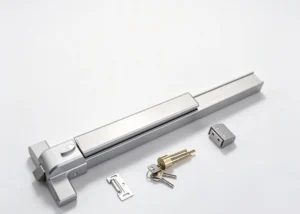
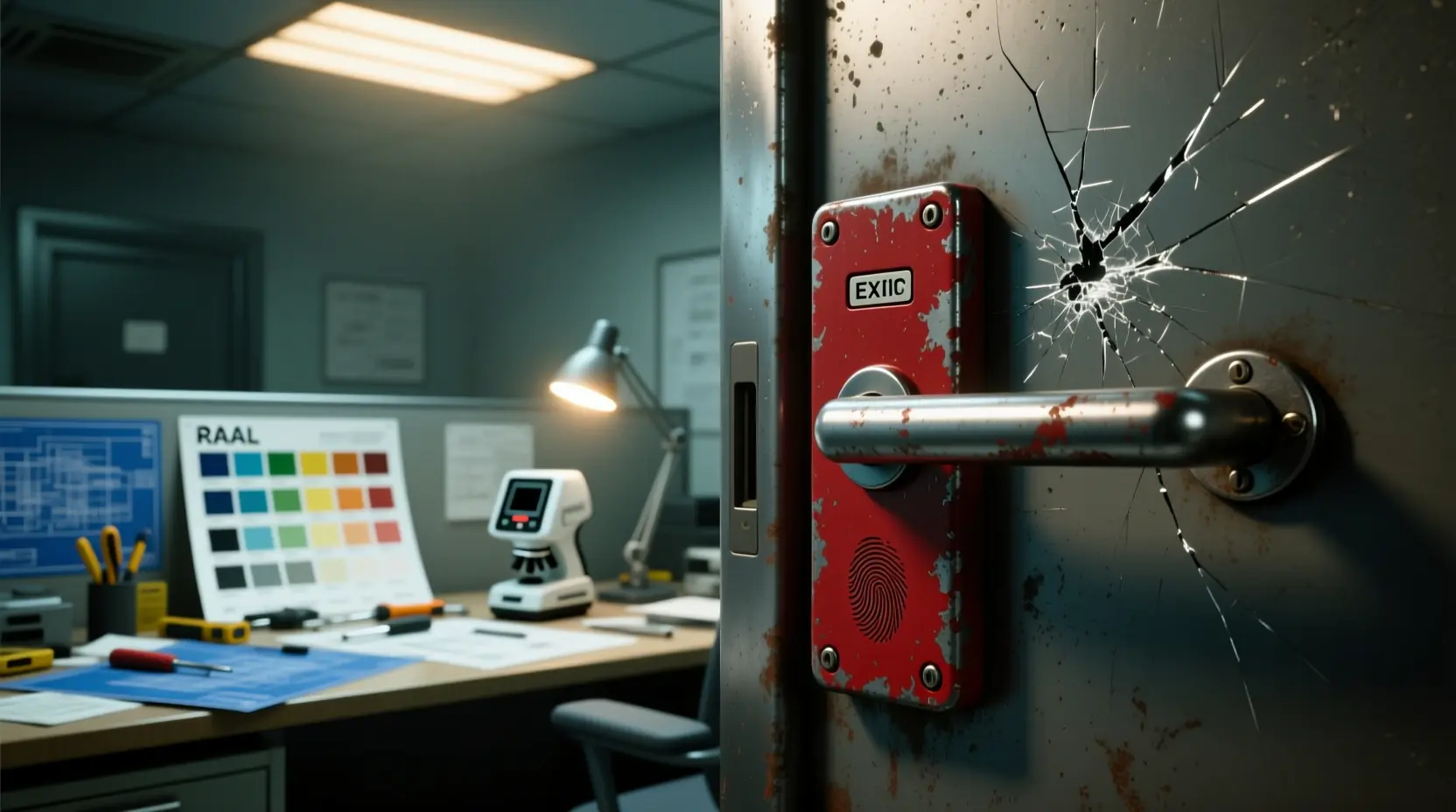
Right. Let’s do this. You need your panic bars painted in ‘Corporate Mascot Aqua’ or ‘Brand Euphoria Magenta.’ Because apparently, the sole purpose of a device designed for blind panic and brute force survival is now to accessorize. I’ve been sourcing and specifying this hardware since bell-bottoms were new, so let’s cut the marketing fluff. This is the raw, grumpy, intentionally chaotic truth about putting lipstick on a life-safety bulldog. It’s going to cost you, it’s going to annoy you, and if you do it wrong, it might just be illegal.
The RAL Chart: Your Holy Grail and Your Source of Eternal Pain
You’ll hear ‘RAL Matching’ thrown around like a magic spell. It’s not magic. It’s a system. RAL Classic is a European color standard—a bunch of numbers that replace poetic nonsense like ‘Whispering Wheat’ with cold, hard facts. RAL 3020 is Traffic Red. Done. I like it because it’s merciless.
Here’s where you, the designer with a vision, first faceplant. You sashay in with a Pantone swatch from your graphic designer’s fancy pad, a snippet of upholstery, or—God help us—a photo of a pebble from a beach in Santorini, and declare ‘Match this!’ We don’t speak Pantone. We speak RAL. That ‘match’ is an interpretation, a best-efforts guess by a guy in a lab coat staring at a spectrophotometer and muttering curses. Your metallic sheen from a fabric sample? You’re getting a matte grey. That’s the reality.
The Snarky Takeaway: Start with the RAL chart. Pick a damned number. If you’re matching something else, understand it’s an approximation and demand a physical powder-coated sample. Not an email. Not a JPEG. A tangible piece of metal you can throw against a wall in frustration. Get it approved in writing.
Powder Coating: It’s Science, Not Sorcery
That finish isn’t paint. It’s powder coating—a thermoplastic polymer sprayed on electrostatically and baked. It’s tough. It’s why we use it. But ‘tough’ isn’t ‘invincible,’ and your durability questions start here. The quality isn’t in the color; it’s in the process amateurs ignore:
- The Substrate Prep (The Part Everyone Skimps On): If the metal isn’t surgically cleaned and treated, your lovely coat is just a mask over future corrosion. It will chip. It will peel. It’s a prophecy.
- The Powder Chemistry (The Invisible Choice): Powders differ. A standard polyester for your lovely ‘Lemon Zest’ might be fine for a low-traffic interior door. Put that same formula on a south-facing exterior door in Madrid, and in a year you’ll have ‘Lemon Faded to Memory.’ Specify for the environment. Or don’t, and enjoy the callback.
- The Film Thickness (Where Pretty Meets Functional): Too thin, it wears. Too thick on a moving part like a latchbolt, and you’ve invented a new door stop. The mechanism binds. A quality finisher masks critical areas. A cheap one drowns the entire thing and hopes for the best.
The Ugly Marriage of Aesthetics and Physics
So you’ve got your custom RAL 6018 (Yellow Green, a truly courageous choice) bars, pristine in their crate. Installation day arrives. Behold:
- The Installers: They have tools, grit, and a deadline. They are not curators. They will scratch it. A good powder coat resists this; it does not defy the laws of physics.
- The Human Gauntlet: Keychains, belt buckles, trolleys, wheelchairs—it’s a daily assault. A high-gloss black will show every single scuff like a neon sign. A matte, textured finish hides a multitude of sins. Choose wisely, or choose vanity.
- The Cleaning Crew: They will use whatever chemical is within arm’s reach. Ammonia, abrasives, mystery solvents—all slowly digesting your custom finish. Your carefully provided maintenance guide will make excellent spill-blotting material.
- The Myth of Eternal Matching: You specified RAL 3020 for the panic bar, the door pull, and the frame. Different manufacturers. Different metal alloys. Different batches. Different installation dates. In three years, under the same light, you will have three distinct shades of red. This is not a failure. This is material science. Anyone who promises otherwise is selling you a fairy tale.
The Inevitable Conclusion (As Promised, No Polish)
Custom-colored panic hardware is a luxury, not a necessity. It carries a luxury price tag and a luxury headache. For the vast majority of functional buildings—schools, hospitals, offices—the standard architectural bronze, black, or dark bronze exist for a reason: they are forgiving, durable, and they quietly acknowledge that people are, fundamentally, destructive.
If you absolutely must proceed, here is your chaotic checklist:
- Start with a physical RAL sample. End with a physical production sample. Trust nothing else.
- Interrogate your supplier and the finishing house about the environment. Is it interior? Direct sun? A salt-air coastal site? Their answer dictates the powder chemistry.
- Specify a high-performance powder. This isn’t for garden furniture. Demand the good stuff for anything that will see more than five people a day.
- Demand a mock-up. Install it in a real, but discreet, location. Let the building inhabitants abuse it for six months. Learn from the scars.
- Budget for the premium, and for the future. Replacement parts won’t be on a shelf. They’ll be a custom batch with a 12-week lead time and a 30% price hike.
AHJ WARNING: THE ONLY PART THAT MATTERS MORE THAN COLOR
Listen closely. All this chatter about sheens and shades is irrelevant if the Authority Having Jurisdiction (AHJ)—your local fire marshal or building inspector—rejects it. Panic hardware is tested and listed (UL 305, BHMA A156.3) *as manufactured*. A custom finish applied post-factory, especially by a third party, can VOID THAT LISTING. If the baking process alters spring temper, or if coating thickness impedes latching, you have installed a very attractive, very illegal door prop.
The Non-Negotiable Rule: Submit your full custom finish specification—powder brand, type, application process—to the AHJ and your door hardware consultant before you order a single piece. Get their approval in writing. The most stunning, durable, perfect custom panic bar is a massive liability if it’s not compliant. Imagine explaining your color choice to a judge after a failed egress incident. Don’t be that procurement story.
Now go away. The data sheets aren’t going to read themselves.