Alright, power down the neon sign in the decompression zone and listen up. We need to talk about doors. Not the aesthetic, reclaimed-barn-door-sliding-into-a-pocket nonsense that decorates your LinkedIn profile. The other ones. The ones that stand between your ‘collaborative ecosystem’ and a coroner’s report. Specifically, we’re untangling the barbed wire knot that is Delayed Egress versus Controlled Egress under NFPA 101. I’ve seen more confusion on this in tech specs than in a scrum meeting about agile methodologies.
Let’s start with the immutable, inconvenient law you all try to UX-widget your way around: The means of egress shall be continuous and unobstructed. From the beanbag to the public sidewalk. No puzzles, no turnstiles, no badge-readers that only work for full-time employees. It’s not a guideline. It’s the code.
But you have problems. Problem A: You don’t want the prototype drone walking out with Tuesday’s intern. Problem B: You want to funnel visitors past a receptionist who judges them. Problem C: You think ‘secure campus’ means every door has a maglock. The code says ‘no.’ But it offers two—exactly two—very specific, wildly different, and catastrophically misunderstood exceptions. Mix them up and you’ll be explaining your ‘innovative egress strategy’ to a fire marshal who enjoys saying ‘violation.’
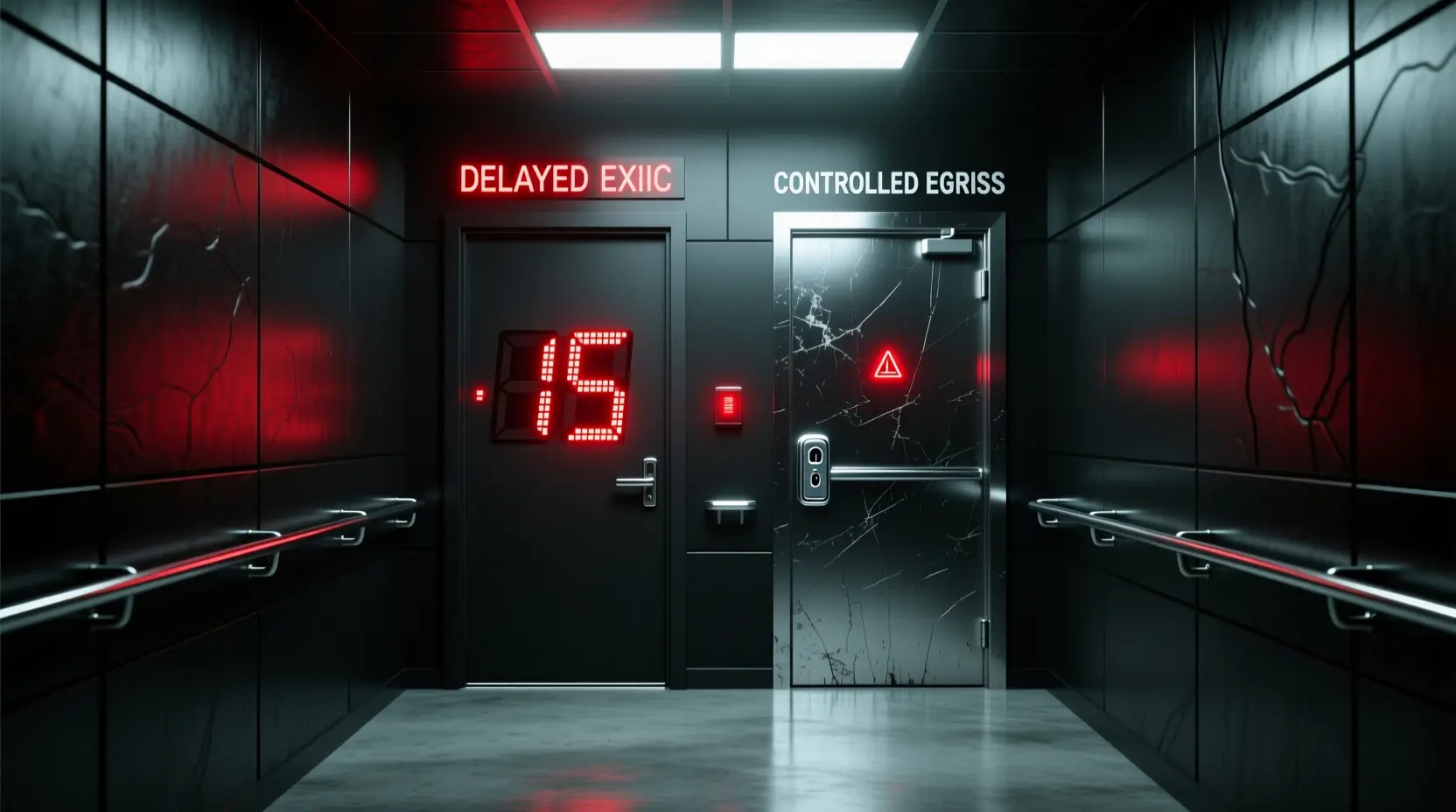
Delayed Egress: The ‘Wait For The Beep’ Door
This is the one you’ve maybe heard of. NFPA 101, Sections 7.2.1.6.1 & 11. It’s a locking system designed to delay unauthorized exit, not prevent it. The philosophy is that a brief, controlled delay for security is acceptable, provided the door becomes a free, open passage the instant things get real.
Here is the non-negotiable checklist. This isn’t a buffet. You take all of it.
- The Delay: 15 seconds. Maximum. From the moment constant pressure is applied to the release device, a timer starts. Not 14. Not 16. Fifteen.
- The Alarm: It must sound a distinctive, local alarm when activated. This alerts security someone’s at the door and tells the person pushing, ‘You did it. Now wait.’
- The Automatic Release: This is the core. The lock MUST release immediately upon:
- Activation of the sprinkler system or fire alarm.
- Loss of power to the lock.
- The expiration of the 15-second delay.
- The Signage: A glaring, idiot-proof sign reading: ‘PUSH UNTIL ALARM SOUNDS. DOOR CAN OPEN IN 15 SECONDS.’ The exact words matter.
- The Hardware: It must be a listed, tested device for this purpose. You cannot hack a Raspberry Pi to a maglock and call it a day.
Where it might—might—work in your tech palace: Perhaps a ground-floor lab or server room door opening directly to a secure exterior yard. As a main exit for 200 caffeine-fueled engineers in a panic? The Authority Having Jurisdiction (AHJ) will picture that queue and laugh you out of the room. It’s a security delay, not a people-management tool.
Controlled Egress: The ‘You Are Not Leaving’ Door
Now, the more complex, more restrictive, and more frequently misapplied beast: Controlled Egress. NFPA 101, Section 7.2.1.6.2 & 18. This isn’t a delay; it’s a conditional lockdown. The code permits locked egress doors only for specific occupancies under draconian conditions. We’re talking hospitals, psychiatric facilities, detention centers. Places where the occupants are deemed incapable of self-preservation due to clinical need or security risk.
Notice what’s conspicuously absent from that list? Your tech office. Your R&D lab. Your innovation hub.
The requirements are apocalyptic. A sample:
- Continuous, on-duty staff supervision within the locked unit.
- Redundant, instantaneous release mechanisms at a constantly staffed location.
- Release on all the conditions of Delayed Egress, plus a manual mechanical release at the door itself.
- Clinical or security justification for the locking.
So, for your startup? Forget it. Unless you’re running a licensed psychiatric ward on the third floor (‘The Crypto Wing’), Controlled Egress is not your tool. The moment you say, ‘We need to badge-lock the exits to protect our smoothie blender IP,’ you are describing a code violation, not a code exception.
The Inevitable Whine: ‘But Our Security Posture!’
The whimper is audible from here. ‘Our intellectual property! Our hardware!’ I understand. NFPA 101 does not. Its sole mission is to prevent people from dying in a fire. Theft is a problem you solve within the code’s constraints, not by ignoring them.
So what are your actual options, besides mandatory mindfulness seminars?
- Vestibules & Air Locks: Create a secured interior layer. The final exit door itself remains unlocked to the outside. To reach it, you pass through an interior door that is access-controlled. In a fire, the interior lock releases, providing a clear path to the free-to-open exit. This is often the most elegant solution.
- Security at the Entrance, Not the Exit: Funnel controlled entry at the main lobby. Use turnstiles, mantraps, or a human who looks up. All designated exit doors remain unimpeded, outward-opening, with simple hardware. You solve theft at the point of entry, not by trapping your workforce.
- Protect Assets, Not Trap People: Lock the server closet. Lock the prototype lab. Install CCTV. Do not lock the doors leading to fresh air and survival.
- The Pre-Mortem Meeting: Bring your security director, your life safety consultant, and your architect into a windowless room before schematic design. Let them fight it out then, not when the drywall is up and the fire marshal is holding a red tag.
The Bottom Line
To summarize this rant into actionable, if bitter, points:
- Delayed Egress = A 15-second hold-up with guaranteed release. Possible for specific, secondary doors. The AHJ will scrutinize it with extreme prejudice.
- Controlled Egress = A full lockdown for institutional settings. Almost certainly NOT permissible for your Business Occupancy tech office. Suggesting it reveals a fundamental misunderstanding that will sink your project.
The tension between the Security team (who wants a fortress) and the Life Safety Code (which wants an open runway) is real. But the code is the law. Your open-plan office, with its ping-pong tables and existential dread, is a Business Occupancy. The rules assume the occupants are awake, ambulatory, and familiar with their environment. Your job is to keep them that way on their worst day.
Treat egress not as an architectural afterthought or an IT security problem, but as a life-critical system. It sits at the ugly intersection of architecture, fire protection engineering, liability, and local bureaucracy. Grant it the respect you’d grant a data center’s cooling system, because the cost of failure is measured in lives, not latency.
***
AHJ WARNING:
Everything above is grumpy commentary, not professional advice. NFPA 101 is adopted and amended locally. The Authority Having Jurisdiction (AHJ)—your local fire marshal, building official, or fire department—has the final, unappealable say. Their interpretation is law. You will engage them early. You will present your plans clearly. You will not argue based on an article you read. Their word is gospel. Disregard this at your own profound financial and legal peril.