
Exit Bars on Old Warehouse Doors: A Grumpy Procurement Manager’s Guide to Not Killing Anyone
Look. I’ve been sourcing and installing hardware for industrial facilities since your ‘value-engineered’ consultants were in diapers. I’ve seen the aftermath of the ‘cobble-it-together’ approach: the sheared bolts, the bent bars, the doors that opened directly into a lawsuit. So, someone with a shred of sense has finally pointed at your warehouse’s rolling steel sarcophagus and muttered, ‘We need an exit bar.’ A glimmer of hope. Now, let’s promptly extinguish it by explaining how you’re about to screw this up.
First, a fundamental truth you must accept: Your grandpappy’s 10-foot sliding timber door or that cold-rolled steel behemoth is not a ‘door’ in the eyes of modern building code. It’s a barrier. It was designed to keep weather out and inventory in. Its ‘latch’ was a bent piece of rebar and a prayer. Retrofitting it for safe human egress isn’t an upgrade; it’s a complete re-engineering project disguised as a hardware swap.
The Exit Bar Illusion: Savior or Expensive Paperweight?
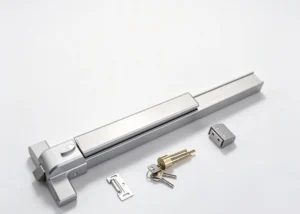
The siren song is clear. A push pad, a loud *clunk*, freedom. It’s the holy grail for fire marshals. Slap one on, check the box, go home early. This fantasy lasts exactly until you try to mount it.
Mounting Mayhem: Your door is 1/4-inch steel plate or 6-inch thick timber. It’s not a hollow metal door with a nice, prepped edge. Mounting an exit device requires surgical precision. You’ll need a mag drill, annular cutters, and a template drawn by someone who hasn’t had their third whiskey. Off by a few millimeters? The latch won’t engage. Try to weld a bracket on? Heat warps things. Now your door binds in its track. Brilliant.
The Latch Locator Game: The bar is just the actuator. It needs a latch to retract. Where does that latch… latch? Into the crumbling concrete floor? The rotted timber jamb? You’ll need a mortise latch (good luck pocketing that into iron), or a surface-mounted vertical rod device. That means more holes, more reinforcement plates, more points of potential failure. Every drill bit you break is a metaphor for your project timeline.
The Door Itself, The Forgotten Hero: An exit device assumes the door moves with reasonable effort. Does your door? Or does it require a running start, a pry bar, and a curse against your ancestors? The exit bar only retracts the latch. If the door weighs four tons and rides on a track packed with 50 years of dirt and rust, pushing the bar just gives you a satisfying mechanical *thud* as you remain trapped. You’ve now paid thousands for a placebo.
A Walk Through Your New Nightmare
Let’s visualize your ‘simple’ retrofit on a typical sliding industrial door.
- The ‘Survey’: You look above the door for mounting space. The track and hangers are there. So, you’re forced into a surface-mounted vertical rod device. Double the hardware, double the installation complexity, double the things that can go wrong.
- Strike Plate Archeology: The door slides into a pocket. There’s no strike. You must fabricate a steel beast and anchor it into the masonry. Hope the concrete behind the facade isn’t powder. Hope your anchors are rated for a school bus impact.
- Rod Roulette: Cutting vertical rods to exact length is a dark art. Too long, they bind. Too short, they don’t latch. You’ll be on a jobside with a hacksaw and a dream, covered in metal shavings.
- The Grand Finale: You install it all. You push the bar. The latch retracts! The door moves three inches and groans to a halt. The exit device housing starts to bend because the door isn’t moving. You now need new rollers, track alignment, and possibly a door replacement. The ‘simple’ project just ate your entire CapEx budget.
The Grumpy List of Overlooked Catastrophes
- Clear Width Shrinkage: That 10-foot opening? After your new hardware and required clearances, the actual operable clear width might now be under code minimum. Did you measure? Of course not.
- The 30-Pound Rule: NFPA 101 dictates max force to start door movement. Your door needs a forklift nudge. Your shiny new bar is now a very expensive code violation.
- Signage Silliness: You need the ‘PUSH TO OPEN’ decal. Not your corporate mantra. Legible, high-contrast, 1-inch letters. The inspector will check.
- Low-Voltage Labyrinth: Want to tie it to an alarm or door monitor? Now you’re running conduit and flexible wiring on a moving object. Say hello to chafed wires and false alarms in six months.
- The Dogging Device Debacle: The little key or lever that locks the bar down for loading? You NEED it. Otherwise, a pallet kiss will un-latch the door, sending it swinging into a person or truck. More parts, more cost, more things to lose.
The Step You’ll Try to Skip (And Will Regret)
Before you even think about a purchase order, get a structural assessment. Not from a salesman. From a licensed structural engineer. Adding a concentrated point load where people will push with panic-force changes everything. Will that old steel lintel handle it? Will the timber header splinter? This is your ‘cover your assets’ phase. Skip it, and you own all the liability.
The Only Non-Negotiable Truth
Pay attention. This isn’t grumpy opinion; it’s career-saving fact.
BOLTING AN EXIT BAR ONTO AN EXISTING DOOR IS A MODIFICATION TO THE MEANS OF EGRESS. THIS IS NOT A MINOR HARDWARE SWAP. THE AUTHORITY HAVING JURISDICTION (AHJ) – YOUR LOCAL FIRE MARSHAL OR BUILDING OFFICIAL – MUST REVIEW AND APPROVE YOUR PLANS BEFORE YOU START, AND MUST INSPECT THE FINAL INSTALLATION. THEIR WORD IS LAW. A CATALOG’S ‘CODE-COMPLIANT’ STAMP IS WORTHLESS IF YOUR INSPECTOR SAYS ‘NO.’ FAILURE TO INVOLVE THE AHJ CAN LEAD TO FINES, ORDERS TO DEMO YOUR WORK, AND SOUL-CRUSHING LEGAL LIABILITY IF YOUR INSTALLATION FAILS WHEN IT MATTERS MOST.
There. Your ‘quick fix’ is now the complicated, expensive, code-driven project it always was. Now go do it properly, or leave the death-trap door alone. I have a budget meeting to scowl at.