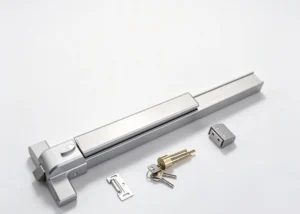

Right. You’re here because your project timeline is a fantasy and your blood pressure is a reality. The email just landed: ‘Grade 1 Exit Devices – 40+ Week Lead Time.’ Your carefully sequenced schedule now resembles a Dali painting. The GC’s daily ‘just checking in’ texts are less check-ins and more digital gut-punches. You’re not looking for sympathy; you ran out of that six supply-chain crises ago. You need the unvarnished, occasionally snarky truth about why this is happening and how you might—might—navigate the intentional chaos without getting professionally crucified.
The Anatomy of a Category 5 Cluster: Why This Isn’t ‘Just’ a Delay
Forget ‘supply chain issues.’ That’s a lazy umbrella term for a symphony of failures. This is a precision-engineered disaster. Let’s pull apart the watch and find all the broken springs.
1. The Raw Material Hunger Games
A Grade 1 device isn’t a commodity. It’s a vault on a door. It requires specific, often proprietary, alloys—the right steel for the latch, the exact brass for the cylinder, a particular aluminum for the housing. These aren’t sitting in a bin at the local metal supermarket. Post-2020, the global metals market decided your panic bar is low-priority cargo. Mills chased automotive and aerospace dollars. European energy prices turned smelters into tourist attractions. So the sublime piece of engineered steel that must withstand 500,000 cycles of abuse? Its raw ore is currently appreciating in value on a container ship drifting off Shanghai. Congratulations.
2. The JIT (Just-In-Time) Joke
Manufacturers perfected lean inventory. It was beautiful. A $0.12 spring arrived at 7 AM for the 8 AM assembly line. Peak efficiency. Then the truck carrying the $0.12 spring didn’t come. The entire $850 rim device assembly line stops. Dead. Not for a day. For weeks. Because the entire model was built on the assumption of perpetual motion in global logistics. That assumption is now a punchline. They aren’t building half a device. They’re building nothing, waiting for all the somethings to arrive.
3. The Ghosts in the Machine: Skilled Labor
Walk a factory floor. The person assembling a vertical rod device for a hospital isn’t a button-pusher. They’re a technician who understands torque, tolerance, and the terrifying rigor of ASTM F476. A lot of those people rode into the sunset during the Great Reshuffling. Training a replacement to that level takes months. So, when the mythical $0.12 spring finally arrives, the line is being run by a skeleton crew of veterans training newbies. Output is a trickle, not a flow.
4. The Demand Tsunami (From the Last Place You’d Expect)
With interest rates up, you’d think demand would cool. Cute thought. Enter the public sector tsunami: federal infrastructure bills, state school grants, municipal hospital expansions. These projects are mandated to use Grade 1 hardware. There’s no value-engineering it out. The spec is the spec. So, while your sleek corporate HQ might get delayed, the new 500-bed county hospital will not. Factories are allocating their pitiful output to these massive, multi-year, politically-sensitive jobs. Your 50-device order for an office retrofit just got bumped to 2025. Enjoy the view from the back of the queue.
5. Distributors: From Warehouse Kings to Click-Taking Clerks
This one is personal. The distribution partner of yore—the one with a cavernous warehouse and a grizzled pro who could find a discontinued part in the dark—is nearly extinct. The modern ‘distributor’ is an e-commerce platform with a sales team. Their inventory is a line item on a P&L they’re desperate to minimize. Their value proposition is next-day delivery of items the manufacturer has in stock. When the manufacturer has nothing, they have less than nothing. They become a very expensive, very polite messenger service, reading you the 40-week lead time with a sympathetic tone they learned in a webinar.
6. Logistics: The Final, Feeble Link
Assume the miracle occurs. Your devices are built, finished, and boxed. Now they must travel. The national trucking network is held together by duct tape and caffeine. LTL (Less Than Truckload) is a lottery. Your pallet will sit. And sit. It will wait for a driver, then wait at a cross-dock, then wait on a trailer that’s missing two wheels. The final mile is now the final marathon.
The Grumpy Manager’s Survival Guide: Tactics for the Trenches
You can’t fix the world. But you can stop being its favorite doormat. Here is your messy, imperfect, often frustrating playbook.
1. Spec for War, Not for Brochures
The single greatest leverage point is before the bid. Your specifications must be battle-hardened. ‘Or equal’ is not a suggestion; it is your lifeline. You need a pre-vetted, AHJ-ready list of three acceptable manufacturers for every critical device. This turns a single-source catastrophe into a multi-front sourcing campaign. It gives you options. Options are oxygen.
2. Partner Early, Partner Savagely
The moment a project is even a glimmer, engage your supplier. Not with a PO. With a strategy session. Demand transparency: “What’s your real allocation look like? What finishes are moving faster? Who at the factory owns your account?” This is where you identify the true partners from the order-takers. The partner has a warehouse with actual stock and a direct line to the factory floor. The order-taker has a ‘Contact Us’ form.
3. Embrace the Boring Workhorse
Does every door need the architectural flagship model with the custom lever and integrated everything? Or will a no-frills, Grade-1-compliant workhorse suffice on 80% of the openings? Architects will fuss. Remind them that a functioning, code-compliant building with ‘standard’ finishes opens on time. A ‘bespoke’ building with no doors does not. Simplify mechanism choices where possible. The fewer moving parts in the spec, the fewer moving parts waiting on a boat.
4. Lock in Allocation, Not Just a Quote
A price is a fantasy. An allocation slot is a tangible asset. Once the design is 90%, place a deposit and get a firm, written production slot. You are no longer a name on a list; you are a line on a schedule. Yes, that schedule might slide, but you’ll slide with it, instead of being thrown off the back.
5. The Contrarian Play: Pre-Buy & Warehouse
For the well-capitalized and the chronically busy. If you consistently use the same hardware across projects (student housing, retail chains), buy it in bulk, 12-18 months ahead of need. Become your own distributor. The capital tie-up is significant, but you achieve something priceless: certainty. You control the inventory. You are the master of your own lead-time destiny.
6. Worship at the Altar of Stock Finishes
Anodizing and custom PVD finishes are artistry. Art takes time. ‘US10B Satin Stainless’ and ‘US26D Dull Bronze’ are commodities. They are sprayed in batches and shoved out the door. That architect’s ‘Weathered Zinc’ custom color is a beautiful, project-derailing liability. Fight for stock finishes like your profit margin depends on it. Because it does.
7. The Aftermarket Minefield (Tread Lightly)
Reputable refurbishment firms exist. They take old devices, rebuild them to Grade 1 spec, and refinish them. They often have stock. It is a viable, if complex, path. The catch? You must navigate a labyrinth of AHJ approvals and potential warranty voids. This is not a casual decision. It is a procedural siege requiring meticulous documentation.
8. Redesign the Door (The Nuclear Option)
When the device is a phantom, attack the opening. Can a pair of doors become a single? Can a concealed vertical rod become surface-mounted? It’s a change order, a hassle, and an architect’s nightmare. But it might be faster than waiting for a unicorn. Weigh the cost of redesign against the cost of delay. Sometimes, the math is brutal but clear.
THE NON-NEGOTIABLE, CAPS-LOCK AHJ WARNING
Read this twice. Every clever workaround, every substitution, every ‘or equal’ dies at the feet of the Authority Having Jurisdiction. The Fire Marshal is not impressed by your lead times. The Building Inspector’s code book does not have a ‘supply chain exception’ clause.
- NO STEALTH SUBSTITUTIONS: Swapping a manufacturer without formal, written approval is professional suicide. You will be found out. You will be red-tagged. You will pay to rip it out.
- REFURBISHED HARDWARE IS GUILTY UNTIL PROVEN INNOCENT: Many jurisdictions prohibit it outright. Others require specific third-party certifications. Do not assume. Get the ruling in writing from your specific AHJ before you even think about it.
- EARLY AND OFTEN IS THE ONLY STRATEGY: Bring the AHJ into the conversation the moment lead times threaten the schedule. Present options, seek guidance, document everything. Your paper trail is your only shield when things go sideways.
There it is. The game has changed. You are no longer just a procurement manager; you are a logistician, a diplomat, and a gambler. The chaos is intentional because the system is broken. Your job is to navigate the brokenness. Now go. Annoy your distributor. Befriend a warehouse manager. And for heaven’s sake, get everything in writing.