
Perplexity & Burstiness: The Grumpy Truth About Measuring Narrow Stile Backset
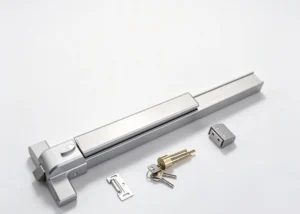
Forget everything you think you know about door hardware. If you’ve ever ordered a beautiful, expensive exit device for a sleek, modern narrow stile door and ended up with a site supervisor screaming down the phone and a project budget bleeding out, you’ve experienced the two silent killers of procurement: Perplexity and Burstiness.
Perplexity is that dizzying, head-in-your-hands moment when you realize that “backset” doesn’t mean one simple thing. It’s a hydra-headed monster that changes depending on the door profile, the device model, and whether you care about looks or function. Burstiness is the subsequent, catastrophic explosion of cost, time, and reputation when your best guess meets cold, hard, mis-drilled metal. This isn’t a tutorial; it’s a post-mortem for an industry-wide pathology.
Why Your Tape Measure is Lying to You
In the gentle, forgiving world of wood doors and cylindrical locks, backset is a polite suggestion. On an aluminum narrow stile door with an exit device, it’s a binding contract written in blood and powder coating. The “backset” here is the critical vector from the door’s leading edge to the heart of the device’s latch mechanism. Get it wrong by a few sixteenths, and you haven’t just made a minor error. You’ve created a single point of failure for life safety, accessibility, and security. And you’ve probably voided about eight different warranties.
The Anatomy of a Disaster: AKA The Usual Process
Let’s follow the chaos. The architect selects a minimal-profile door from a high-end catalog. The hardware spec, drafted under the influence of budget constraints and wishful thinking, calls for a “compatible” exit device. The door fabricator, drowning in shop drawings, makes a reasonable assumption based on a blurry PDF. The installer, on the day, becomes the unwilling star of a tragedy. The device doesn’t fit. Or it fits but looks grotesque. Or it latches with all the security of a wet noodle.
This is Burstiness in action. The single event—the wrong measurement—triggers a cascade: expedited freight for new parts, skilled labor for rework, delay penalties, and the priceless erosion of professional trust. All because Perplexity—the lack of a single, clear, authoritative standard—was allowed to fester.
A Grumpy, Non-Linear Guide to Not Failing
So, how do you fight Perplexity to prevent Burstiness? You embrace intentional, meticulous chaos. You become a detective, not an order-taker.
Step 1: Secure the Holy Texts (No Substitutions)
Before you even breathe the word “backset,” you need two documents: the exact, detailed cross-section drawing from the door manufacturer (not a generic profile, the specific series) and the full-scale, 1:1 template from the exit device manufacturer (not the cute little drawing in the catalog, the actual PDF template for the exact model number). If anyone tells you they’re “similar,” walk away. This is the foundation. Without both, you are building on sand.
Step 2: Declare Your War: Aesthetics vs. Mechanics
Here’s where philosophy meets metal. Do you want the device centered perfectly on the narrow stile because it pleases the design gods? Or do you need to position it for optimal latch throw and strike engagement to please the fire marshal? Spoiler: they are almost never the same spot. This decision must be made early, documented loudly, and communicated in triplicate. The choice dictates your measurement origin point.
Step 3: The Overlay (Where the Magic Doesn’t Happen)
Take the device template. Overlay it—digitally or with a printed, painstakingly scaled version—onto the door section. You are looking for two things: First, does the proposed location give you the required latch projection? Second, and this is crucial, does it avoid the door’s internal reinforcements? Drilling into a horizontal stiffener is a rite of passage I wouldn’t wish on my worst enemy. This overlay exercise is the measurement. The number you derive (“1-1/4” from leading edge to crossbore center”) is merely the artifact of this investigation.
Step 4: Communicate Like a Paranoid Conspiracy Theorist
Scribbling “BS 1-1/4” on a submittal is professional malpractice. You must create a marked-up, high-resolution, idiot-proof drawing. Circle the measurement. Draw an arrow. Use red. Add a note: “CRITICAL DIMENSION: CENTERLINE OF CROSSBORE FOR [DEVICE MODEL XYZ] TO BE 1-1/4″ FROM LEADING DOOR EDGE (REFER TO TEMPLATE DWG #12345). VERIFY WITH DOOR SHOP ENGINEER BEFORE ANY FABRICATION.” Send it to the door shop, the GC, the architect, the installer, and your own personal archives. Cover. Your. Assets.
Step 5: The Special Circle of Hell: Vertical Rod Devices
If a standard mortise or rim device is a difficult puzzle, a surface vertical rod device is a Rubik’s Cube, blindfolded. Now your single backset measurement must align perfectly across the top latch, the bottom rod, and the floor guide. A misalignment here doesn’t just look bad; it causes binding, mechanical failure, and a door that won’t open in a panic. The tolerance is unforgiving. This is Perplexity squared, leading directly to Burstiness of epic proportions.
The Real Cost of a Shortcut
Think a re-measure and a new hole is the worst outcome? Think bigger. A failed backset can mean:
- A brand-new door leaf (because you can’t un-drill structural aluminum).
- A new, now “modified” and non-returnable exit device.
- Skilled labor for demounting, re-prepping, and re-hanging.
- Project delays that ripple through every other trade.
- Your name whispered in conference rooms as “the person who cost us the quarter.”
**AHJ WARNING: THE MOST IMPORTANT PART OF THIS ARTICLE**
Read this twice. Maybe three times. Burn it into your soul.
EVERYTHING DISCUSSED HERE—EVERY MEASUREMENT, EVERY TEMPLATE, EVERY ASSUMPTION—IS NULL AND VOID UNTIL BLESSED BY THE LOCAL AUTHORITY HAVING JURISDICTION (AHJ).
The Fire Marshal, the Building Inspector, the Code Official: they are the final arbiters of reality. They do not care about your aesthetic alignment, your manufacturer’s tolerances, or your project schedule. They care about one thing: will this door, under panic load, release instantly and fully to allow egress? If your perfectly calculated backset results in a latch engagement they deem insufficient, you lose. Full stop. You will remove and replace. Their codebook is law; your purchase order is a suggestion.
THE ONLY WAY TO MITIGATE THIS ULTIMATE BURSTINESS RISK IS TO CONSULT THE AHJ EARLY AND OFTEN. Show them your plans, your templates, your proposed dimensions. Get their nod in writing if possible. This step is non-negotiable. It’s the difference between a professional installation and a very expensive lesson.
Now go forth. Be perplexed by the complexity, but for the love of all that’s holy, plan meticulously so you don’t burst the budget, the schedule, or your own sanity.