
Mortise vs. Rim Exit Devices on Narrow Stile Doors: A Procurement Manager’s Angry Guide
Let’s skip the coffee. It’s never good enough anyway. We’re addressing one of the most consistently botched details in commercial construction: specifying exit devices for narrow stile aluminum frames. You know, the skinny glass boxes adorning every corporate headquarters and boutique retail space built after everyone forgot what a solid wall was. The industry treats it like a simple choice. It’s not. It’s a geometric and financial trap masquerading as a hardware selection. Most decisions are made based on a glossy brochure or an architect’s whim, not physics or fiscal sanity. I’m here, from my desk littered with submittal rejects and change orders, to tell you why you’re probably doing it wrong.
The Battlefield: What Even Is a Narrow Stile Frame?
First, the basics we pretend to understand. A narrow stile aluminum frame is, shockingly, narrow. The vertical members might be 2 inches wide. They’re designed to be minimal, to disappear, to hold vast sheets of expensive glass. They are not designed, in their pure form, to have a heavy, mechanical panic device bolted to them. This is the foundational lie. You’re trying to adapt hardware engineered for the robust, forgiving world of steel doors and solid core wood onto a delicate, hollow aluminum profile. It’s like mounting a plow on a sports car and being surprised when it falls apart.
Contender 1: The Mortise Exit Device (The “Inside Job”)
The mortise device is the elegant, integrated solution. The mechanism lives inside a pocket milled into the door edge. You see a touchpad or crossbar on the face. It’s clean. It’s invisible from the exterior. Architects adore it. On a standard 1-3/4″ thick door, it’s perfection.
The Catch: That elegance requires a mortise. A significant amount of material must be removed to house the mechanism. On a hollow aluminum door? There is no ‘there’ there. It’s a thin shell. You can’t just rout out a pocket.
The solution? A closer edge or false stile. This is a supplemental piece of aluminum or steel welded or mechanically fastened to the door’s vertical edge, creating a solid section wide enough to accept the mortise pocket. It’s a fabrication project, not a simple installation.
The Grumpy Pros:
- Aesthetic Victory: Unbeatable. The door face remains nearly pristine.
- Perceived Security: The internal latch is generally more resistant to forced entry than a rim device’s vertical rods.
- Streamlined Operation: When executed flawlessly, the actuation feels solid and direct.
The Costly, Maddening Cons:
- Budget Annihilator: You’re not buying a device; you’re buying a custom fabrication. The cost of the closer edge, precision machining, and specialized labor eclipses the hardware itself. This is a shop-built assembly.
- Door Integrity Gambit: Adding that much metal changes weight, balance, and stress points. Your door closer and hinge adjustments become a high-wire act.
- Service Nightmare: A field repair on a mortised narrow stile door is a specialist’s call. It’s not a cover-plate-off fix. Prepare for extravagant billable hours.
- Glazing System Stress: The forces from actuating the device transmit into the glass holding system. If the glazing isn’t engineered for it, failure is a matter of when, not if.
Contender 2: The Rim Exit Device (The “Bolt-On Bruiser”)
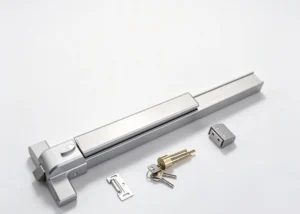
The rim device is the exterior-mounted workhorse. The entire mechanism—a heavy steel box—mounts on the interior face of the door. Vertical rods run from it to latch into the frame’s head and sill. It’s bulky. It’s visibly mechanical. It looks, as the design team will lament, “industrial.”
The Reality: For many narrow stile applications, this is the pragmatic default, and for brutally simple reasons.
Grumpy Pros:
- Structural Sense: It doesn’t compromise the door’s thin edge. The device’s own housing provides the structural integrity. The door is essentially a backing plate.
- Field-Sanity: Installation is comparatively straightforward. A competent installer can mount it, align the rods, and set the strikes. Maintenance is easier—everything is accessible.
- Fiscal Responsibility: Dramatically cheaper. No custom fabrication, less precision milling, lower labor cost. It’s the value-engineered answer before the term is uttered.
- Forgiving Nature: On a flexible aluminum door, the rim device acts as a stiffening brace.
The Loud, Obvious Cons:
- The Look: It’s utilitarian. It announces its purpose. It is the antithesis of minimalism. Be prepared for pushback.
- Vertical Rod Vulnerability: The rods are the weak point. They require precise alignment and clearance. Bottom rods can snag debris; single top-rod configurations compromise security.
- Snag Hazard & Cleaning Burden: The protruding box is a hip-bruiser in tight corridors. In sterile or clean environments, it’s a dust and germ trap.
- Door Thickness Dependency: The device is designed for a nominal door thickness. A very thin narrow stile door may require unsightly spacers, defeating the purpose.
The Unvarnished Decision Matrix (Napkin Edition)
Forget the sales poetry. Here’s your flowchart, scribbled in permanent marker:
- Who’s Driving? Is the architect’s vision sacrosanct with a blank-check budget? You’re on the path to a mortise device with a fabricated door edge. Is the project manager breathing down your neck about cost? The rim device is your only rational exit.
- What’s the Door’s Actual Life? Loading dock, warehouse, school hallway—anywhere it will be abused? Rim. Luxury showroom or executive suite where aesthetics trump all? Mortise might be viable, if you can afford the supporting cast.
- What is the Door, Really? Not all narrow stile doors are equal. Some have reinforced internal structures. Some are glorified tin foil. Your hardware supplier and door fabricator must be in locked-room consensus. A mortise device on an inadequate door is a warranty disaster.
- Who’s Swinging the Tools? A seasoned commercial hardware installer? They might navigate a mortise installation. A general contractor’s crew? Specify rim. Save everyone the headache.
The Core, Unpleasant Truth
Both solutions are compromises on narrow stile frames. The frame was never intended for this. You are choosing the least-bad adaptation for your specific set of constraints—cost, aesthetics, use, and door construction. There is no perfect answer, only a series of managed trade-offs.
The Final, Non-Negotiable Mandate: The AHJ Warning
PAY ATTENTION. THIS IS THE ONLY PART THAT MATTERS.
All this debate about elegance versus economy is academic theater if you ignore the Authority Having Jurisdiction (AHJ). The AHJ—the fire marshal, the building official—is the final arbiter. Their codebook is law.
You cannot simply select a device you like. The device MUST be:
- Listed for the Assembly: If this is a fire-rated opening, the exit device must be part of a tested and listed complete assembly (door, frame, hardware, glazing). You cannot mix and match. The specific combination of your narrow stile door and chosen exit device must have a qualifying listing (UL, Intertek WHI, etc.). This stops more projects than anything else.
- Approved for the Door Type: The listing report will explicitly state the door constructions it’s approved for. “Narrow stile aluminum” is not a universal approval.
- Installed ExACTLY Per the Listing: The manufacturer’s installation instructions are part of the listing. If the instructions call for specific fasteners, spacing, or preparations, and your installer deviates, you have voided the listing. The AHJ can and will reject it.
Do not accept vague assurances from sales representatives or contractors. Your duty is to obtain the manufacturer’s installation instructions and the official listing report that explicitly includes your specific narrow stile door and frame with the chosen exit device. Have this documentation in hand before you finalize the specification. Engage the AHJ early. Submit this documentation with your plans.
Ignore this, and you will own a beautiful, expensive, non-compliant door assembly that must be ripped out and replaced. The project will be delayed, budgets shattered, and reputations damaged. And I will have no sympathy for you. I’ll just add your failure to my list of cautionary tales. Now go make a decision, and for goodness’ sake, get the documentation.