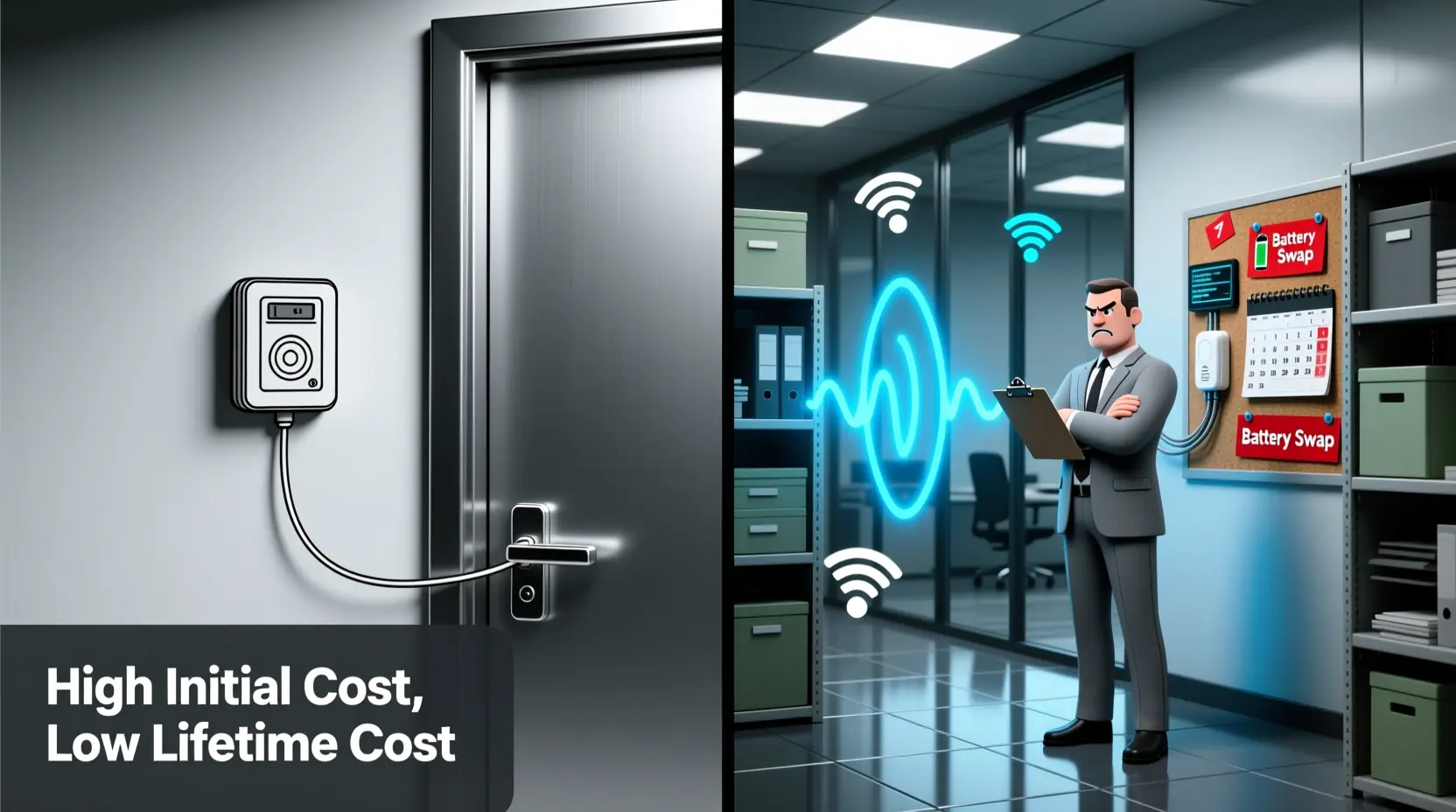
Let’s begin with a painful truth you already know but are desperately trying to ignore: you’re considering wireless exit alarms because you want to save money now. The siren song of lower installation costs is echoing in your budget spreadsheet, drowning out the tiny, rational voice whispering about the next decade. You’re a procurement professional, not a sucker. So stop acting like one. This isn’t a choice between two technologies; it’s a choice between paying upfront or paying perpetually. Let’s dissect this with the cold, grumpy precision it deserves.
The Seductive Mirage of Installation Day
This is where the wireless salesman earns his commission. The scene is familiar: an existing building, a door that needs monitoring, and a quote for running conduit that looks like the national debt of a small country. The electrician’s timeline involves phrases like “core drilling,” “asbestos abatement,” and “architectural review.” It’s a nightmare.
Enter the wireless unit. It’s a box. You mount the box. You insert a battery. You press a button to pair it. There is no dust. There is no deafening core drill. The installer is in and out in 30 minutes. The project manager looks like a hero. The finance department approves the champagne order. The initial Capex savings are real, tangible, and utterly misleading. You have just traded a known, finite capital expense for an open-ended, operational one. Congratulations.
The Eternal Grind of Operational Reality
Welcome to ownership. The installers are gone. The champagne is flat. Now, the wireless devices become your problem. They are not assets; they are liabilities with a blinking LED.
Battery Ballet: A Recurring Nightmare
That “long-life” battery has a lifespan shorter than a middle manager’s strategic initiative. The datasheet says 5 years. In a hot server room? A freezing loading dock? Expect three. Maybe. Now, scale that. For 100 devices, you are not managing a life safety system; you are running a just-in-time battery supply chain. You need procurement schedules, stocked inventory, certified disposal protocols, and labor hours—expensive, qualified labor hours—to play musical chairs with battery packs every few years. This isn’t savings; it’s a subscription fee you didn’t agree to in writing. A hardwired device drinks from the building’s endless cup of power. It is blissfully unconcerned with your logistical headaches.
The Spectrum of Chaos: RF Isn’t Magic, It’s Just Physics
Wireless communicates via radio waves through the air. You know what else is in the air? Interference. The new warehouse management system’s Wi-Fi, the 5G tower down the street, the industrial microwave, a newly installed metal shelving unit, a festive holiday foil decoration—all of them are potential party crashers in your RF environment. The result? Supervisory trouble signals. Ghost alarms. Mysterious “communication lost” events at 2:17 AM that require a $350 service call to diagnose, only to find the signal has miraculously returned. This isn’t reliability; it’s diva behavior. Copper wire doesn’t get spooked by a forklift’s radio. It’s a dumb, glorious pipe. Dumb is reliable.
The Ecosystem Lock-In: You’re Now a Hostage
With a conventional hardwired system, the components are largely interoperable. You can mix panels and devices from manufacturers who play nice with standard protocols. With proprietary wireless, you are buying a walled garden. The devices are married to their gateway with digital vows. In 8 years, when you need to upgrade the panel or the manufacturer sunsets that product line, your choices are grim: plead for legacy support or replace the entire field device network. That “cost-effective” wireless solution just mandated a future system-wide refresh on their timeline, not yours. That’s not procurement; that’s serfdom.
The Invisible Invoice: Costs They Never Show You
- Advanced Technical Labor: Troubleshooting a wire break requires a voltmeter and common sense. Troubleshooting an RF issue requires a spectrum analyzer, deeper training, and more time. You pay for that expertise, hourly.
- Compliance Theater: Your Authority Having Jurisdiction (AHJ) will eye wireless systems with deep suspicion. They may demand exhaustive, annual RF path surveys, documented battery replacement logs with serial numbers, and more frequent full-function tests. This turns a simple inspection into a forensic audit, consuming man-days.
- The Obsolescence Clock: The technology in that wireless device—the chipset, the protocol—is aging from day one. Hardwired contact and sounder technology is mature to the point of being geological. It will still work when the wireless unit is a museum piece.
The Grumpy Procurement Matrix
So, let’s frame the decision properly, with the cynicism it requires:
Hardwired: High initial capital expense. Predictable, stable, and nearly zero ongoing operational burden. A 15-year asset that minds its own business.
Wireless: Low initial capital expense. High, recurring operational expense (batteries, specialized labor). Unpredictable service costs from interference. High risk of forced obsolescence. A 15-year liability that demands constant attention.
The math only works for wireless in a few, specific cases: the single, architecturally sacred door in a historic landmark; the temporary monitoring scenario; the isolated gate a half-mile from the nearest building. These are exceptions. They are not the rule.
Your default position should be to wire it. Suffer the upfront cost. Enjoy the decades of silent, forgotten, boring operation. Use wireless where you must, not where you want to save a few euros today. Your future self, the one not dealing with a low-battery trouble signal on a Friday afternoon, will thank you.
NON-NEGOTIABLE AHJ WARNING: This is not a suggestion. It is the rule. Before you purchase, specify, or even dream about a wireless life safety solution, you will engage your local Authority Having Jurisdiction (Fire Marshal, Building Official). Their whims are law. They may outright reject wireless for your occupancy type. They may have a byzantine list of approved models. They will certainly have testing and documentation requirements that make your head spin. If you proceed without their written blessing, you are conducting a very expensive experiment in civil disobedience. They will fail your inspection. They will withhold your Certificate of Occupancy. They will make you tear it all out. This has happened. It will happen again. Do not be the reason.