
Explosion-Proof Exit Devices for Oil & Gas Facilities: Let’s Get This Over With.
Alright, sit down. Coffee’s bad, the lighting’s worse, and we’ve got to talk about something that makes accountants twitch and project managers break out in a cold sweat: explosion-proof exit devices. Not “fire exit” devices. Not “security” devices. Explosion-proof. The big, ugly, brutally expensive hunks of cast metal that live on doors in places where the air itself can decide to have a very bad day.
If you’re specifying, buying, or installing these things and you think they’re just a “heavy-duty panic bar,” you’re about three seconds away from a catastrophic mistake. So, let’s trudge through the essential specs. I’m not here to sell you anything. I’m here so you don’t blow something up, get someone killed, or fail an inspection so spectacularly they name it after you.
First, The “Why” You Keep Pretending to Understand
We’re not in an office building. This is Oil & Gas. Class I, Division 1 or 2. Groups IIA, IIB, sometimes IIC (hydrogen, you devil). Zones, if you’re feeling fancy and European. Flammable gases, vapors, mists. The job of an explosion-proof device isn’t to withstand an explosion inside it. It’s to contain any internal explosion and prevent it from igniting the surrounding hazardous atmosphere. How? By being so stupidly robust, with such precisely machined flame paths (gaps between mating surfaces), that an internal spark or explosion cools below the ignition temperature of the outside atmosphere before it escapes.
Got it? It’s a containment vessel. Now, slap that requirement on a device that also has to let 300 panicked people flow through it in two minutes, survive -40°F to 140°F, resist corrosion from salt, H2S, and God-knows-what chemical soup, and get used 50 times a day for 30 years. Fun, right?
The Specs That Actually Matter (Forget the Brochure Fluff)
1. The Listing & Certification: The Holy Grail (That Everyone Ignores Until It’s Too Late)
“Explosion-proof” isn’t a marketing term. It’s a legal one. You need a third-party certification for the specific hazard. In North America, look for UL 924 (for the exit device function) AND UL 1203 (for the explosion-proof part). The label must state the exact Class, Division, and Group (e.g., Class I, Div 1, Groups C & D). Not “suitable for.” Listed for. If it doesn’t have the mark (UL, CSA, ATEX for Europe), it’s a very expensive paperweight. Don’t come crying to me when the AHJ (Authority Having Jurisdiction – more on him later) laughs you off the site.
2. The Body: It’s All About the Metal (And No, Not That Kind)
Forget stainless steel panic bars from the mall. We’re talking cast aluminum alloy (for weight reduction) or cast ductile iron. Copper-free aluminum for certain environments. The housing isn’t just a cover; it’s the primary containment vessel. The spec sheet must detail the material, including copper content. The thickness isn’t an aesthetic choice; it’s calculated for containment pressure. Ask for the pressure data. If they won’t give it, walk away.
3. The Flame Path: The Magic (and Expensive) Gap
This is the heart of it. Where the cover mates with the body, or where the crossbar enters the housing, you’ll have a precisely engineered gap. Too wide? Flame escapes. Too narrow? Metal expansion under heat seals it shut, pressure builds, and turns the device into a frag grenade. These are machined to tolerances you’d find in a Swiss watch, only dirtier and heavier. The spec should reference the flame path design complying with the standard. Ask about the machining process. If the rep starts sweating, you’re asking the right questions.
4. The Crossbar & Actuation: Where Theory Meets a Boot
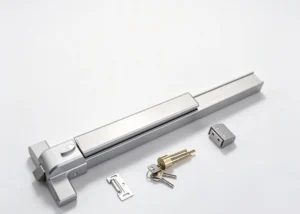
The crossbar can’t just be a tube. Its entry points into the housing are critical flame paths. The mechanism inside must be simple – we’re talking levers and rods, not micro-switches and circuit boards (unless intrinsically safe and separately certified). The latching mechanism must be brutal. Think “over-center toggle” or “vertical rod mortise” types. Rim devices? Maybe in Div 2. In Div 1, you want a mortise lock body inside the explosion-proof housing. It needs to operate under 15 lbs of force (code) but also survive someone hitting it with a sledgehammer. Or a forklift.
5. Corrosion Protection: Because Everything is Trying to Die Here
A “painted finish” is a joke. You need marine-grade anodizing for aluminum, or electroless nickel plating over copper-nickel-chromium plating for steel components. Look for ASTM B117 salt spray test ratings – 500 hours minimum, 1000+ is better. The finish isn’t for looks; corrosion changes flame path dimensions. A corroded flame path is a failed flame path. Also, specify stainless steel fasteners (316 SS). Anything else will weld itself into place after six months.
6. The Doggone Seals & Gaskets
You need environmental seals to keep out dust, moisture, and contaminants. But remember, the explosion-proof rating does not come from a gasket. O-rings and gaskets are for environment. The flame path is metal-to-metal. If your spec says “sealed with silicone for explosion-proof,” burn the spec. That’s wrong and dangerous. The gasket material must be compatible with the chemicals on site. Standard Buna-N? Might turn to mush in hydrocarbon exposure. Viton is better, check compatibility charts.
7. Electrical Integration (The Real Headache)
This is where projects go to die. You want an electric latch retraction? A status monitor? A request-to-exit sensor? You can’t just run conduit into the thing. Any electrical connection must be via an explosion-proof conduit hub that is part of the listed assembly. The internal electrical components (solenoids, switches) either need to be in their own explosion-proof compartment or be intrinsically safe (energy-limited) and certified as such. This isn’t an add-on. This is a fully engineered, certified system. It will double the cost and lead time. Plan accordingly, or just use the mechanical dogging option and be done with it.
8. The Door & Frame: The Weakest Link
Specifying the perfect device and slapping it on a hollow metal door with a standard hinge is like putting a bank vault door on a tent. The door must be rated for the hardware – stile reinforcement, full-length pull plates, structural frames. The frame anchorage must handle the forces. The hinges? Heavy duty, corrosion-resistant, minimum three. This is a system. The device is the most visible part of a chain. The chain is only as strong as its stupidest component.
Common Pitfalls (Where People Love to Waste Money)
- Over-specifying the Group: You don’t need a Group IIC (hydrogen) device for a Group IIB (propane) area. The cost and weight jump is insane. Know your area classification.
- Ignoring Temperature Ratings: T-rated (T1 to T6). The device’s surface temperature under fault conditions must be below the auto-ignition temperature of the surrounding gas. If you’re in a T6 (85°C) area, your T3 (200°C) device is an ignition source. Check the label.
- Forgetting about Maintenance: That device needs to be inspected. Can you access the internal mechanism without destroying the flame paths? Does it have a removable cover with captive, corrosion-resistant bolts? If not, you’ve just installed a future nightmare.
- Mixing and Matching: That UL-listed device is only listed with specific mounting screws, gaskets, and components from the manufacturer. Substituting a Phillips-head bolt from the local hardware store for the provided slotted, spanner-head bolt voids the listing. The AHJ will spot this. He loves finding this.
The “Messy Structure” Summary (Because I Know You Skipped Ahead)
Heavy metal box. UL 1203 & 924 listing. Correct Class/Div/Group/T-rating. Metal-to-metal flame paths. Marine-grade corrosion fighting. Reinforced door. Certified electrical integration if needed. No gasket miracles. Use the right bolts.
AHJ WARNING: READ THIS OR REGRET EVERYTHING
Listen up, and wipe that smug look off your face. Nothing, and I mean NOTHING, in this rant matters more than this final point.
The Authority Having Jurisdiction (AHJ) is God, King, and Supreme Warlord on this. It might be the Fire Marshal, the site’s Chief Safety Officer, an insurance company inspector, or a provincial/state regulator. Their word is final, even if it contradicts the manufacturer’s brochure, this article, or your precious project timeline.
YOU MUST INVOLVE THE AHJ AT THE SPECIFICATION STAGE. Before you buy a single bolt. Bring them the data sheets, the listings, the installation drawings. Their interpretation of the code (NFPA 70, NFPA 101, CSA C22.1) is the law on your site. They might have site-specific rules that are stricter than any published standard. They might hate a particular brand for a reason they discovered five years ago when something failed.
If you install a device that is technically “to code” but the AHJ hasn’t pre-approved it, they can and will make you rip it out. They will red-tag the entire facility. They will halt operations. You will be responsible for the six-figure change order, the weeks of delay, and the eternal scorn of everyone on site.
Your certification is a ticket to the game. The AHJ is the referee. And this referee doesn’t care about your deadlines, your budget, or your excuses. Get their approval in writing. Then, and only then, proceed.
Now get out of my office. I need to yell at someone about conduit seals.