
Right. You want to buy door hardware for a high-security psychiatric ward. Have you lost your mind? That’s not procurement, that’s a test of your soul. Forget every tender, every spec, every nice, predictable RFQ you’ve ever managed. This is where logic goes to die, budgets go to weep, and your supply chain becomes a therapist’s couch.
Let’s be brutally, snarkily clear: this isn’t about doors. It’s about managing intentional chaos within a cage of codified contradictions. The primary function is to NOT function as intended—at least, not by the occupant. It must open instantly in a fire but refuse every other creative attempt at egress or self-harm. You’re not sourcing hardware; you’re commissioning a passive-aggressive, steel-bound babysitter.
The Core Paradox: Life Safety vs. Ligature Resistance
Your starting point is a beautiful, screaming paradox. Code says: ‘Thou shalt exit swiftly in a fire.’ Clinical reality says: ‘Thou shalt not provide a convenient anchor point.’ ‘Ligature-resistant’ is the term. It’s a sterile, procurement-friendly phrase for ‘remove every single bloody thing a human could possibly tie something to.’ A standard door is a catalog of suicidal intent: levers, gaps, hinges, bolts, screw heads. Your job is to annihilate that catalog.
You start with a door that’s less an entryway and more a vault segment. Hollow metal. Welded frame. Then you get to the fun part—the hardware. This is where your ulcers will blossom.
1. The Lever Handle: A Designated Villain, Neutered
The common door lever is an elegant tool. It is therefore forbidden. It’s a perfect hook. The ‘solution’ is the anti-ligature lever. It looks like a lever designed by someone who hates levers—and people. It’s a monolithic, contoured lump of stainless steel, clamped flush to the door. The critical metric is the ‘noose gap’—the space behind it. It must be less than 5mm, often under 3. You couldn’t slip a credit card behind it.
Then, the real engineering comedy: it must be ‘breakaway.’ But not ‘break’ break. It must detach under a specific, downward ligature load, without exposing sharp edges or fixings, and then be easily reattached by staff. So, you need a mechanism that is simultaneously robust enough for decades of daily abuse and fragile enough to fail under a very specific type of abuse. The maintenance protocol for these things reads like a bomb disposal manual. Expect the lifecycle cost to be five times the purchase price. You’re welcome.
2. The Push Pad: From Panic Bar to Blank Slab of ‘No’
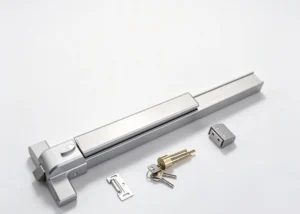
More common is the ligature-resistant push pad. Forget the standard panic bar with its inviting gaps and end caps. The high-sec psych version is a blank, seamless slab. A solid, featureless expanse of stainless steel designed to inspire despair in anyone looking for a purchase. The actuation zone is broad. The edges are radiused into oblivion. End caps are welded or secured with screws that require a proprietary, ‘you-probably-lost-it’ driver. The gap between slab and door? See above: <3mm. The internal mechanism is a monolithic block of over-engineering, because in a real emergency, it might need to release against the combined weight of several panicked individuals. It must never, ever fail to do so. The pressure is literally on.
3. The Lock & Latch: The Heart of the Contradiction
The visible hardware is just the mask. The true personality disorder lives in the lock. Mortise locksets reign. They’re strong, integrate functions, and allow for the crucial detail: there is no keyhole on the inside. A keyhole is a ready-made anchor. Instead, you get a ‘turn piece’—a sad, flush-fitting disc or lever that requires a deliberate pinch-grip to operate. It’s designed to be useless to someone in a state of crisis. The latch bolt itself is often an ‘anti-friction’ roller type, because the door might be barricaded by a mattress. So the lock must be strong, but its latch must yield. Make it make sense. I’ll wait.
4. The Hinges: The Unnoticed Hero (Until It Squeaks)
Butt hinges? Cute. We use continuous (piano) hinges. They run the full height of the door. No central pin to drive out and turn into a shiv. No gaps along the hinge line. They provide superior weight distribution for a door that will be used as a punching bag. They are also fantastically annoying to install and align perfectly. Your contractor will hate you. This is a sign you are doing it right.
5. The Gaps: Where Perfection is Mandatory and Impossible
You can spend a fortune on perfect hardware and have it installed by a contractor who leaves a 6mm gap because ‘it’s just a door.’ You have now failed. The perimeter gap spec is often ≤3mm. Achieving this requires a level of precision typically reserved for watchmakers and neurosurgeons. It involves special seals, astragals (overlapping moldings), and a threshold that balances wheelchair access with ‘nothing-threadable-here.’ The door must be hung not just plumb and level, but with paranoid intent.
The Procurement Nightmare: A Snarky Summary
- Materials: 316 Stainless steel. Nothing else. It’s brutal, expensive, and hard to fabricate. The finish is satin—not for aesthetics, but because it hides scratches and doesn’t glare.
- Installation: Your biggest risk point. This cannot be installed by someone who does office fit-outs. It requires a specialist who understands the ‘why,’ not just the ‘how.’ Inspect for intent, not just function. Run your hand over everything. If you can catch a fingernail, it’s wrong.
- Maintenance & Supply Chain: You are now married to a single manufacturer’s proprietary ecosystem. Parts are not on Amazon. Lead times are measured in fiscal quarters. Maintenance is a constant, vigilant degradation management exercise. The hardware will be cleaned with corrosive chemicals ten times a day and assaulted the other 23 hours and 50 minutes.
What you end up with, after all this spending and swearing, is a door that looks stupefyingly boring. Bland. Institutional. To the uneducated eye, it looks cheap. Every smooth, radiused, seamless, featureless inch of it is a monument to frustrated intent and controlled failure. It is a monument to saying ‘no’ in a thousand subtle ways, so that someone, someday, might have the chance to hear ‘yes.’
And then the hinge will squeak, and you’ll start the whole miserable process over again.
AHJ WARNING: Let’s end with the only truth that matters in procurement: I am a grumpy voice in the void. Nothing I say here is gospel. Your Authority Having Jurisdiction (AHJ)—the local fire marshal, building inspector, state health authority—is your god, your king, and your nightmare. Their interpretation of the code is the only one that counts. A product being ‘listed’ is meaningless if the AHJ walks in, spots a 4mm gap where their brain wants 3mm, and fails the installation. Your elegant submittals are toilet paper to them without prior approval. Engage them before you spec a single screw. Their whims are your new technical specifications. Fail to understand this, and you’ll be writing off six-figure hardware installations as a learning experience. Consider yourself warned.