The Hardware Scandal: Your Panic Bar Just Voided That $5,000 Fire Door
Right. Let’s skip the pleasantries. You’ve got a deadline, I’ve got a migraine induced by yet another “value-engineered” hardware disaster. That pristine, label-bedecked fire door you just signed off on? It’s already a write-off. Not because of a manufacturing defect, but because someone—probably while chasing a savings metric—specified a panic bar that renders the entire assembly about as fire-resistant as a wet paper bag.
Welcome to the brutal, often ignored intersection of procurement logistics and life-safety physics. You bought a system, then gutted its core functionality with an incompatible component. It’s like buying a Formula 1 car and fitting it with grocery-getter tyres. It might roll, but the first real test will be catastrophic.
Decoding the Label: It’s a Legal Contract, Not a Sticker
That little metal tag on the door edge? That’s not a decoration. It’s the DNA of the door’s fire-resistance. In the parallel universe of European (EN) and American (UL/Intertek) testing, they don’t test a naked slab of steel and wood. They test a complete, frozen-in-time assembly.
The published listing—searchable if you bother—reads like a recipe: Door Model X, with Hinge Package Y, installed in Frame Z, using Panic Device Model P123 from Manufacturer ABC, or Evaluated Equivalent.
And here, Procurement Pal, is where your world caves in. “Evaluated Equivalent” is a term of art, not a suggestion. It does not mean “looks similar,” “has the same function,” or “was 22% cheaper on that online hardware bazaar.” It means a competitor’s device has been formally submitted to the listing body, physically tested on that exact door model, and issued its own supplementary report tying it to the assembly.
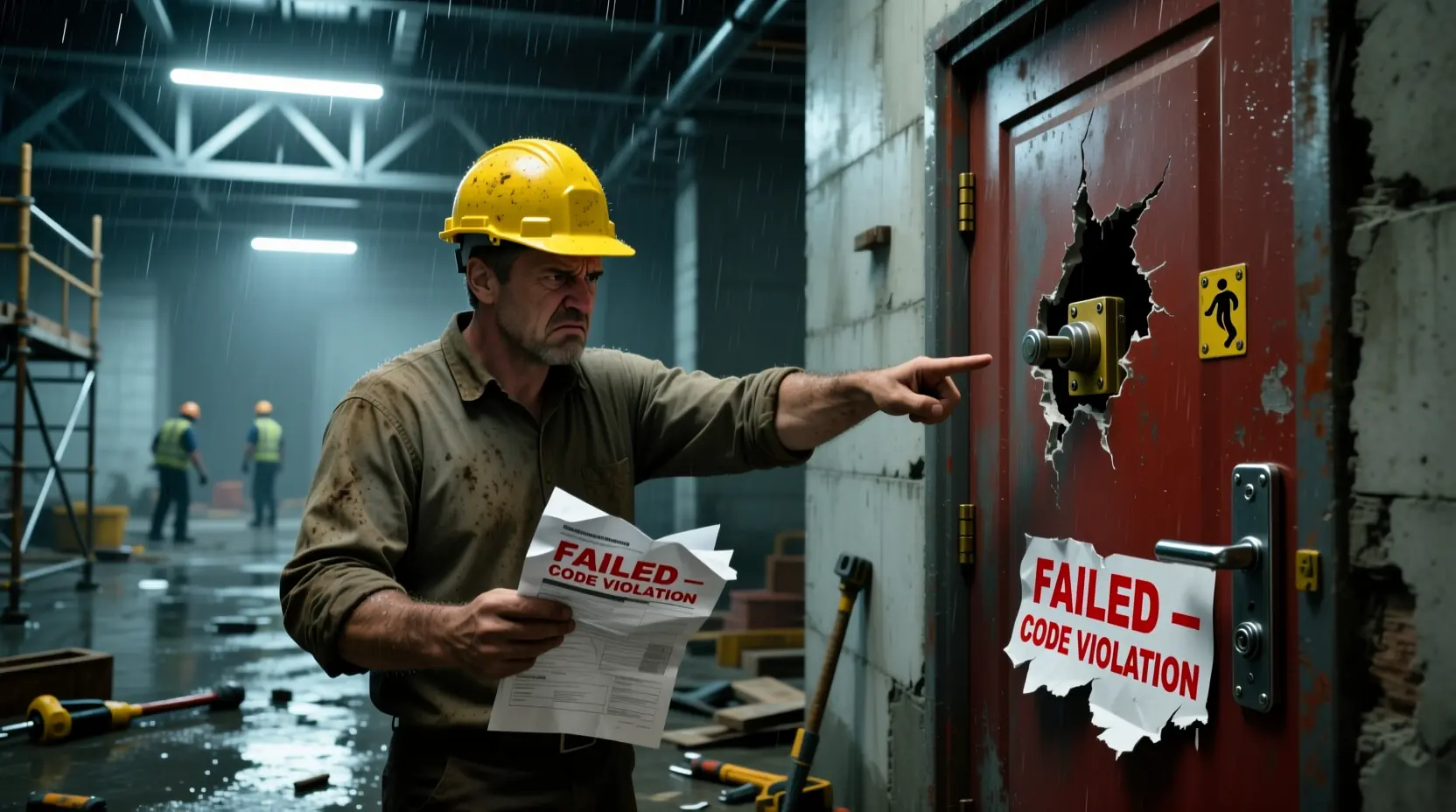
If your cheaper bar isn’t on that short, sacred list for your specific door model, you have just purchased a very heavy, very expensive non-compliant partition. The rating is null. The warranty is void. The inspector will laugh, then fail you.
The Trifecta of Procurement-Fueled Failure
1. The Latching Catastrophe
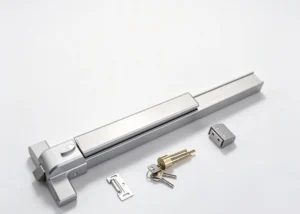
A fire door must close and latch. Every. Time. The wrong panic hardware murders latching geometry. The door was engineered for a mortise lock’s specific bolt projection and backset? Too bad, you bought a rim device. Now the latch barely kisses the strike plate. A firm slam might catch it. A pressure differential from a fire will not. You’ve traded compliance for a vague feeling of clicking. Enjoy the violation notice.
2. The Structural Sabotage of Drilling
A fire door is a pressure vessel. Its core is meant to swell, its skins to contain. Every drill point is a calculated risk. The listed hardware comes with a templated drill pattern that was part of the test. Your knock-off hardware’s “just wing it” installation creates new thermal bridges, weak points, and pathways for failure. You’re not just installing a bar; you’re perforating a safety system. The core doesn’t care about your cost-saving KPIs.
3. The Weight & Force Mismatch
This is pure physics, ignored for spreadsheet physics. A lightweight corridor door tested with a specific panic device has a calculated hinge load, closing force, and alignment tolerance. You then hang an industrial-grade exit bar meant for a warehouse on it. This brute forces the door to sag, misaligns the latch, and overpowers the closer. The door is now in a permanent state of mechanical distress. It’s like giving a ballet dancer a backpack full of bricks and expecting the same performance.
The Great ‘UL Listed!’ Misconception (A Personal Rant)
“But the panic bar is UL Listed!” I hear this. I die a little. My desk fan is UL Listed. It doesn’t belong on a fire door. A component’s standalone listing is merely a prerequisite. The only thing that matters is the marriage license—the door manufacturer’s listing that explicitly names that hardware model as part of its certified system. Anything else is hardware adultery, and the AHJ is the divorce judge.
The Snarky, Actionable Checklist for the Remorseful
- Treat the Door Label as the First Gospel. The model number is your primary key.
- Cross-Reference with the Manufacturer’s Official Listing. Find the “Builders Hardware” section. Those listed models are your only options. Not “guidelines.” Options.
- Procure the Exact Model or a Cross-Referenced Equivalent. This is not a suggestion box. This is a pull-from-stock part number.
- Enforce the Installation Instructions as Holy Scripture. The drill template is law. Give it to the installer. Watch them use it.
- When Confused, Call the Door Maker’s Tech Line. Five minutes on the phone is cheaper than a six-figure retrofit. They know.
This isn’t about bureaucracy. It’s about integrity. The integrity of a pressurized compartment in a fire. Your job isn’t just to buy things cheaply; it’s to buy things that work as a system. Saving $300 on the wrong panic bar doesn’t make you a strategic hero. It makes you the reason the entire passive fire protection strategy fails. And I, the grumpy consultant, get to write that report.
AHJ WARNING: Let’s end with the only capital letters that truly matter. The Authority Having Jurisdiction (AHJ)—your local Fire Marshal, Building Official—holds absolute, unappealable power. They can reject any installation for any reason. My ranting article? Just a prelude to their verdict. Their interpretation of the code is final law. This information merely explains why they will fail you. Their signature is the only one that grants occupancy. Don’t argue. Fix it.