The Grumpy Truth: Your ‘Clever’ Panic Bar Retrofit is a Fire Code Nightmare
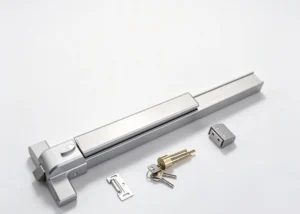
Let’s not mince words. I’ve managed procurement for industrial facilities across Europe and the US for longer than I care to admit. I’ve seen cost-saving “innovations” that would curl a safety inspector’s mustache. And right now, I’m watching a particular brand of self-inflicted chaos sweep through boardrooms and maintenance sheds: the grand, misguided plan to retrofit modern panic bars onto ancient fire doors.
Someone finds a “fantastic deal” on some sleek, contemporary exit devices. They arrive, gleaming with potential and cheap chromium. The logic that follows is a masterpiece of flawed thinking: “Why replace the whole door? Just bolt the new thing on the old thing. It’s just hardware!” This is the procurement equivalent of putting a jet engine on a biplane and wondering why it disintegrates on the runway.
You are not being frugal. You are constructing a liability funnel. You’re creating intentional chaos, and you will pay for it—in rework, in failed inspections, and in sleepless nights. Let’s embrace the mess and unpack why this is a catastrophically bad idea.
A Fire Door Isn’t a Door. It’s a Tested, Listed System.
First, you must purge from your mind the concept of a door as a simple slab of wood or metal. A fire-rated door assembly is a system. The one installed circa 1985 was tested and listed as a complete unit: the specific door leaf, the specific frame, the specific hinges, the specific latch, and yes, the specific panic device. They passed the fire test together. They are a married couple in the eyes of the law (NFPA 80, the IBC, your local building codes). You don’t get to casually swap out one spouse for a younger model and expect the same happy household.
Your shiny new panic bar is an orphan from a different family. Its engineering—the force needed to retract its latch, its weight distribution, its mounting footprint—is calibrated for modern door constructions. Drilling its new holes into your veteran door isn’t an upgrade; it’s a violation of the original listing’s covenant. You are performing surgery with a hacksaw.
The Four Horsemen of Your Impending Retrofit Apocalypse
Let’s walk through the predictable, grisly consequences. I call them the Four Horsemen.
1. The Hinge Rebellion
Your door is hanging on original hinges that have borne the weight of the original hardware for decades. They are tired. Your new device has a different mass and balance. This alters the door’s pivot point. The result? A door that sags, binds against the frame, fails to latch, or accelerates hinge wear into a matter of months. An unlatched fire door is a welcome mat for smoke and flame. Congratulations, your “upgrade” just created a lethal corridor.
2. The Latchbolt & Strike Plate Debacle
The old door has an old latchbolt and a perfectly fitted strike plate in the frame. Your new panic bar brings its own latchbolt. Will it magically align with the old, worn strike? Don’t be absurd. So now you’re chiseling out a new mortise in a 30-year-old, possibly steel-clad, fire-rated frame. Did you just compromise the frame’s integrity and its rating? Quite possibly. But you definitely introduced alignment issues. A gap you can slip a credit card into might as well be a tunnel for toxic smoke.
3. The Door Closer Calamity
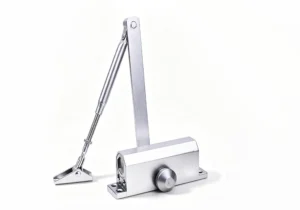
This is a beautiful cascade of failure. The existing door closer has spent a lifetime calibrated to close the door with the original hardware weight and balance. You change that balance. Now the door either slams shut with enough force to shake the wall or, more likely, doesn’t close at all, held open by the new geometry. So now you need a new closer. But not just any closer—one listed for fire doors, compatible with your new panic hardware, and sized for the door’s weight. The “simple swap” now requires a physicist and a bigger purchase order.
4. The Label Lobotomy (The Point of No Return)
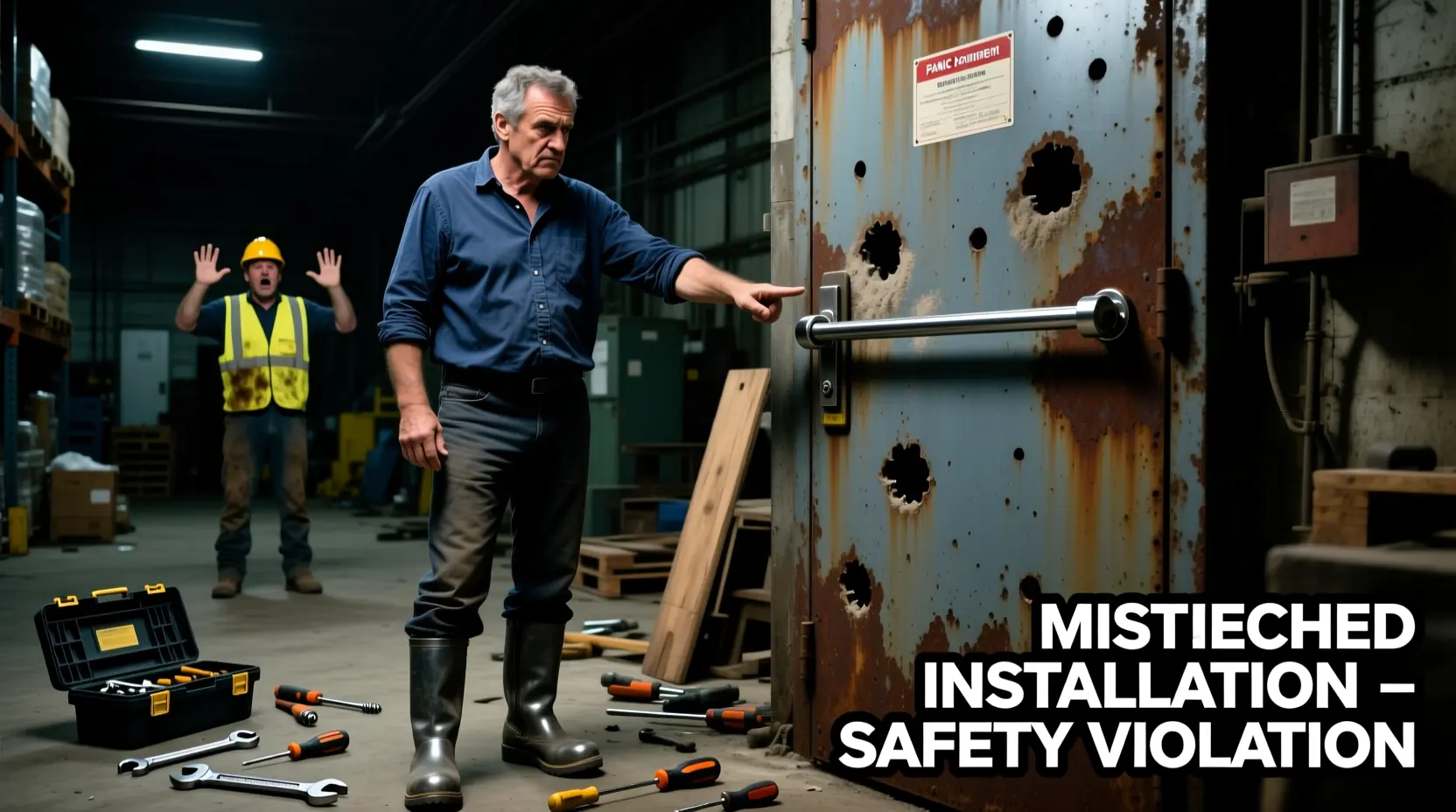
This is the cardinal sin. That small, embossed metal label on the door edge is its birth certificate and fire rating diploma. The moment you drill a new hole not specified in its original listing, you have likely voided that certification. You are now the proud owner of a very heavy, very expensive non-fire door. The inspector will not be impressed by your shiny new bar. He will see a mutilated label and write you a violation that halts your project. I’ve seen it paralyze multi-million-dollar facility upgrades. All for two misplaced drill holes.
“But the Catalog Says It’s Fire-Rated!”
Spare me. Of course the hardware catalog says that. The sales rep wants commission. Their definition of “compatible” means the screws thread into the holes, not that the integrated system will perform for 60 minutes in a 1,800-degree furnace. “For use on fire doors” means on new, tested assemblies, not on your artifact from the era of brick-sized mobile phones.
The Grumpy, Real-World Path Forward (If You Ignore All Wisdom)
Fine. You’re committed. The pallets of new hardware are already blocking the warehouse aisle. If you insist on this path of maximum resistance, here is your chaotic, un-fun, and absolutely necessary checklist:
- Unearth the Original Gospel: Find the original listing data for the door assembly: manufacturer, model, rating. No guesswork. Start here or abandon the mission immediately.
- Contact the Original Door Manufacturer (Pray They Exist): Ask them one question: Is there a formal, written retrofit compatibility listing for your exact door model with your exact new panic hardware model? If the answer is “no,” “we don’t know,” or silence, you stop. Full stop.
- Scrutinize the Templates: Lay the new panic bar’s installation template over the old hardware. Are every single hole and cutout identical? A 1/8-inch offset is a deal-breaker. I guarantee they won’t match.
- Beg for Early Judgment: Involve a qualified fire door consultant or, crucially, your Authority Having Jurisdiction (AHJ) before you touch a tool. Show them the plan. This consult might cost a fee. It will be 0.1% of the cost of redoing the entire job after a failed inspection.
- Budget for the Domino Effect: You are not just buying a panic bar. You are buying: new listed hinges, a new listed closer, professional installation labor, and a contingency for when you discover the frame is also shot. Now do the math.
The Snarky, Unavoidable Conclusion
When you run the real numbers—the ancillary hardware, the specialized labor, the consultation, the risk premium for voiding the listing—you’ll find that retrofitting a modern panic bar onto a legacy fire door is the very definition of a false economy.
You are pouring capital into a depreciated asset while manufacturing a compliance liability. The professional, albeit grumpy, solution is to replace the entire door assembly: door, frame, hardware, everything. It’s a single, clean purchase order. It’s installed by a certified team in a day. It comes with a pristine, unquestioned label. It will work flawlessly for decades. And it allows you to sleep at night, knowing you didn’t cleverly engineer a coffin door.
AHJ WARNING – READ THIS TWICE
This is not advice; this is a legal and moral imperative. The Authority Having Jurisdiction (AHJ)—your local Fire Marshal, Building Official, or Life Safety Inspector—holds absolute, final authority over your door’s compliance. Not me. Not your contractor. Not the hardware salesman. Them. They can reject your retrofit based on their interpretation of the codes. They can demand a manufacturer’s engineered judgment. They can order a full assembly replacement on the spot. Your only defense is pre-emptive, written approval. Always, ALWAYS secure the AHJ’s sign-off in writing before modifying any fire-rated assembly. To proceed otherwise is negligent. Don’t let your cost-saving measure become someone else’s tragedy.