Panic Bars Under $200: A Procurement Manager’s Grumpy Guide to Not Getting Fired
Coffee’s cold. The weekly compliance report is due. And my inbox is full of bright-eyed requests for “cost-effective” exit hardware. You want to talk about panic bars under two hundred dollars? Fine. Let’s get this over with before my 11 AM argument with the logistics team. I’m not here to sell you a dream. I’m here to give you the unvarnished, slightly bitter truth about what that budget actually buys in the world of life-safety hardware. Spoiler alert: it’s mostly headaches, with brief moments of “it’ll do.”
Let’s start with the only rule that matters: The AHJ is God. The Authority Having Jurisdiction—your fire marshal, building inspector, that person who can shut your entire operation down with a red tag—does not care about your budget constraints. They care about the International Building Code, NFPA 101, and local amendments. Buying the wrong hardware to save a few bucks isn’t frugal; it’s professional suicide with a side of massive liability. Consider this your first, and only, polite warning.
The “Value” Proposition: Where $200 Actually Goes
In commercial hardware, $200 isn’t a budget; it’s a compromise waiting to happen. You’re not shopping for quality. You’re shopping for the least-bad option for a specific, often non-critical, application. The moment that door is on a required egress path, you need to forget this price point and talk to a specialist. What follows is not a ranking. It’s a spectrum of calculated risks.
1. The Big-Box Illusion: Residential Garbage in a Commercial Disguise
You’ve seen them. ‘Defender,’ ‘Eclipse,’ ‘SecureHome Pro.’ They sit on the bottom shelf, packaged in colors that scream “bargain.”
- The Allure: $65. Maybe $79.99. The price is a siren song for managers who see a door as just a door.
- The Grumpy Reality: This is residential-grade hardware with a fancy sticker. The crossbar has the structural integrity of a stale pretzel. The latch mechanism is made from what I call “Chinesium”—a mystery alloy that fatigues faster than my patience in a stakeholder meeting. It might be ANSI/BHMA Grade 3, which is fine for your garden shed. For a commercial building? It’s a maintenance callback factory. The finish will corrode. The screws will strip. It will start rattling like a haunted house prop within six months. Purchasing this for anything beyond an interior storeroom door (in an already occupied suite) is an act of intentional chaos.
2. The Honest Workhorse: Marks USA 1591 Rim Exit Device
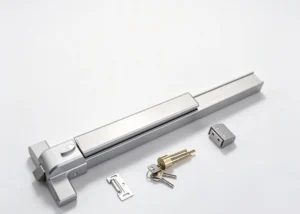
Now we enter the realm of actual commercial hardware. Marks is part of Assa Abloy. The 1591 is their value-line rim device. It sits on the face of the door, all its mechanical guts exposed.
- The Allure: ANSI/BHMA Grade 1 certified. Cast aluminum. A real steel crossbar. You can usually find it kissing the $200 mark through real distributors. It’s code-compliant for light to medium traffic—think secondary school doors, office back-entries, low-volume retail.
- The Grumpy Reality: It’s a rim device. It’s ugly. It looks like you bolted a railroad tie to your door. It protrudes and is a magnet for damage from hand trucks, pallet jacks, and clumsy interns. The acoustic profile is “catastrophic metallic crash.” But here’s the truth: it’s honest. It does what it says. It’s not pretending to be something it’s not. For a purely functional, low-aesthetic priority location, it’s the baseline for “acceptable.”
3. The Aesthetic Mirage: Securitech 7000 Series (Mortised)
Ah, the mortised panic device. Clean lines. Flush installation. It looks professional. Securitech’s 7000 series sometimes dips near our magical price point, causing procurement teams to break out in applause.
- The Allure: It looks like proper hardware. The push pad is intuitive, the profile is slim. It whispers “we care about design” rather than the Marks’ device shouting “WE HAVE A DOOR HERE!”
- The Grumpy Reality: The $200 price is a lie. That’s for the bare exit device body only. Add the mandatory outside trim (lever or knob), the correct latchbolt, cylinders for keying, and mounting screws. You’re suddenly at $350+. Then, factor in the mortise. Cutting a precise pocket into the door edge requires skill. A bad mortise job costs you a $1,000 door. The total installed cost is 3-4x the device cost. This option is only “under $200” if you’re playing spreadsheet games and ignoring reality.
4. The Digital Phantom: Amazon’s “Commercial Grade” Wonders
A category defined by algorithms, not engineers. Brands like “ProForceMax,” “GlobalSecure,” with 4.8 stars from 2,000 reviews.
- The Allure: Prime shipping. A price of $129.95. Photoshopped images showing it on a gleaming office door. Descriptions stuffed with every SEO keyword imaginable, including “UL Listed” (they’re not).
- The Grumpy Reality: This is the Big-Box Special with a markup and better web design. There is no traceable testing certification. The metallurgy is unknown. They fail under cyclical testing—the kind an inspector might perform. Buying this is the ultimate act of faith over facts. You are trading due diligence for two-day delivery. I would rather barricade a door with a filing cabinet than install one of these and call it compliant.
5. The Contrarian Play: Refurbished Von Duprin 98/99 Series
Von Duprin is the industry benchmark. New, a model costs more than your department’s quarterly coffee budget. But their classic 98 (rim) and 99 (mortise) devices are built to survive nuclear winter.
- The Allure: For under $200, you can source a professionally refurbished unit. A specialist shop has stripped it, replaced all wear items, re-finished it, and tested it. You get a $700+ level of robustness for a bargain price. The reliability is in a different galaxy than anything new at this cost.
- The Grumpy Reality: It’s not new. You must source from a reputable commercial hardware refurbisher, not “Joe’s Lock Shop.” You need precise specs: backset, latch type, handing, finish. It may have character (a small scratch). This is for the savvy, detail-oriented buyer who values proven performance over shiny-new packaging. It’s the smartest money you can spend under $200, but it’s not for the faint of heart or those who can’t read a spec sheet.
The Procurement Verdict: It’s Not About Best, It’s About Least-Worst
So, what do you do? You match the device to the door’s purpose, not just its price tag.
- The Janitor’s Closet Door: Fine. Get the Big-Box Special. I’ll sigh audibly, but I won’t stop you.
- The Back Door of a Low-Traffic Office: The Marks USA 1591. It’s compliant, durable, and won’t spark an existential crisis.
- The Client-Facing Door on a Shoe-String Reno: If aesthetics are non-negotiable, acknowledge the budget is wrong. Stretch it for the Securitech and its required accessories, or find a refurbished mortised Von Duprin 99.
- Any Door on a Fire Egress Plan: Abandon the $200 fantasy. Talk to your AHJ and a hardware consultant. Your job, and your liability insurance, depends on it.
The through-line of this entire, miserable exercise is that “under $200” is the procurement twilight zone. You are balancing on a razor’s edge between acceptable commercial grade and lawsuit-in-a-box. The initial purchase price is the smallest part of the total cost of ownership. Factor in installation, maintenance, early failure, and the catastrophic cost of non-compliance.
And now, because I know you skimmed the first warning, here is the final, non-negotiable, all-caps directive. Consider this the most important line item on this entire page:
AHJ WARNING: FINAL AND NON-NEGOTIABLE
THE SELECTION AND INSTALLATION OF ANY EXIT DEVICE IS GOVERNED SOLELY BY LOCAL BUILDING AND FIRE CODES AS INTERPRETED BY YOUR AUTHORITY HAVING JURISDICTION (AHJ). THE DEVICES DISCUSSED HERE ARE FOR INFORMATIONAL PURPOSES ONLY. YOU, THE SPECIFIER OR BUYER, ARE RESPONSIBLE FOR VERIFYING THAT THE EXACT MODEL, ITS INSTALLATION METHOD, AND ITS INTENDED USE ARE FULLY COMPLIANT FOR YOUR SPECIFIC DOOR, OCCUPANCY, AND SITUATION. FAILURE TO DO SO CAN RESULT IN FAILED INSPECTIONS, FINES, VOIDED INSURANCE, AND CIVIL/CORPORATE LIABILITY IN THE EVENT OF AN INCIDENT. CONSULT YOUR AHJ AND A QUALIFIED HARDWARE CONSULTANT BEFORE PROCURING ANY LIFE-SAFETY HARDWARE.
Now, if you’ll excuse me, I have to go reject a requisition for “nice-looking panic bars” for a main lobby. The chaos never ends.