The Door Hardware Cage Match: SVR vs. Rim Exit Devices. Stop Asking for Simple Answers.
You want to know which is more secure: Surface Vertical Rod (SVR) or Rim exit devices? That question, lobbed into my inbox with hopeful naivety, is a special kind of procurement headache. It’s like asking if a Swiss Army knife is better than a sledgehammer. The only honest answer is a weary sigh followed by, “It depends, and you’re probably thinking about this wrong.” But since we’re here, let’s cut through the glossy catalog copy and the optimistic nonsense. Let’s talk about the grumpy, chaotic, and often infuriating reality of securing a hole in a wall that people need to flee through.
Defining “Security” in a World That Wants Contradictions
First, let’s gut the term “security.” In the realm of exit devices, it’s a schizophrenic master. It demands we keep the bad actors out while ensuring a panicked crowd can get in (or out) with a single shove. It’s a balance between fortification and free flow. Most projects fail by optimizing for one and catastrophically ignoring the other. The hardware is just the scapegoat.
Surface Vertical Rod (SVR): The High-Maintenance Divas
Ah, the SVR. The showpiece. You see it on corporate glass palaces and institutions with budgets that haven’t yet met reality. A horizontal bar with two vertical rods shooting up and down, latching into the header and the floor. It screams, “We take this seriously.”
The Sales Brochure Fantasy
The pitch is seductive: Three-Point Latching. Top, bottom, and edge. It’s a trinity of deterrence. Theoretically, it resists forced entry better. It controls door sag, improves sealing against elements and smoke, and handles wind pressure. On paper, in a perfect world, it’s the armored car of exits.
The On-Site Nightmare
Now, welcome to the real world. Complexity is the enemy of reliability. Every rod, guide, and strike plate is a future failure point waiting for its moment.
- The Alignment Tango: Install it a millimeter off? Enjoy a lifetime of binding. The building settles? The rods declare independence. Adjusting one throws the other two into protest.
- The Floor Strike Garbage Disposal: The hole where the bottom rod lives is a universal repository for every bit of dirt, debris, and sticky spill in a ten-meter radius. A single pebble or a glob of hardened mop gunk can render your fortress immovable.
- Maintenance? What Maintenance? Telling a facilities manager to schedule quarterly cleaning and lubrication of the floor strike is a conversation that ends with their eyes glazing over. Without it, the device seizes up. A “secure” door that won’t open is a code violation with a side of mortal danger.
- Trip Hazards and Code Snarls: That protruding bottom rod? Many an AHJ (Authority Having Jurisdiction) has failed an installation for creating an egress path obstacle. You bought premium security and got a liability.
SVR security is a conditional state. It’s potentially higher, but only under a strict regime of perfect installs and monastic upkeep. That regime rarely exists.
Rim Exit Devices: The Unlovable, Unbreakable Workhorses
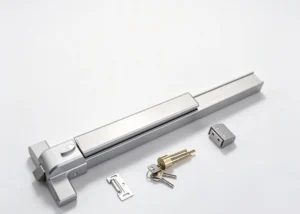
Now, observe the Rim device. It’s a bar. On the door. It retracts a latch. The end. No frills, no rods, no floor holes. It’s the utilitarian boot of the hardware world—seen on a million school corridors and warehouse doors.
The Understated Pitch
Its virtue is stark simplicity. Fewer parts mean fewer failures. It’s brutally easy to install, adjust, and fix. Its reliability curve is famously flat. It doesn’t promise three-point marvels; it promises to work, today and a decade from now, with minimal fuss.
The Grumpy Counterpoint
It’s a one-point latch. That’s it. On a wide or poorly reinforced door, a well-placed kick can spring it. It doesn’t control the top or bottom of the door, allowing more flex, rattle, and potential compromise. In a purely brute-force test against a perfectly functioning SVR, it is less formidable. But note the caveat: perfectly functioning.
The “More Secure” Debate is a Professional Trap
Demanding a winner is asking to be wrong. In a physics lab, with a robot for an installer, the SVR wins the trophy for physical resistance. Three latches beat one.
But procurement doesn’t happen in a lab. It happens in a universe of value engineering, rushed contractors, and neglected operational budgets. Here, the calculus flips:
- Reliability IS Security: A device that consistently latches and unlatches is more “secure” than a sophisticated one that jams in the locked or unlocked position. A Rim device failing usually means a door doesn’t lock. An SVR failing can mean a door doesn’t open. One is a nuisance; the other is a headline.
- The Door is the Star, The Hardware is the Supporting Actor: This is my hill to die on. Slapping an SVR on a flimsy aluminum storefront door is security theater. A Rim device on a solid-core wood door in a reinforced steel frame is a tank. The strength of the door-leaf, frame, and hinges contributes more to overall security than the choice between Rim and SVR. Obsessing over the device while ignoring its host system is the mark of an amateur.
- Function Dictates Form: Is this a back-of-house exterior door facing an alley? The extra points of SVR might be justified. Is it a high-traffic interior cross-corridor door in an office building? The Rim’s simplicity and proven durability make it the objectively more secure choice, because its performance won’t degrade into failure.
The Total Cost of Ownership Abyss
Look beyond the initial quote. The SVR device is a high-maintenance pet. It demands skilled installation (read: expensive labor), and its ongoing care is non-negotiable. The Rim device is a cactus. Install it, maybe spray some lubricant in it yearly, and forget about it. Over a 10-year lifecycle, the labor hours saved on adjustments and emergency call-outs for jammed rods can dwarf the initial hardware cost difference. What good is “more secure” if its total cost is unsustainable and it’s neglected into dysfunction?
The Grumpy Procurement Manager’s Decision Matrix
Stop seeking a universal rule. Start thinking like a cynical adult:
Specify SVR when:
The door is a genuine vulnerability point (exterior, high-risk).
The project budget and the long-term operational budget support professional installation and a guaranteed, funded maintenance plan.
You have a bona fide need for three-point latching for environmental sealing (weather, smoke, pressurization).
You are prepared to manage it as a critical asset, not just install it and walk away.
Specify Rim when:
Operational reliability and low lifetime cost are the primary drivers.
Maintenance will be minimal, reactive, or performed by general staff.
Traffic is high, and simplicity is a virtue.
The door and frame assembly itself is robust. You’re reinforcing strength, not compensating for weakness.
THE NON-NEGOTIABLE, ALL-CAPS RANT: THE AHJ WARNING
Listen closely. Everything written above is intellectual pillow talk without this. The only opinion that matters belongs to the Authority Having Jurisdiction (AHJ)—the fire marshal, the building official, the inspector holding the clipboard of doom.
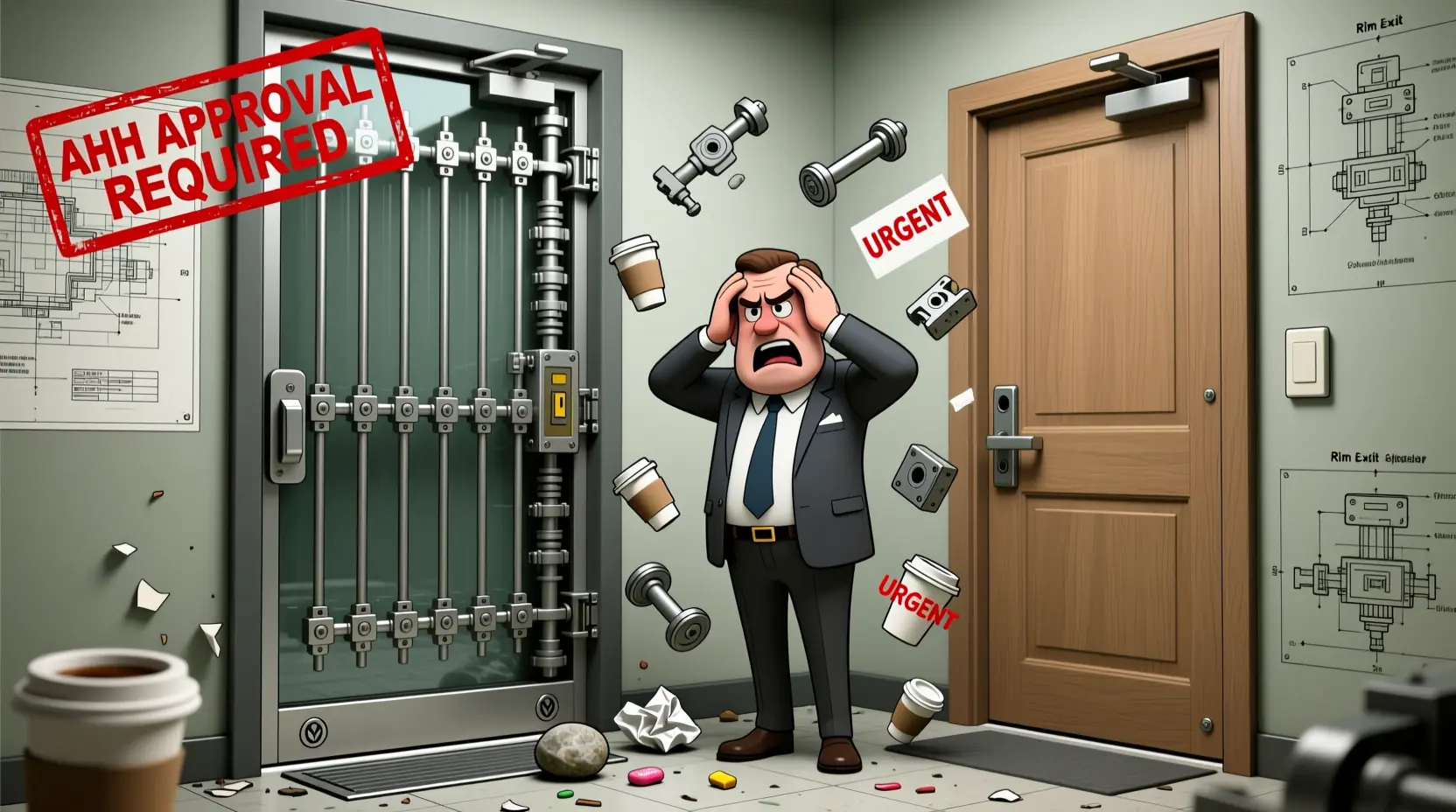
They don’t care about your whitepapers. They don’t care about my grumpy expertise. They enforce their interpretation of the code. You can install the most beautiful, textbook-perfect SVR system, and if the AHJ deems the floor strike a trip hazard or the operation force too high, YOU FAIL. You can install a bulletproof Rim device, and if they require top and bottom latching for the door rating, YOU FAIL.
The single most important step in this entire process happens before you even draft a spec: Engage the AHJ early. Present your plans. Get their preference in writing. Their word is law. Choosing the theoretically “more secure” option against their guidance is a fantastically expensive way to learn humility.
Now, with that chaos properly acknowledged, go make a decision. And for heaven’s sake, budget for maintenance.